70,95 €
inkl. MwSt.
Sofort per Download lieferbar
35 °P sammeln

Andere Kunden interessierten sich auch für
") Epidemic Risk Reduction (eBook, ePUB)70,95 €
Epidemic Risk Reduction (eBook, ePUB)70,95 €") COVID-19 and Gender-Based Violence in Zimbabwe (eBook, PDF)42,95 €
COVID-19 and Gender-Based Violence in Zimbabwe (eBook, PDF)42,95 €") Effective Threat Management (eBook, PDF)32,95 €
Effective Threat Management (eBook, PDF)32,95 €") Global Health (eBook, PDF)45,95 €
Global Health (eBook, PDF)45,95 €") The COVID-19 Pandemic (eBook, PDF)37,95 €
The COVID-19 Pandemic (eBook, PDF)37,95 €") Urban Responses to the Covid-19 Pandemic (eBook, PDF)0,00 €
Urban Responses to the Covid-19 Pandemic (eBook, PDF)0,00 €") Social Work in Health Emergencies (eBook, PDF)39,95 €
Social Work in Health Emergencies (eBook, PDF)39,95 €


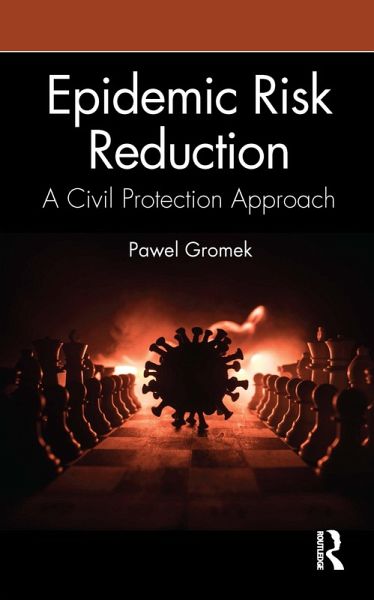
Epidemic Risk Reduction: A Civil Protection Approach focuses on disaster risk reduction (DRR) relative to epidemic outbreak and the concept of civil protection and public safety. First and foremost, the primary role of public officials and agencies-including police, military, public health, and emergency management and response professionals-must be the safety and security of citizens. The book provides practical solutions and policies that can be enacted and instituted to protect human life and health as well as property and environment in the scope of human survival, providing essential services, and providing for peoples' basic needs.
The author examines epidemics as disasters, similar to natural hazards or other large-scale events that require planning, preparedness, mitigation, and response. The approach is unique in looking at tools for risk assessment and strategic planning formulated around civil protection measures as a means to reduce and mitigate risk. Often, preparedness and response planning is siloed with an epidemiological and medical response at the forefront. While absolutely important and essential, doing so-in conjunction with coordinated government efforts to provide necessary supplies, security, and logistics-is equally critical to meet the public's needs and provide a coordinated response.
Key Features:
Epidemic Risk Reduction: A Civil Protection Approach establishes a common language which will help in overcoming barriers for more coordinated efforts focused on epidemic management and operational response. While drawing on current research, and based on theoretical knowledge, the book also provides practical examples from around the world that look at real-world response efforts. This includes recommendations on how politicians, crisis response personnel, emergency planners, and public administrators and health professionals can better plan and prepare for future epidemics.
The author examines epidemics as disasters, similar to natural hazards or other large-scale events that require planning, preparedness, mitigation, and response. The approach is unique in looking at tools for risk assessment and strategic planning formulated around civil protection measures as a means to reduce and mitigate risk. Often, preparedness and response planning is siloed with an epidemiological and medical response at the forefront. While absolutely important and essential, doing so-in conjunction with coordinated government efforts to provide necessary supplies, security, and logistics-is equally critical to meet the public's needs and provide a coordinated response.
Key Features:
- Examines the phenomenon of epidemics and hazards, explaining that they are often multi-hazard
- Provides public leaders with various considerations to meet the challenge of managing the complexity of various threat vectors
- Details universal terms and definitions-e.g., disaster, risk, and epidemic-using diagrams, illustrations, and analogies to clearly explain critical concepts
- Presents epidemic risk reduction strategies-based on the lead role that disaster, emergency management, and state/civil authorities need to play-focusing primarily on individual health and security
Epidemic Risk Reduction: A Civil Protection Approach establishes a common language which will help in overcoming barriers for more coordinated efforts focused on epidemic management and operational response. While drawing on current research, and based on theoretical knowledge, the book also provides practical examples from around the world that look at real-world response efforts. This includes recommendations on how politicians, crisis response personnel, emergency planners, and public administrators and health professionals can better plan and prepare for future epidemics.
Dieser Download kann aus rechtlichen Gründen nur mit Rechnungsadresse in A, B, BG, CY, CZ, D, DK, EW, E, FIN, F, GR, HR, H, IRL, I, LT, L, LR, M, NL, PL, P, R, S, SLO, SK ausgeliefert werden.