160,95 €
160,95 €
inkl. MwSt.
Sofort per Download lieferbar

80 °P sammeln
160,95 €
Als Download kaufen
160,95 €
inkl. MwSt.
Sofort per Download lieferbar
80 °P sammeln
Jetzt verschenken
Alle Infos zum eBook verschenken
160,95 €
inkl. MwSt.
Sofort per Download lieferbar
Alle Infos zum eBook verschenken
80 °P sammeln

Andere Kunden interessierten sich auch für
") The Foundations of Quantum Mechanics (eBook, PDF)40,95 €
The Foundations of Quantum Mechanics (eBook, PDF)40,95 €") The Concept of Probability (eBook, PDF)72,95 €
The Concept of Probability (eBook, PDF)72,95 €") Quantum Information Theory and Quantum Statistics (eBook, PDF)48,95 €
Quantum Information Theory and Quantum Statistics (eBook, PDF)48,95 €") Entanglement, Information, and the Interpretation of Quantum Mechanics (eBook, PDF)64,95 €
Entanglement, Information, and the Interpretation of Quantum Mechanics (eBook, PDF)64,95 €") Probabilistic Safety Assessment of WWER440 Reactors (eBook, PDF)72,95 €
Probabilistic Safety Assessment of WWER440 Reactors (eBook, PDF)72,95 €") Fundamental Problems in Quantum Physics (eBook, PDF)112,95 €
Fundamental Problems in Quantum Physics (eBook, PDF)112,95 €") General Principles of Quantum Field Theory (eBook, PDF)120,95 €
General Principles of Quantum Field Theory (eBook, PDF)120,95 €

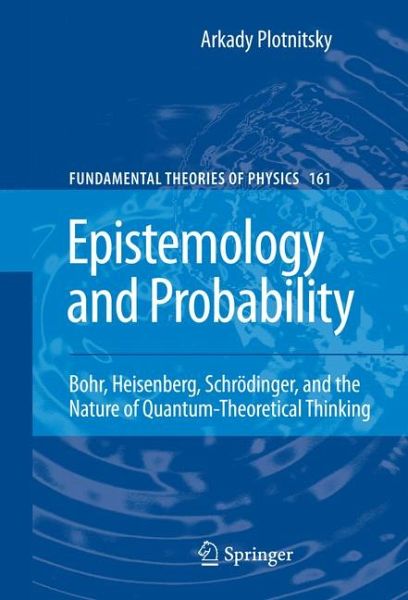
This book offers an exploration of the relationships between epistemology and probability in the work of Niels Bohr, Werner Heisenberg, and Erwin Schro- ¿ dinger, and in quantum mechanics and in modern physics as a whole. It also considers the implications of these relationships and of quantum theory itself for our understanding of the nature of human thinking and knowledge in general, or the ''epistemological lesson of quantum mechanics,'' as Bohr liked 1 to say. These implications are radical and controversial. While they have been seen as scientifically productive and intellectually liberating to some, Bohr and Heisenberg among them, they have been troublesome to many others, such as Schrö dinger and, most prominently, Albert Einstein. Einstein famously refused to believe that God would resort to playing dice or rather to playing with nature in the way quantum mechanics appeared to suggest, which is indeed quite different from playing dice. According to his later (sometime around 1953) remark, a lesser known or commented upon but arguably more important one: ''That the Lord should play [dice], all right; but that He should gamble according to definite rules [i. e. , according to the rules of quantum mechanics, rather than 2 by merely throwing dice], that is beyond me. '' Although Einstein's invocation of God is taken literally sometimes, he was not talking about God but about the way nature works. Bohr's reply on an earlier occasion to Einstein's question 1 Cf.
Dieser Download kann aus rechtlichen Gründen nur mit Rechnungsadresse in A, B, BG, CY, CZ, D, DK, EW, E, FIN, F, GR, HR, H, IRL, I, LT, L, LR, M, NL, PL, P, R, S, SLO, SK ausgeliefert werden.
From the reviews: "Plotnitsky (theory and cultural studies, Purdue Univ.) analyzes the discussions and disagreements among the principals (mentioned in the title), and offers his insightful comments on the questions. ... The discussions on probability and epistemology remind readers of 18th-century debates on the topic in which d'Alembert participated. This book should interest anyone seeking a deeper understanding of the epistemology of quantum mechanics, especially the issues thrashed out in the early phases. ... Summing Up: Highly recommended. Academic libraries serving graduate students, researchers, and faculty." (V. V. Raman, Choice, Vol. 47 (10), June, 2010)