79,95 €
inkl. MwSt.
Sofort per Download lieferbar
40 °P sammeln

Andere Kunden interessierten sich auch für
") Law, Responsibility and Vulnerability (eBook, ePUB)44,95 €
Law, Responsibility and Vulnerability (eBook, ePUB)44,95 €") Routledge Readings on Law and Social Justice (eBook, ePUB)41,95 €
Routledge Readings on Law and Social Justice (eBook, ePUB)41,95 €") Social Justice and Adequate Housing (eBook, ePUB)39,95 €
Social Justice and Adequate Housing (eBook, ePUB)39,95 €") Law, Culture and the Figure of the Girl (eBook, ePUB)45,95 €
Law, Culture and the Figure of the Girl (eBook, ePUB)45,95 €") The Evolution of the Gender Pay Gap (eBook, ePUB)38,95 €
The Evolution of the Gender Pay Gap (eBook, ePUB)38,95 €") Routledge Handbook of Freedom of Religion or Belief (eBook, ePUB)48,95 €
Routledge Handbook of Freedom of Religion or Belief (eBook, ePUB)48,95 €") The Spaces of Mental Capacity Law (eBook, ePUB)44,95 €
The Spaces of Mental Capacity Law (eBook, ePUB)44,95 €






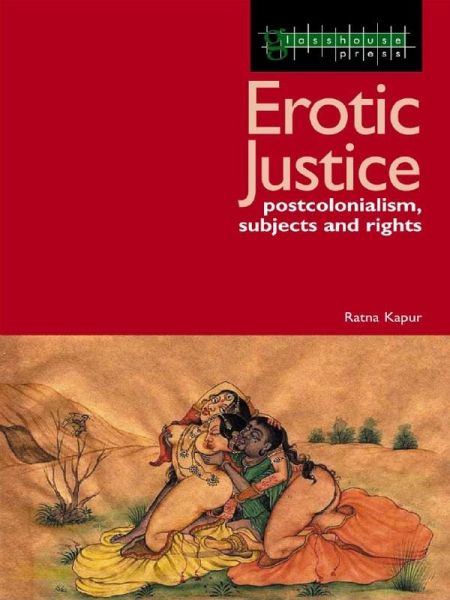
The essays in Erotic Justice address the ways in which law has been implicated in contemporary debates dealing with sexuality, culture and `different' subjects - including women, sexual minorities, Muslims and the transnational migrant. Law is analyzed as a discursive terrain, where these different subjects are excluded or included in the postcolonial present on terms that are reminiscent of the colonial encounter and its treatment of difference.
Bringing a postcolonial feminist legal analysis to her discussion, Kapur is relentless in her critiques on how colonial discourses, cultural essentialism, and victim rhetoric are reproduced in universal, liberal projects such as human rights and international law, as well as in the legal regulation of sexuality and culture in a postcolonial context. Drawing her examples from postcolonial India, Ratna Kapur demonstrates the theoretical and disruptive possibilities that the postcolonial subject brings to international law, human rights, and domestic law. In the process, challenges are offered to the political and theoretical constructions of the nation, sexuality, cultural authenticity, and women's subjectivity.
Bringing a postcolonial feminist legal analysis to her discussion, Kapur is relentless in her critiques on how colonial discourses, cultural essentialism, and victim rhetoric are reproduced in universal, liberal projects such as human rights and international law, as well as in the legal regulation of sexuality and culture in a postcolonial context. Drawing her examples from postcolonial India, Ratna Kapur demonstrates the theoretical and disruptive possibilities that the postcolonial subject brings to international law, human rights, and domestic law. In the process, challenges are offered to the political and theoretical constructions of the nation, sexuality, cultural authenticity, and women's subjectivity.
Dieser Download kann aus rechtlichen Gründen nur mit Rechnungsadresse in A, B, BG, CY, CZ, D, DK, EW, E, FIN, F, GR, HR, H, IRL, I, LT, L, LR, M, NL, PL, P, R, S, SLO, SK ausgeliefert werden.
'In this elegantly argued book, [Kapur] provides a rich account of a series of disruptions that, in itself, is a welcome act of political resistance.' - Social & Legal Studies
'Kapur demonstrate[s] the continuing importance of gender and sexuality as sites for critical engagement with liberalism, citizenship, nationalism, and postcolonialism. These are interventions that challenge much recieved orthodoxy and they deserve careful reading.' - Social & Legal Studies
'Kapur demonstrate[s] the continuing importance of gender and sexuality as sites for critical engagement with liberalism, citizenship, nationalism, and postcolonialism. These are interventions that challenge much recieved orthodoxy and they deserve careful reading.' - Social & Legal Studies
'In this elegantly argued book, [Kapur] provides a rich account of a series of disruptions that, in itself, is a welcome act of political resistance.' - Social & Legal Studies
'Kapur demonstrate[s] the continuing importance of gender and sexuality as sites for critical engagement with liberalism, citizenship, nationalism, and postcolonialism. These are interventions that challenge much recieved orthodoxy and they deserve careful reading.' - Social & Legal Studies
'Kapur demonstrate[s] the continuing importance of gender and sexuality as sites for critical engagement with liberalism, citizenship, nationalism, and postcolonialism. These are interventions that challenge much recieved orthodoxy and they deserve careful reading.' - Social & Legal Studies