6,99 €
inkl. MwSt.
Sofort per Download lieferbar
0 °P sammeln

Andere Kunden interessierten sich auch für
") Arduino Workshop, 2nd Edition (eBook, ePUB)17,95 €
Arduino Workshop, 2nd Edition (eBook, ePUB)17,95 €") Getting Started with FPGAs (eBook, ePUB)22,95 €
Getting Started with FPGAs (eBook, ePUB)22,95 €") AVR Workshop (eBook, ePUB)20,95 €
AVR Workshop (eBook, ePUB)20,95 €") Low Power Designs in Nanodevices and Circuits for Emerging Applications (eBook, ePUB)59,95 €
Low Power Designs in Nanodevices and Circuits for Emerging Applications (eBook, ePUB)59,95 €") Integrated Devices for Artificial Intelligence and VLSI (eBook, ePUB)168,99 €
Integrated Devices for Artificial Intelligence and VLSI (eBook, ePUB)168,99 €") VLSI Circuits and Embedded Systems (eBook, ePUB)53,95 €
VLSI Circuits and Embedded Systems (eBook, ePUB)53,95 €") FinFET Devices for VLSI Circuits and Systems (eBook, ePUB)51,95 €
FinFET Devices for VLSI Circuits and Systems (eBook, ePUB)51,95 €







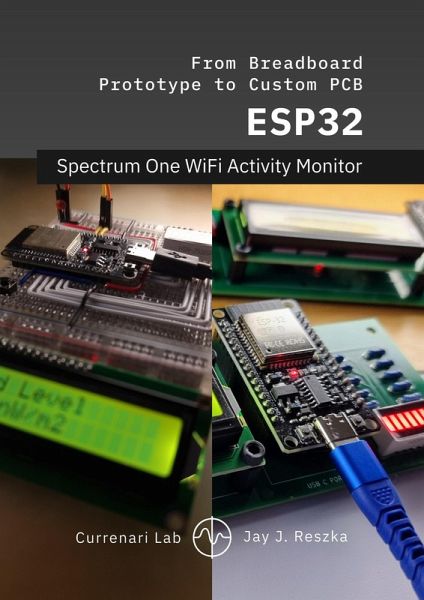
Spectrum One is a dedicated ESP32-based device designed to observe WiFi activity and present it as a simple, readable visual display. It scans the 2.4 GHz band and renders relative activity using a ten-segment LED bar and a 16×2 character LCD.
This book documents the complete reference build of that device.
The project begins on a breadboard and remains there until behaviour is understood and stable. Wiring layout, mechanical limits, contact reliability, and power distribution are treated as part of the system rather than temporary inconveniences. Once the design is proven, the same circuit and firmware are transferred to a PCB without redesigning or reinterpreting the behaviour.
The firmware is written in C and runs directly on the ESP32 using the ESP-IDF toolchain. It operates locally without mobile applications, cloud services, or operating-system mediation. Scan timing, result handling, and display updates are controlled explicitly. The book explains what the device shows, what it does not show, and why those limits exist.
RSSI values are treated as observational data rather than calibrated measurement. The interpretation layer is described as a deliberate set of choices that convert scan results into a visual form that remains consistent and readable. Display drivers are kept separate from WiFi logic so behaviour can be inspected, reasoned about, and modified without hidden coupling.
This is not a tutorial collection or a simplified introduction. It is a complete, reproducible reference build for readers who want to understand how a small embedded system behaves when hardware, firmware, and physical construction are treated as one unified system.
The full firmware source code and PCB Gerber files are made available as open-source resources on GitHub and are described and referenced throughout the book.
This book documents the complete reference build of that device.
The project begins on a breadboard and remains there until behaviour is understood and stable. Wiring layout, mechanical limits, contact reliability, and power distribution are treated as part of the system rather than temporary inconveniences. Once the design is proven, the same circuit and firmware are transferred to a PCB without redesigning or reinterpreting the behaviour.
The firmware is written in C and runs directly on the ESP32 using the ESP-IDF toolchain. It operates locally without mobile applications, cloud services, or operating-system mediation. Scan timing, result handling, and display updates are controlled explicitly. The book explains what the device shows, what it does not show, and why those limits exist.
RSSI values are treated as observational data rather than calibrated measurement. The interpretation layer is described as a deliberate set of choices that convert scan results into a visual form that remains consistent and readable. Display drivers are kept separate from WiFi logic so behaviour can be inspected, reasoned about, and modified without hidden coupling.
This is not a tutorial collection or a simplified introduction. It is a complete, reproducible reference build for readers who want to understand how a small embedded system behaves when hardware, firmware, and physical construction are treated as one unified system.
The full firmware source code and PCB Gerber files are made available as open-source resources on GitHub and are described and referenced throughout the book.
Dieser Download kann aus rechtlichen Gründen nur mit Rechnungsadresse in A, B, CY, CZ, D, DK, EW, E, FIN, F, GR, H, IRL, I, LT, L, LR, M, NL, PL, P, R, S, SLO, SK ausgeliefert werden.