3,49 €
3,49 €
inkl. MwSt.
Sofort per Download lieferbar

0 °P sammeln
3,49 €
Als Download kaufen
3,49 €
inkl. MwSt.
Sofort per Download lieferbar
0 °P sammeln
Jetzt verschenken
Alle Infos zum eBook verschenken
3,49 €
inkl. MwSt.
Sofort per Download lieferbar
Alle Infos zum eBook verschenken
0 °P sammeln

Andere Kunden interessierten sich auch für
 (eBook, ePUB)") The Shadow War - THE TAGUS DECEPTION (EPISODE 1, #1) (eBook, ePUB)3,49 €
The Shadow War - THE TAGUS DECEPTION (EPISODE 1, #1) (eBook, ePUB)3,49 € (eBook, ePUB)") The Rusted Riddle: Echoes Of The Locked Past (1, #1) (eBook, ePUB)3,99 €
The Rusted Riddle: Echoes Of The Locked Past (1, #1) (eBook, ePUB)3,99 € (eBook, ePUB)") The Twins: A Psychological Thriller (Book 1, #1) (eBook, ePUB)1,99 €
The Twins: A Psychological Thriller (Book 1, #1) (eBook, ePUB)1,99 € (eBook, ePUB)") Hunting Malice (A LIV OLSEN INVESTIGATION BOOK 1, #1) (eBook, ePUB)4,49 €
Hunting Malice (A LIV OLSEN INVESTIGATION BOOK 1, #1) (eBook, ePUB)4,49 € (eBook, ePUB)") The Ericksen Connection (A Mark Ericksen Thriller Book 1, #2) (eBook, ePUB)5,49 €
The Ericksen Connection (A Mark Ericksen Thriller Book 1, #2) (eBook, ePUB)5,49 € (eBook, ePUB)") Echoes of the Past: Detective Arthur Blackwood's Haunting Case in Victorian London (Detective Arthur Blackwood Series, #1) (eBook, ePUB)5,49 €
Echoes of the Past: Detective Arthur Blackwood's Haunting Case in Victorian London (Detective Arthur Blackwood Series, #1) (eBook, ePUB)5,49 € (eBook, ePUB)") Ladies' Night Brawl (A Detective DeLuca Mystery 1, #1) (eBook, ePUB)3,99 €
Ladies' Night Brawl (A Detective DeLuca Mystery 1, #1) (eBook, ePUB)3,99 €



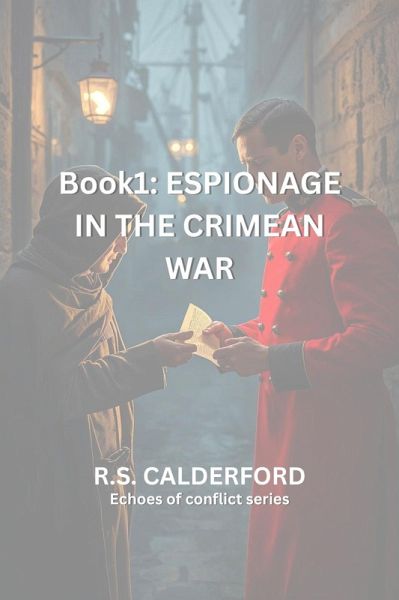
Echoes of Conflict: Espionage in the Crimean War reveals the hidden struggle for information behind one of the nineteenth century's most misunderstood wars. Between 1854 and 1856, the Crimean War was fought not only with cannon and cavalry, but with rumours, sketches, intercepted messages, medical records, and decisions made far from the battlefield. This book explores the shadow war that unfolded alongside Alma, Balaclava, Inkerman, and the long siege of Sevastopol-where misunderstanding, delay, and imperfect intelligence often proved as deadly as enemy fire. Drawing on narrative history rather than technical jargon, Echoes of Conflict follows scouts counting campfires in fog-choked valleys, surveyors mapping hostile ground, couriers racing unreliable roads, and diplomats and journalists shaping perception in Constantinople, Vienna, and London. It examines how early telegraph systems transformed communication while spreading rumours at unprecedented speed, and how geography-ravines, plateaux, harbours, and coastlines-dictated what armies could see, conceal, or misunderstand. The book also highlights unexpected intelligence actors. Florence Nightingale emerges not only as a reformer, but as a pioneer of strategic insight, using hospital data and visual statistics to expose that disease and mismanagement were killing more soldiers than Russian guns. Engineers, merchants, medical staff, and civilians all play roles in a war where knowledge was fragmented and often dangerously wrong. Through a series of focused case studies and vivid interludes, the narrative explores intelligence failures that prolonged the conflict, alongside quieter successes that went largely unnoticed. Rather than presenting espionage as glamorous or decisive, the book shows it as uncertain, human, and flawed-an essential but imperfect tool in an age before formal intelligence agencies. Echoes of Conflict: Espionage in the Crimean War argues that the Crimea marks a critical stage in the evolution of modern intelligence. It is a war where information mattered deeply, but systems to gather, verify, and interpret it lagged behind events. Courage alone could not compensate for ignorance. As the first volume in the Echoes of Conflict series, this book sets the pattern for later instalments on the War of 1812 and the American Revolution-short, narrative-driven histories that examine how wars are shaped by what people believe they know, and how often they are wrong.
Dieser Download kann aus rechtlichen Gründen nur mit Rechnungsadresse in A, B, CY, CZ, D, DK, EW, E, FIN, F, GR, H, IRL, I, LT, L, LR, M, NL, PL, P, R, S, SLO, SK ausgeliefert werden.