40,95 €
40,95 €
inkl. MwSt.
Sofort per Download lieferbar

20 °P sammeln
40,95 €
Als Download kaufen
40,95 €
inkl. MwSt.
Sofort per Download lieferbar
20 °P sammeln
Jetzt verschenken
Alle Infos zum eBook verschenken
40,95 €
inkl. MwSt.
Sofort per Download lieferbar
Alle Infos zum eBook verschenken
20 °P sammeln

Andere Kunden interessierten sich auch für
") Chitin in Nature and Technology (eBook, PDF)72,95 €
Chitin in Nature and Technology (eBook, PDF)72,95 €") Bioactive Carbohydrate Polymers (eBook, PDF)112,95 €
Bioactive Carbohydrate Polymers (eBook, PDF)112,95 €") Radiation Effects on Polymers for Biological Use (eBook, PDF)160,95 €
Radiation Effects on Polymers for Biological Use (eBook, PDF)160,95 € (eBook, PDF)") The European Polysaccharide Network of Excellence (EPNOE) (eBook, PDF)160,95 €
The European Polysaccharide Network of Excellence (EPNOE) (eBook, PDF)160,95 €") Single Cell Protein (eBook, PDF)72,95 €
Single Cell Protein (eBook, PDF)72,95 €") Class 2 Transferases V (eBook, PDF)160,95 €
Class 2 Transferases V (eBook, PDF)160,95 €") Class 2 Transferases IV (eBook, PDF)160,95 €
Class 2 Transferases IV (eBook, PDF)160,95 €



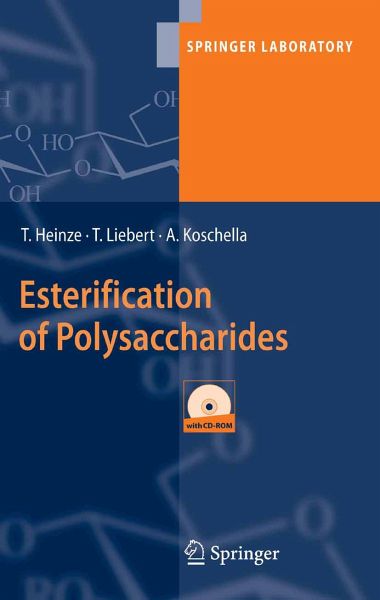
Polysaccharide esters (cellulose and starch) are among the first polymeric materials applied commercially. The way of producing these technically relevant derivatives has changed little during the entire history of their manufacture. In the last decade, investigation of new acylation methods and strategies of analysis was revived by the search for tailored, biocompatible, material for specific fields of application, e.g., biotechnology, sensor techniques and medicine. This book provides the first practical, comprehensive summary of modern acylation methods.
Dieser Download kann aus rechtlichen Gründen nur mit Rechnungsadresse in A, B, BG, CY, CZ, D, DK, EW, E, FIN, F, GR, HR, H, IRL, I, LT, L, LR, M, NL, PL, P, R, S, SLO, SK ausgeliefert werden.
"It is inevitable that the increasing cost of petroleum-based products will result in polymers based on renewable resources becoming competitive. Among the naturally occuring polymers, polysaccharides are by far the most abundant, and a wide range of structural and functional types can be readily obtained. Formation of esters is a long-established approach to obtain polysaccharide derivatives with modified properties. New methods of preparation and, particularly, new methods for the evaluation of the results of modified procedures have resulted in a resurgence in interest in these materials. Applications of these new methods along with brief outlines of earlier work are summarized in this concise, easily readable book."..."The book is clearly written, but there are some typographical errors. The audience for this book will include polymer chemists and those interested in polysaccharides. Although the subject of the book has a long history, many of the references date from within the past 5 years. For the reader, it provides a concise summary of the structures and methods of characterization for the important polysaccharides and their esters as well as an outline of the advances that are being made in the preparation of new materials. The low cost and clear presentation will encourage personal purchase." -- (T. Bruce Grindley, Journal of the American Chemical Society, Vol. 129 (7), 2007)
From the reviews:
"It is inevitable that the increasing cost of petroleum-based products will result in polymers based on renewable resources becoming competitive. Among the naturally occuring polymers, polysaccharides are by far the most abundant, and a wide range of structural and functional types can be readily obtained. Formation of esters is a long-established approach to obtain polysaccharide derivatives with modified properties. New methods of preparation and, particularly, new methods for the evaluation of the results of modified procedures have resulted in a resurgence in interest in these materials. Applications of these new methods along with brief outlines of earlier work are summarized in this concise, easily readable book."..."The book is clearly written, but there are some typographical errors. The audience for this book will include polymer chemists and those interested in polysaccharides. Although the subject of the book has a long history, many of thereferences date from within the past 5 years. For the reader, it provides a concise summary of the structures and methods of characterization for the important polysaccharides and their esters as well as an outline of the advances that are being made in the preparation of new materials. The low cost and clear presentation will encourage personal purchase."
(T. Bruce Grindley, Journal of the American Chemical Society, Vol. 129 (7), 2007)
"It is inevitable that the increasing cost of petroleum-based products will result in polymers based on renewable resources becoming competitive. Among the naturally occuring polymers, polysaccharides are by far the most abundant, and a wide range of structural and functional types can be readily obtained. Formation of esters is a long-established approach to obtain polysaccharide derivatives with modified properties. New methods of preparation and, particularly, new methods for the evaluation of the results of modified procedures have resulted in a resurgence in interest in these materials. Applications of these new methods along with brief outlines of earlier work are summarized in this concise, easily readable book."..."The book is clearly written, but there are some typographical errors. The audience for this book will include polymer chemists and those interested in polysaccharides. Although the subject of the book has a long history, many of thereferences date from within the past 5 years. For the reader, it provides a concise summary of the structures and methods of characterization for the important polysaccharides and their esters as well as an outline of the advances that are being made in the preparation of new materials. The low cost and clear presentation will encourage personal purchase."
(T. Bruce Grindley, Journal of the American Chemical Society, Vol. 129 (7), 2007)