16,95 €
16,95 €
inkl. MwSt.
Sofort per Download lieferbar

8 °P sammeln
16,95 €
Als Download kaufen
16,95 €
inkl. MwSt.
Sofort per Download lieferbar
8 °P sammeln
Jetzt verschenken
Alle Infos zum eBook verschenken
16,95 €
inkl. MwSt.
Sofort per Download lieferbar
Alle Infos zum eBook verschenken
8 °P sammeln

Andere Kunden interessierten sich auch für
") The Eternal War (eBook, ePUB)7,99 €
The Eternal War (eBook, ePUB)7,99 €") Negotiating Power and Inequality in Ghana (eBook, ePUB)33,95 €
Negotiating Power and Inequality in Ghana (eBook, ePUB)33,95 €") Who Are We Now? (eBook, ePUB)7,99 €
Who Are We Now? (eBook, ePUB)7,99 €") Henry George and the Crisis of Inequality (eBook, ePUB)20,95 €
Henry George and the Crisis of Inequality (eBook, ePUB)20,95 €") Eternal Vigilance? (eBook, ePUB)49,95 €
Eternal Vigilance? (eBook, ePUB)49,95 €") Citizenship and Disadvantaged Groups in Chile (eBook, ePUB)72,95 €
Citizenship and Disadvantaged Groups in Chile (eBook, ePUB)72,95 €") America's Founding and the Struggle over Economic Inequality (eBook, ePUB)44,95 €
America's Founding and the Struggle over Economic Inequality (eBook, ePUB)44,95 €





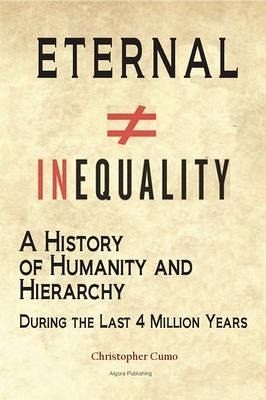
Eternal Inequality: A History of Humanity and Hierarchy During the Last 4 Million Years by Christopher Cumo offers a thought-provoking exploration of how inequality has shaped human civilization. Integrating insights from the natural sciences, social sciences, and humanities, Dr. Cumo reveals that the impulse to rank individuals began well before Homo sapiens emerged, starting with our evolutionary predecessors over 4 million years ago.
The book highlights how hierarchies began around campfires, where Homo erectus gathered and evaluated each other based on personal talents, aspirations, and motivations. This initial ranking based on attributes deepened over time as cultures became more complex. Money and other forms of wealth, such as land, slaves, and means of production, have always been central to defining power and status within societies. These commodities, aggregated and passed down through generations, served as markers of wealth that cemented inequality.
Dr. Cumo presents accounts of revolutions-military, technological, economic, and social-that arose to challenge the inequality between rich and poor. He illustrates how violence often became a tool both to enforce and resist these inequalities, provoking significant global changes. Historical contexts, including the turn to agriculture, colonialism, and the Black Death, are examined for their impact on forced labor, slavery, and social subjugation.
Moreover, the book delves into how plutocrats and ruling elites have employed cruelty and systemic oppression to maintain control over the underclass. While those subjugated often lacked the resources to mount sustained resistance, revolutions and uprisings eventually led to significant societal changes.
In conclusion, Eternal Inequality provides a sweeping historical account, showing that inequality has been intrinsic to human society since the beginning. Dr. Cumo's work is essential for understanding how hierarchy and inequality continue to shape the world today.
The book highlights how hierarchies began around campfires, where Homo erectus gathered and evaluated each other based on personal talents, aspirations, and motivations. This initial ranking based on attributes deepened over time as cultures became more complex. Money and other forms of wealth, such as land, slaves, and means of production, have always been central to defining power and status within societies. These commodities, aggregated and passed down through generations, served as markers of wealth that cemented inequality.
Dr. Cumo presents accounts of revolutions-military, technological, economic, and social-that arose to challenge the inequality between rich and poor. He illustrates how violence often became a tool both to enforce and resist these inequalities, provoking significant global changes. Historical contexts, including the turn to agriculture, colonialism, and the Black Death, are examined for their impact on forced labor, slavery, and social subjugation.
Moreover, the book delves into how plutocrats and ruling elites have employed cruelty and systemic oppression to maintain control over the underclass. While those subjugated often lacked the resources to mount sustained resistance, revolutions and uprisings eventually led to significant societal changes.
In conclusion, Eternal Inequality provides a sweeping historical account, showing that inequality has been intrinsic to human society since the beginning. Dr. Cumo's work is essential for understanding how hierarchy and inequality continue to shape the world today.
Dieser Download kann aus rechtlichen Gründen nur mit Rechnungsadresse in A, D ausgeliefert werden.