97,95 €
inkl. MwSt.
Sofort per Download lieferbar
49 °P sammeln

Andere Kunden interessierten sich auch für
") Ethical Education in Plutarch (eBook, ePUB)97,95 €
Ethical Education in Plutarch (eBook, ePUB)97,95 €") Logos und Praxis (eBook, PDF)139,95 €
Logos und Praxis (eBook, PDF)139,95 €") Commentary on Aristotle, >Nicomachean Ethics< (eBook, PDF)0,00 €
Commentary on Aristotle, >Nicomachean Ethics< (eBook, PDF)0,00 €") Aretai und Virtutes (eBook, PDF)230,00 €
Aretai und Virtutes (eBook, PDF)230,00 €") Geschichte als Element antiker Kultur (eBook, PDF)0,00 €
Geschichte als Element antiker Kultur (eBook, PDF)0,00 €") Lysias 21 (eBook, PDF)73,95 €
Lysias 21 (eBook, PDF)73,95 €") Dall'Elicona a Roma (eBook, PDF)90,95 €
Dall'Elicona a Roma (eBook, PDF)90,95 €
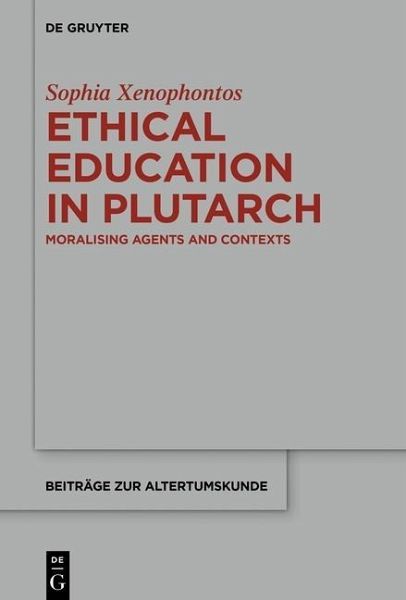
In addition to being the author of the Parallel Lives of noble Greeks and Romans, Plutarch of Chaeronea (AD c.46-c.120) is widely known for his rich ethical theory, which has ensured him a reputation as one of the most profound moralists in antiquity and beyond. Previous studies have considered Plutarch's moralism in the light of specific works or group of works, so that an exploration of his overall concept of ethical education remains a desideratum. Bringing together a wide range of texts from both the Parallel Lives and the Moralia, this study puts the moralising agents that Plutarch considers important for ethical development at the heart of its interpretation. These agents operate in different educational settings, and perform distinct moralising roles, dictated by the special features of the type of moral education they are expected to enact. Ethical education in Plutarch becomes a distinctive manifestation of paideia vis-à-vis the intellectual trends of the Imperial period, especially in contexts of cultural identity and power. By reappraising Plutarch's ethical authority and the significance of his didactic spirit, this book will appeal not only to scholars and students of Plutarch, but to anyone interested in the history of moral education and the development of Greek ethics.
Dieser Download kann aus rechtlichen Gründen nur mit Rechnungsadresse in A, B, BG, CY, CZ, D, DK, EW, E, FIN, F, GR, HR, H, IRL, I, LT, L, LR, M, NL, PL, P, R, S, SLO, SK ausgeliefert werden.
"[...] Ethical Education in Plutarch is a clear and interesting account of a lifelong teacher's consuming didactic passions."
James Uden in: Bryn Mawr Classical Review Blog 2017, http://bmcr.brynmawr.edu/2017/2017-05-35.html
"[...] überzeugende[n] Arbeit [...] kann man auch die Gesamtargumentation der Arbeit als nachvollziehbar und geglückt bewerten [...] Der weniger spezialisierte Leser kann für die wertvollen Ergebnisse einer so umfangreichen und fundierten Untersuchung nur dankbar sein und sie vertrauensvoll weiterverwerten."
Marion Schneider in: H-Soz-Kult 09.01.2017
"In general, this is an excellent discussion of Plutarch's views on ethical education, based on a thorough familiarity with both the Corpus Plutarcheum and with existing scholarly literature. The different chapters contain many innovative insights and rest on a varied methodology that does justice to the particular character of the source texts. Furthermore, Xenophontos correctly presents her study as "the first sustained attempt to show that both the Parallel Lives and the Moralia offer comprehensive and intriguingly sophisticated ways of reading and gauging Plutarch's mental mapping on ethical pedagogy" (p. 195). This is definitely one of the greatest merits of the book. It is only fairly recently that the unity of Plutarch's works and the many interconnections between Moralia and Parallel Lives have received more attention, and by adopting this line of approach, Xenophontos sets the standard for further studies in this field."
Geert Roskam in: L'Antiqité Classique 87 (2018), 332-334
James Uden in: Bryn Mawr Classical Review Blog 2017, http://bmcr.brynmawr.edu/2017/2017-05-35.html
"[...] überzeugende[n] Arbeit [...] kann man auch die Gesamtargumentation der Arbeit als nachvollziehbar und geglückt bewerten [...] Der weniger spezialisierte Leser kann für die wertvollen Ergebnisse einer so umfangreichen und fundierten Untersuchung nur dankbar sein und sie vertrauensvoll weiterverwerten."
Marion Schneider in: H-Soz-Kult 09.01.2017
"In general, this is an excellent discussion of Plutarch's views on ethical education, based on a thorough familiarity with both the Corpus Plutarcheum and with existing scholarly literature. The different chapters contain many innovative insights and rest on a varied methodology that does justice to the particular character of the source texts. Furthermore, Xenophontos correctly presents her study as "the first sustained attempt to show that both the Parallel Lives and the Moralia offer comprehensive and intriguingly sophisticated ways of reading and gauging Plutarch's mental mapping on ethical pedagogy" (p. 195). This is definitely one of the greatest merits of the book. It is only fairly recently that the unity of Plutarch's works and the many interconnections between Moralia and Parallel Lives have received more attention, and by adopting this line of approach, Xenophontos sets the standard for further studies in this field."
Geert Roskam in: L'Antiqité Classique 87 (2018), 332-334