52,95 €
inkl. MwSt.
Sofort per Download lieferbar
26 °P sammeln

Andere Kunden interessierten sich auch für
") EU-Central Asian Interactions (eBook, ePUB)52,95 €
EU-Central Asian Interactions (eBook, ePUB)52,95 €") The Taiwan Question in Xi Jinping's Era (eBook, PDF)52,95 €
The Taiwan Question in Xi Jinping's Era (eBook, PDF)52,95 €") India, China and the Strategic Himalayas (eBook, PDF)42,95 €
India, China and the Strategic Himalayas (eBook, PDF)42,95 €") India's Sri Lanka Policy (eBook, PDF)39,95 €
India's Sri Lanka Policy (eBook, PDF)39,95 €") Competing Desires (eBook, PDF)42,95 €
Competing Desires (eBook, PDF)42,95 €") Reinventing Regional Security Institutions in Asia and Africa (eBook, PDF)45,95 €
Reinventing Regional Security Institutions in Asia and Africa (eBook, PDF)45,95 €") India and Central Asia in the Post-Cold War Era (eBook, PDF)39,95 €
India and Central Asia in the Post-Cold War Era (eBook, PDF)39,95 €

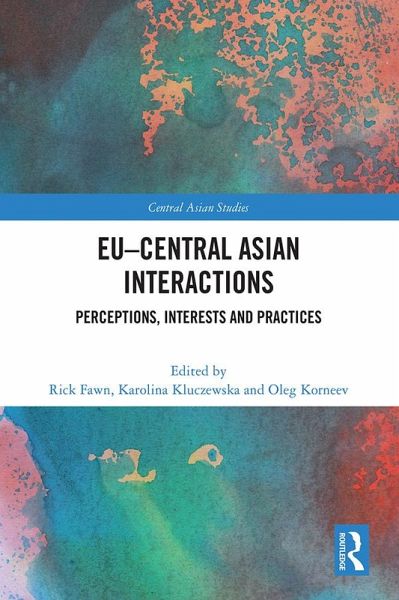
From limited interactions in the early 1990s, the EU and Central Asia now consider each other to be increasingly important. This book includes 12 chapters written by seasoned and policy-engaged researchers from across Eurasia and the wider world that analyse multiple levels of mutual interactions, understandings and misunderstandings across a range of policy areas. It shows why and in what ways exactly the EU and Central Asia matter to each other and why policymakers and researchers should pay more attention to their interactions.
Central Asia falls under the broader external relations and security agenda of the EU, and over years it provided a testing ground for many EU policies, including the priority ones of region-building and resilience promotion. Looking at the EU, in turn, informs as to how Central Asian actors interact with external partners of the region, and how that can influence national policy agendas and consequently everyday life - bringing new approaches, insights and evidence also to the wide field of EU studies.
This book is of key interest to scholars, practitioners and students of Central Asian history and politics, EU foreign policy, EU-Central Asia relations, and more broadly of EU studies, International Relations, regionalism and interregionalism as well as security studies. The chapters in this book were published over three issues of Central Asian Survey.
Central Asia falls under the broader external relations and security agenda of the EU, and over years it provided a testing ground for many EU policies, including the priority ones of region-building and resilience promotion. Looking at the EU, in turn, informs as to how Central Asian actors interact with external partners of the region, and how that can influence national policy agendas and consequently everyday life - bringing new approaches, insights and evidence also to the wide field of EU studies.
This book is of key interest to scholars, practitioners and students of Central Asian history and politics, EU foreign policy, EU-Central Asia relations, and more broadly of EU studies, International Relations, regionalism and interregionalism as well as security studies. The chapters in this book were published over three issues of Central Asian Survey.
Dieser Download kann aus rechtlichen Gründen nur mit Rechnungsadresse in A, B, BG, CY, CZ, D, DK, EW, E, FIN, F, GR, HR, H, IRL, I, LT, L, LR, M, NL, PL, P, R, S, SLO, SK ausgeliefert werden.
"Unpacking the black boxes of the 'EU' and 'Central Asia', this volume provides a rich account of interactions between both regions. It contributes significantly to ongoing efforts of decentring, pluralizing and decolonizing EU studies through careful examination of how NGOs, grassroots organizations, neighbourhood units such as the mahalla, scholars, businesses and other actors engage within the European-Central Asian space."
Jan Orbie, Ghent University, Belgium
"EU-Central Asian interactions: perceptions, interests and practices systematically examines the seriously neglected topic of the EU's relationships with central Asia. The book's significance is in its broadening and deepening of our understanding of the dynamics of the Europe's engagement with the region. Bringing together a superb collection of contributors, the volume challenges past thinking while opening new avenues for explaining and understanding the landscape of Europe's relationship with Central Asia."
Richard G. Whitman, University of Kent, UK
Jan Orbie, Ghent University, Belgium
"EU-Central Asian interactions: perceptions, interests and practices systematically examines the seriously neglected topic of the EU's relationships with central Asia. The book's significance is in its broadening and deepening of our understanding of the dynamics of the Europe's engagement with the region. Bringing together a superb collection of contributors, the volume challenges past thinking while opening new avenues for explaining and understanding the landscape of Europe's relationship with Central Asia."
Richard G. Whitman, University of Kent, UK