42,95 €
42,95 €
inkl. MwSt.
Sofort per Download lieferbar

21 °P sammeln
42,95 €
Als Download kaufen
42,95 €
inkl. MwSt.
Sofort per Download lieferbar
21 °P sammeln
Jetzt verschenken
Alle Infos zum eBook verschenken
42,95 €
inkl. MwSt.
Sofort per Download lieferbar
Alle Infos zum eBook verschenken
21 °P sammeln

Andere Kunden interessierten sich auch für
") EU Sanctions Litigation (eBook, ePUB)42,95 €
EU Sanctions Litigation (eBook, ePUB)42,95 €") Why Human Security Matters (eBook, PDF)39,95 €
Why Human Security Matters (eBook, PDF)39,95 €") Constitutional and Administrative Law (eBook, PDF)39,95 €
Constitutional and Administrative Law (eBook, PDF)39,95 €") The Perils of International Regime Complexity in Shadow Banking (eBook, PDF)38,95 €
The Perils of International Regime Complexity in Shadow Banking (eBook, PDF)38,95 €") EU Treaties and the Judicial Politics of National Courts (eBook, PDF)41,95 €
EU Treaties and the Judicial Politics of National Courts (eBook, PDF)41,95 €") Rethinking EU Law-making Policy on Confiscation of the Proceeds of Crime (eBook, PDF)39,95 €
Rethinking EU Law-making Policy on Confiscation of the Proceeds of Crime (eBook, PDF)39,95 €") Law and Diplomacy in the Management of EU-Asia Trade and Investment Relations (eBook, PDF)41,95 €
Law and Diplomacy in the Management of EU-Asia Trade and Investment Relations (eBook, PDF)41,95 €



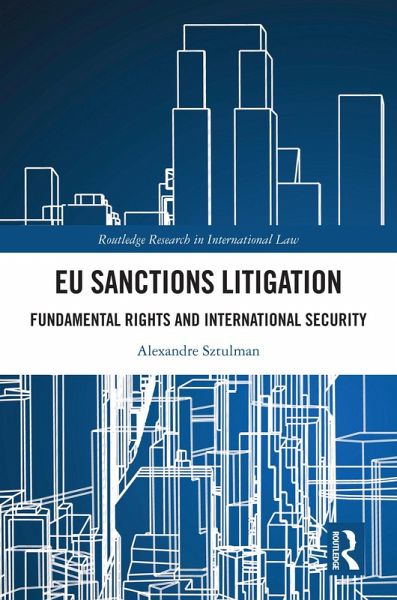
This book comprehensively examines the European Union (EU) judiciary's approach to international sanctions, drawing on recent case law from the Court of Justice and the General Court. It addresses the procedural framework governing judicial review, alongside a substantive evaluation of restrictive measures in terms of their legality and conformity with fundamental rights and procedural guarantees.
As a cornerstone of the EU's Common Foreign and Security Policy (CFSP), restrictive measures, particularly international sanctions, serve as the Union's primary tool for addressing actions that conflict with its core values. Today, the EU stands as a leading global authority on sanctions, both through implementing United Nations Security Council measures and through independently enacted, autonomous sanctions. These complex mechanisms, blending preventive and punitive approaches, impose financial freezes, sector-specific embargoes, and various restrictions targeting governments, legal entities, and individuals outside the EU. Providing a detailed analysis of how these measures intersect with repressive administrative and criminal law, the book sheds light on the judicial balance between effective enforcement and the protection of fundamental rights. Examining both technical legal issues and broader principles of justice and human rights, the book includes recommendations for refining restrictive measures within the EU.
This book will be of interest to researchers in the fields of EU law, international security, and human rights, offering a nuanced understanding of the judicial review processes that shape the EU's sanctioning powers.
As a cornerstone of the EU's Common Foreign and Security Policy (CFSP), restrictive measures, particularly international sanctions, serve as the Union's primary tool for addressing actions that conflict with its core values. Today, the EU stands as a leading global authority on sanctions, both through implementing United Nations Security Council measures and through independently enacted, autonomous sanctions. These complex mechanisms, blending preventive and punitive approaches, impose financial freezes, sector-specific embargoes, and various restrictions targeting governments, legal entities, and individuals outside the EU. Providing a detailed analysis of how these measures intersect with repressive administrative and criminal law, the book sheds light on the judicial balance between effective enforcement and the protection of fundamental rights. Examining both technical legal issues and broader principles of justice and human rights, the book includes recommendations for refining restrictive measures within the EU.
This book will be of interest to researchers in the fields of EU law, international security, and human rights, offering a nuanced understanding of the judicial review processes that shape the EU's sanctioning powers.
Dieser Download kann aus rechtlichen Gründen nur mit Rechnungsadresse in A, B, BG, CY, CZ, D, DK, EW, E, FIN, F, GR, HR, H, IRL, I, LT, L, LR, M, NL, PL, P, R, S, SLO, SK ausgeliefert werden.