0,00 €
inkl. MwSt.
Sofort per Download lieferbar
0 °P sammeln

Andere Kunden interessierten sich auch für
") EU Sustainability Legislation and International Supply Chains (eBook, ePUB)0,00 €
EU Sustainability Legislation and International Supply Chains (eBook, ePUB)0,00 €") Sale and Supply of Goods (eBook, PDF)46,95 €
Sale and Supply of Goods (eBook, PDF)46,95 €") Modern Slavery Legislation (eBook, PDF)25,95 €
Modern Slavery Legislation (eBook, PDF)25,95 €") Foundations of International Commercial Law (eBook, PDF)40,95 €
Foundations of International Commercial Law (eBook, PDF)40,95 €") Critical Company Law (eBook, PDF)49,95 €
Critical Company Law (eBook, PDF)49,95 €") Law and Responsible Supply Chain Management (eBook, PDF)44,95 €
Law and Responsible Supply Chain Management (eBook, PDF)44,95 €") Rethinking EU Consumer Law (eBook, PDF)0,00 €
Rethinking EU Consumer Law (eBook, PDF)0,00 €






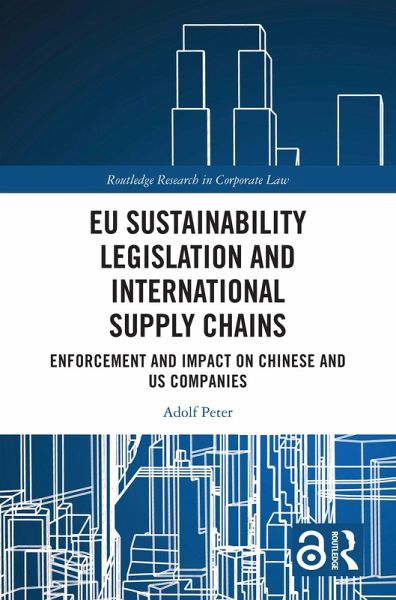
This book provides an in-depth analysis of the Corporate Sustainability Due Diligence Directive (CSDDD) - including the European Commission's Omnibus Directive Proposal - focusing on civil liability, enforcement issues, climate-related transition plans and directors' liabilities. It also discusses other Environmental, Social and Governance (ESG)/ sustainability-related legislation and stock exchange rules in the EU, the United States and China.
Using case studies involving multinationals such as BYD, Shell, RWE, Borealis, BMW, VW and L'Oréal, the book demonstrates the increasing negative impact of ESG-related issues on a company's reputation and finances. Showing that international commercial arbitration is the ideal means for the resolution of ESG/climate/CSDDD-related disputes between multiple parties, the book compares the arbitration rules of 11 leading arbitration institutions in terms of consolidations and joinders. It proposes an incentive mechanism for the contractual cascading of climate-related targets and ESG-related arbitration rules. It also features more than 20 contractual template clauses aimed at (i) implementing the CSDDD throughout international supply chains, (ii) reducing product/service-related GHG emissions (including Scope 3 emissions) year on year to achieve net-zero across entire value chains and (iii) facilitating consolidations and joinders in ESG-related multi-party arbitrations.
The book is directed at legal practitioners, legislators of various jurisdictions, board members of companies, academics, researchers and students.
The Open Access version of this book, available at http://www.taylorfrancis.com, has been made available under a Creative Commons Attribution-Non Commercial-No Derivatives (CC BY-NC-ND) 4.0 license.
Using case studies involving multinationals such as BYD, Shell, RWE, Borealis, BMW, VW and L'Oréal, the book demonstrates the increasing negative impact of ESG-related issues on a company's reputation and finances. Showing that international commercial arbitration is the ideal means for the resolution of ESG/climate/CSDDD-related disputes between multiple parties, the book compares the arbitration rules of 11 leading arbitration institutions in terms of consolidations and joinders. It proposes an incentive mechanism for the contractual cascading of climate-related targets and ESG-related arbitration rules. It also features more than 20 contractual template clauses aimed at (i) implementing the CSDDD throughout international supply chains, (ii) reducing product/service-related GHG emissions (including Scope 3 emissions) year on year to achieve net-zero across entire value chains and (iii) facilitating consolidations and joinders in ESG-related multi-party arbitrations.
The book is directed at legal practitioners, legislators of various jurisdictions, board members of companies, academics, researchers and students.
The Open Access version of this book, available at http://www.taylorfrancis.com, has been made available under a Creative Commons Attribution-Non Commercial-No Derivatives (CC BY-NC-ND) 4.0 license.
Dieser Download kann aus rechtlichen Gründen nur mit Rechnungsadresse in A, B, BG, CY, CZ, D, DK, EW, E, FIN, F, GR, HR, H, IRL, I, LT, L, LR, M, NL, PL, P, R, S, SLO, SK ausgeliefert werden.