45,95 €
45,95 €
inkl. MwSt.
Sofort per Download lieferbar

23 °P sammeln
45,95 €
Als Download kaufen
45,95 €
inkl. MwSt.
Sofort per Download lieferbar
23 °P sammeln
Jetzt verschenken
Alle Infos zum eBook verschenken
45,95 €
inkl. MwSt.
Sofort per Download lieferbar
Alle Infos zum eBook verschenken
23 °P sammeln

Andere Kunden interessierten sich auch für
") European Integration and Postcolonial Sovereignty Games (eBook, ePUB)45,95 €
European Integration and Postcolonial Sovereignty Games (eBook, ePUB)45,95 €") Companion to the European Union (eBook, PDF)49,95 €
Companion to the European Union (eBook, PDF)49,95 €") The Routledge Handbook of Differentiation in the European Union (eBook, PDF)43,95 €
The Routledge Handbook of Differentiation in the European Union (eBook, PDF)43,95 €") The Nested Games of Brexit (eBook, PDF)41,95 €
The Nested Games of Brexit (eBook, PDF)41,95 €") The Politics of the European Neighbourhood Policy (eBook, PDF)38,95 €
The Politics of the European Neighbourhood Policy (eBook, PDF)38,95 €") Peacebuilding (eBook, PDF)39,95 €
Peacebuilding (eBook, PDF)39,95 €") The Routledge Handbook of Self-Determination and Secession (eBook, PDF)44,95 €
The Routledge Handbook of Self-Determination and Secession (eBook, PDF)44,95 €

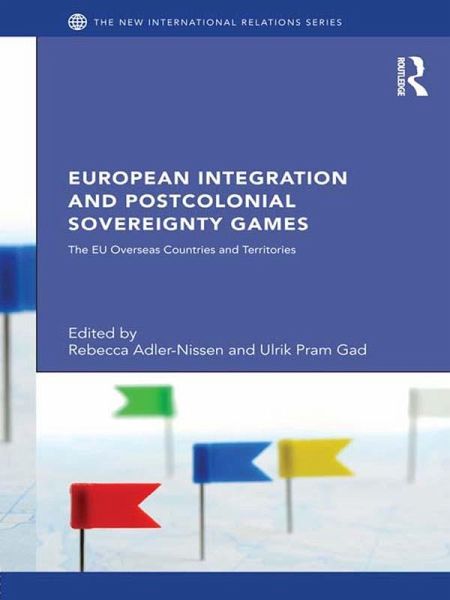
This book examines how sovereignty works in the context of European integration and postcolonialism. Focusing on a group of micro-polities associated with the European Union, it offers a new understanding of international relations in the context of modern sovereignty.
This book offers a systematic and comparative analysis of the Overseas Countries and Territories (OCTs), the EU and the four affected Member States: UK, France, the Netherlands and Denmark. Contributors explore how states and state-like entities play 'sovereignty games' to understand how a group of postcolonial entities may strategically use their ambiguous status in relation to sovereignty. The book examines why former colonies are seeking greater room to manoeuvre on their own, whilst simultaneously developing a close relationship to the supranational EU. Methodologically sophisticated, this interdisciplinary volume combines interviews, participant observation, textual, legal and institutional analysis for a new theoretical approach to understanding the strategic possibilities and subjectivity of non-sovereign entities in international politics.
Bringing together research on European integration and postcolonial theory, European Integration and Postcolonial Sovereignty Games will be of interest to students and scholars of International Relations, EU studies, Postcolonial studies, International Law and Political Theory.
This book offers a systematic and comparative analysis of the Overseas Countries and Territories (OCTs), the EU and the four affected Member States: UK, France, the Netherlands and Denmark. Contributors explore how states and state-like entities play 'sovereignty games' to understand how a group of postcolonial entities may strategically use their ambiguous status in relation to sovereignty. The book examines why former colonies are seeking greater room to manoeuvre on their own, whilst simultaneously developing a close relationship to the supranational EU. Methodologically sophisticated, this interdisciplinary volume combines interviews, participant observation, textual, legal and institutional analysis for a new theoretical approach to understanding the strategic possibilities and subjectivity of non-sovereign entities in international politics.
Bringing together research on European integration and postcolonial theory, European Integration and Postcolonial Sovereignty Games will be of interest to students and scholars of International Relations, EU studies, Postcolonial studies, International Law and Political Theory.
Dieser Download kann aus rechtlichen Gründen nur mit Rechnungsadresse in A, B, BG, CY, CZ, D, DK, EW, E, FIN, F, GR, HR, H, IRL, I, LT, L, LR, M, NL, PL, P, R, S, SLO, SK ausgeliefert werden.
'The value of the book rests not on its conclusions but in its survey of the subject matter. It is the only academic text to do so and as such a necessary starting point for any future review of EU-OCT relations. It is unlikely that a book on this subject would ever have appeared had it not been Denmark's turn to take the EU Presidency when it was being researched; in the end, we must be thankful to the Danish academics who seized the opportunity thus presented to produce an innovative and very welcome study.' - Paul Sutton, Island Studies Journal, Vol.8, No.1, 2013 p179-184
"This book is a remarkably interesting read. It provides a new and very useful insight into some of the practical, complex political, legal, economical, and social relations characteristic of the postcolonial world of the 21st century. It could be gratifying to many disciplines." - Hanne Petersen, University of Copenhagen, Politik 16(4):62-4
"This book successfully brings together research on European integration and postcolonial theory. It sheds a unique, comprehensive and original light on the triangular relationship between the OCTs, their administering powers and the EU, which will certainly appeal to scholars and students of International Relations, EU Studies, Postcolonial Studies and Development Studies." - Joren Verschaeve, Ghent University, Journal of Common Market Studies, 2014, 52(4)
"This book is a remarkably interesting read. It provides a new and very useful insight into some of the practical, complex political, legal, economical, and social relations characteristic of the postcolonial world of the 21st century. It could be gratifying to many disciplines." - Hanne Petersen, University of Copenhagen, Politik 16(4):62-4
"This book successfully brings together research on European integration and postcolonial theory. It sheds a unique, comprehensive and original light on the triangular relationship between the OCTs, their administering powers and the EU, which will certainly appeal to scholars and students of International Relations, EU Studies, Postcolonial Studies and Development Studies." - Joren Verschaeve, Ghent University, Journal of Common Market Studies, 2014, 52(4)