142,95 €
142,95 €
inkl. MwSt.
Sofort per Download lieferbar

71 °P sammeln
142,95 €
Als Download kaufen
142,95 €
inkl. MwSt.
Sofort per Download lieferbar
71 °P sammeln
Jetzt verschenken
Alle Infos zum eBook verschenken
142,95 €
inkl. MwSt.
Sofort per Download lieferbar
Alle Infos zum eBook verschenken
71 °P sammeln

Andere Kunden interessierten sich auch für
") Game Science in Hybrid Learning Spaces (eBook, ePUB)41,95 €
Game Science in Hybrid Learning Spaces (eBook, ePUB)41,95 € and Immersive Learning Environments (ILEs) in Education (eBook, ePUB)") Cross Reality (XR) and Immersive Learning Environments (ILEs) in Education (eBook, ePUB)41,95 €
Cross Reality (XR) and Immersive Learning Environments (ILEs) in Education (eBook, ePUB)41,95 €") Personalized Learning (eBook, ePUB)38,95 €
Personalized Learning (eBook, ePUB)38,95 €") Active Learning in Secondary and College Science Classrooms (eBook, ePUB)37,95 €
Active Learning in Secondary and College Science Classrooms (eBook, ePUB)37,95 €") Well-Being and Success For University Students (eBook, ePUB)24,95 €
Well-Being and Success For University Students (eBook, ePUB)24,95 €") A Teacher's Guide to Conversational AI (eBook, ePUB)32,95 €
A Teacher's Guide to Conversational AI (eBook, ePUB)32,95 €") Computer Supported Collaborative Learning 2005 (eBook, ePUB)103,95 €
Computer Supported Collaborative Learning 2005 (eBook, ePUB)103,95 €
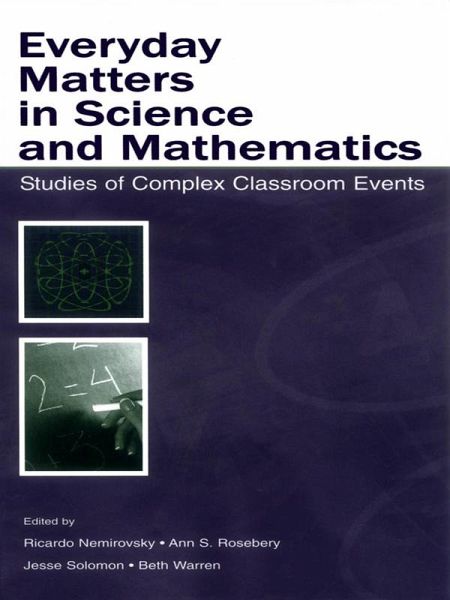
This book re-examines the dichotomy between the everyday and the disciplinary in mathematics and science education, and explores alternatives to this opposition from points of view grounded in the close examination of complex classroom events. It makes the case that students' everyday experience and knowledge in their entire manifold forms matter crucially in learning sciences and mathematics. The contributions of 13 research teams are organized around three themes: 1) the experiences of students in encounters with everyday matters of a discipline; 2) the concerns of curriculum designers, including teachers, as they design activities intended to focus on everyday matters of a discipline; and 3) the actions of teachers as they create classroom encounters with everyday matters of a discipline.
As a whole the volume reflects the shift in the field of educational research in recent years away from formal, structural models of learning toward emphasizing its situated nature and the sociocultural bases of teaching and learning. At least two trends--increasing awareness that formal theories can be useful guides but are always partial and provisional in how they disclose classroom experiences, and the widespread availability of video and audio equipment that enables effortless recording of classroom interactions--have reoriented the field by allowing researchers and teachers to look at learning starting with complex classroom events rather than formal theories of learning. Such examinations are not meant to replace the work on general theoretical frameworks, but to ground them in actual complex events. This reorientation means that researchers and teachers can now encounter the complexity of learning and teaching as lived, human meaning-making experiences. Immersion in this complexity compels rethinking assumptions about the dichotomies that have traditionally organized the field's thinking about learning. Further, it has important implications for how the relationship between theory and practice in understanding teaching and learning is viewed.
Everyday Matters in Science and Mathematics: Studies of Complex Classroom Events is an important resource for researchers, teacher educators, and graduate students in mathematics and science education, and a strong supplemental text for courses in these areas and also in cognition and instruction and instructional design.
As a whole the volume reflects the shift in the field of educational research in recent years away from formal, structural models of learning toward emphasizing its situated nature and the sociocultural bases of teaching and learning. At least two trends--increasing awareness that formal theories can be useful guides but are always partial and provisional in how they disclose classroom experiences, and the widespread availability of video and audio equipment that enables effortless recording of classroom interactions--have reoriented the field by allowing researchers and teachers to look at learning starting with complex classroom events rather than formal theories of learning. Such examinations are not meant to replace the work on general theoretical frameworks, but to ground them in actual complex events. This reorientation means that researchers and teachers can now encounter the complexity of learning and teaching as lived, human meaning-making experiences. Immersion in this complexity compels rethinking assumptions about the dichotomies that have traditionally organized the field's thinking about learning. Further, it has important implications for how the relationship between theory and practice in understanding teaching and learning is viewed.
Everyday Matters in Science and Mathematics: Studies of Complex Classroom Events is an important resource for researchers, teacher educators, and graduate students in mathematics and science education, and a strong supplemental text for courses in these areas and also in cognition and instruction and instructional design.
Dieser Download kann aus rechtlichen Gründen nur mit Rechnungsadresse in A, B, BG, CY, CZ, D, DK, EW, E, FIN, F, GR, HR, H, IRL, I, LT, L, LR, M, NL, PL, P, R, S, SLO, SK ausgeliefert werden.