36,95 €
inkl. MwSt.
Sofort per Download lieferbar
18 °P sammeln

Andere Kunden interessierten sich auch für
") Everyday Silence and the Holocaust (eBook, ePUB)36,95 €
Everyday Silence and the Holocaust (eBook, ePUB)36,95 €") The Making of a Sociologist (eBook, PDF)41,95 €
The Making of a Sociologist (eBook, PDF)41,95 €") Art, Cybernetics and Pedagogy in Post-War Britain (eBook, PDF)39,95 €
Art, Cybernetics and Pedagogy in Post-War Britain (eBook, PDF)39,95 €") The Drama of Social Life (eBook, PDF)33,95 €
The Drama of Social Life (eBook, PDF)33,95 €") Participatory Action Research in Post-Colonial Contexts (eBook, PDF)41,95 €
Participatory Action Research in Post-Colonial Contexts (eBook, PDF)41,95 €") Decolonizing Methodologies (eBook, PDF)16,95 €
Decolonizing Methodologies (eBook, PDF)16,95 €") The Pragmatics of Governmental Discourse (eBook, PDF)45,95 €
The Pragmatics of Governmental Discourse (eBook, PDF)45,95 €


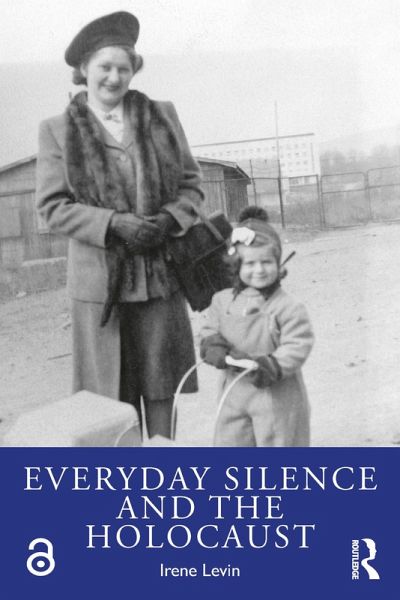
Everyday Silence and the Holocaust examines Irene Levin's experiences of her family's unspoken history of the Holocaust and the silence that surrounded their war experiences as non-topics.
A central example of what C. Wright Mills considered the core of sociology - the intersection of biography and history - the book covers the process by which the author came to understand that notes found in her mother's apartment following her death were not unimportant scribbles, but in fact contained elements of her mother's biographical narrative, recording her parents' escape from occupied Norway to unoccupied Sweden in late 1942. From the mid-1990s, when society began to open up about the atrocities committed against the Jews, so too did the author find that her mother and the wider Jewish population ceased to be silent about their war experiences and began to talk. Charting the process by which the author traced the family's broader history, this book explores the use of silence, whether in the family or in society more widely, as a powerful analytic tool and examines how these silences can intertwine. This book provides insight into social processes often viewed through a macro-historical lens by way of analysis of the life of an "ordinary" Jewish woman as a survivor.
An engaging, grounded study of the biographical method in sociology and the role played by silence, this book will appeal to readers with an interest in the Holocaust and World War II, as well as in social scientific research methods. It will be of use to both undergraduate and postgraduate scholars in the fields of history, social science, psychology, philosophy, and the history of ideas.
The Open Access version of this book, available at http://www.taylorfrancis.com, has been made available under a Creative Commons [Attribution-Non Commercial-No Derivatives (CC-BY-NC-ND)] 4.0 license.
A central example of what C. Wright Mills considered the core of sociology - the intersection of biography and history - the book covers the process by which the author came to understand that notes found in her mother's apartment following her death were not unimportant scribbles, but in fact contained elements of her mother's biographical narrative, recording her parents' escape from occupied Norway to unoccupied Sweden in late 1942. From the mid-1990s, when society began to open up about the atrocities committed against the Jews, so too did the author find that her mother and the wider Jewish population ceased to be silent about their war experiences and began to talk. Charting the process by which the author traced the family's broader history, this book explores the use of silence, whether in the family or in society more widely, as a powerful analytic tool and examines how these silences can intertwine. This book provides insight into social processes often viewed through a macro-historical lens by way of analysis of the life of an "ordinary" Jewish woman as a survivor.
An engaging, grounded study of the biographical method in sociology and the role played by silence, this book will appeal to readers with an interest in the Holocaust and World War II, as well as in social scientific research methods. It will be of use to both undergraduate and postgraduate scholars in the fields of history, social science, psychology, philosophy, and the history of ideas.
The Open Access version of this book, available at http://www.taylorfrancis.com, has been made available under a Creative Commons [Attribution-Non Commercial-No Derivatives (CC-BY-NC-ND)] 4.0 license.
Dieser Download kann aus rechtlichen Gründen nur mit Rechnungsadresse in A, B, BG, CY, CZ, D, DK, EW, E, FIN, F, GR, HR, H, IRL, I, LT, L, LR, M, NL, PL, P, R, S, SLO, SK ausgeliefert werden.
"This is such an important book, combining biography, autobiography and scholarly, meticulous documentary sourcing and analysis. Irene Levin's moving account of her mother's experience poses vital questions about silence and silencing, about agency, choices, complicities and responsibilities, and about whether, why and how these are recollected. This compelling personal story, in its rich, undeniable and specific detail, not only testifies powerfully to the history of how more than half of Norway's Jewish population came to be deported and murdered by the Nazis, it also documents the resourcefulness, creativity and courage of Jewish men and women, and some non-Jewish allies, enabling her parents to escape to Sweden. Crossing memoir, biography and critical interrogation of received histories of World War II Norway, this book challenges us to reconsider what is remembered and the partialities of recall, both on the part of survivors for whom the trauma of the holocaust is so pivotal a feature of their collective psyche that it need not - and perhaps cannot - be talked about explicitly, and on the part of the Norwegian state and its institutions. While fragments and allusions may be all that can be tolerable for those who those who lived through it, Levin shows how we who come later need to hear, learn and speak cogently and clearly about what happened and the individuals, organisations and policies that enabled, sometimes parried and ultimately claimed the authority to say how it happened. By simply recording and documenting her mother's story, Levin cleverly undoes received national and personal investments in particular historical narrations and occlusions, warding off spurious elisions between these. This book needs to be read by all who want to understand how genocides can happen and can be resisted. So relevant for our times."
Erica Burman, Professor of Education, University of Manchester and UKCP Group Analyst, UK
"Told through her mother's accounts, Irene Levin's gripping tale of what happened to a Norwegian Jewish family during and after the Second World War, has huge contemporary relevance. It underlines Hannah Arendt's point about the banality of evil and demonstrates the continuing sources of antisemitism. I read it in one session. I could not put it down."
David Silverman, Emeritus Professor, Sociology Department, Goldsmiths' College, University of London, UK
"Told retrospectively from the point of view of an adult daughter, this is the eminently readable story of the impact of Nazi occupation on the family life of a Norwegian Jewish mother and young daughter during World War II. Commonly overshadowed by accounts of the War's impact on Jews in Germany and Poland, the story on the very first page raises a vexing question applicable to all people: 'How could this happen to us?' Divided into three periods of family life before, during, and after the War, and by way of a mother's notes and notebook and a daughter's recollections, we are witness to the successful growth, adaptive silence, and subsequent ruinations of family living. Demonstrating universal truths in narrative particulars, the book will appeal both to scholars and nonscholars for its depiction of the ordinary contours of social relations in times of chaos."
Jaber F. Gubrium, Professor Emeritus of Sociology, University of Missouri, USA
"In Everyday Silence and the Holocaust Irene Levin weaves together silence and unsilencing of her mother; of herself and of the Norwegian Jewish community of the 1940s. Her project is personal, political and sociohistorical, bringing back to mind C.W. Mills' understanding of the biographical as a powerful instrument in the understanding of political processes. However, this intriguing project extends the biographical by becoming an eye opener on the normalization of institutional cruelty."
Orly Benjamin, President of the Israeli Sociological Society (ISS) and Professor, Department of Sociology and Anthropology, Bar Ilan University, Israel
Erica Burman, Professor of Education, University of Manchester and UKCP Group Analyst, UK
"Told through her mother's accounts, Irene Levin's gripping tale of what happened to a Norwegian Jewish family during and after the Second World War, has huge contemporary relevance. It underlines Hannah Arendt's point about the banality of evil and demonstrates the continuing sources of antisemitism. I read it in one session. I could not put it down."
David Silverman, Emeritus Professor, Sociology Department, Goldsmiths' College, University of London, UK
"Told retrospectively from the point of view of an adult daughter, this is the eminently readable story of the impact of Nazi occupation on the family life of a Norwegian Jewish mother and young daughter during World War II. Commonly overshadowed by accounts of the War's impact on Jews in Germany and Poland, the story on the very first page raises a vexing question applicable to all people: 'How could this happen to us?' Divided into three periods of family life before, during, and after the War, and by way of a mother's notes and notebook and a daughter's recollections, we are witness to the successful growth, adaptive silence, and subsequent ruinations of family living. Demonstrating universal truths in narrative particulars, the book will appeal both to scholars and nonscholars for its depiction of the ordinary contours of social relations in times of chaos."
Jaber F. Gubrium, Professor Emeritus of Sociology, University of Missouri, USA
"In Everyday Silence and the Holocaust Irene Levin weaves together silence and unsilencing of her mother; of herself and of the Norwegian Jewish community of the 1940s. Her project is personal, political and sociohistorical, bringing back to mind C.W. Mills' understanding of the biographical as a powerful instrument in the understanding of political processes. However, this intriguing project extends the biographical by becoming an eye opener on the normalization of institutional cruelty."
Orly Benjamin, President of the Israeli Sociological Society (ISS) and Professor, Department of Sociology and Anthropology, Bar Ilan University, Israel