112,95 €
112,95 €
inkl. MwSt.
Sofort per Download lieferbar

56 °P sammeln
112,95 €
Als Download kaufen
112,95 €
inkl. MwSt.
Sofort per Download lieferbar
56 °P sammeln
Jetzt verschenken
Alle Infos zum eBook verschenken
112,95 €
inkl. MwSt.
Sofort per Download lieferbar
Alle Infos zum eBook verschenken
56 °P sammeln

Andere Kunden interessierten sich auch für
") Evidence-Based Surgery (eBook, PDF)80,95 €
Evidence-Based Surgery (eBook, PDF)80,95 €") Optimizing Widely Reported Hospital Quality and Safety Grades (eBook, PDF)80,95 €
Optimizing Widely Reported Hospital Quality and Safety Grades (eBook, PDF)80,95 €") Hemodialysis Access (eBook, PDF)72,95 €
Hemodialysis Access (eBook, PDF)72,95 €") Management of Diabetic Complications (eBook, PDF)96,95 €
Management of Diabetic Complications (eBook, PDF)96,95 €") Evidence-based Therapy in Vascular Surgery (eBook, PDF)68,95 €
Evidence-based Therapy in Vascular Surgery (eBook, PDF)68,95 €") Evidence-Based Cosmetic Breast Surgery (eBook, PDF)72,95 €
Evidence-Based Cosmetic Breast Surgery (eBook, PDF)72,95 €") Evidence-based Therapy in Vascular Surgery (eBook, PDF)72,95 €
Evidence-based Therapy in Vascular Surgery (eBook, PDF)72,95 €
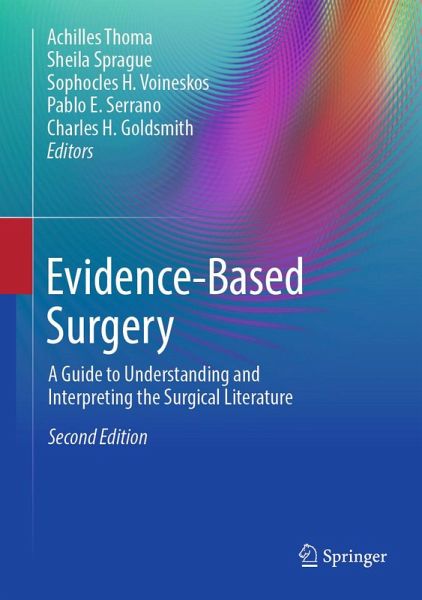
Now in a revised second edition, this book is a comprehensive guide to teach surgeons, surgical fellows and surgical residents, regardless of their specialty, the skills to appraise what they encounter in the surgical literature. Surgeons need to be able to understand what they read before applying the conclusions of a surgical article to their practice. As most surgeons do not have the extra training in health research methodology, understanding how the research was done, how to interpret the results, and finally deciding to apply them to the patient level can be a difficult task.
Chapters included here explain the methodological issues pertaining to the various study designs reported in the surgical literature. Readers are taught how to search the literature for the best evidence that will answer the surgical problem under discussion. An identified article that seems relevant to the problem under investigation can be appraised by addressing three key questions: 1) Is the study I am reading valid? 2) what are the results of this study? and 3) can I apply these results to my patients? Chapters new to this edition discuss cluster RCTs, network meta-analyses, enhanced recovery after surgery (ERAS) and core outcome sets (COS).
While the primary goal of Evidence-Based Surgery is to teach surgeons how to appraise the surgical literature, an added benefit is that the concepts explained here may help research-minded surgeons produce higher quality research.
Chapters included here explain the methodological issues pertaining to the various study designs reported in the surgical literature. Readers are taught how to search the literature for the best evidence that will answer the surgical problem under discussion. An identified article that seems relevant to the problem under investigation can be appraised by addressing three key questions: 1) Is the study I am reading valid? 2) what are the results of this study? and 3) can I apply these results to my patients? Chapters new to this edition discuss cluster RCTs, network meta-analyses, enhanced recovery after surgery (ERAS) and core outcome sets (COS).
While the primary goal of Evidence-Based Surgery is to teach surgeons how to appraise the surgical literature, an added benefit is that the concepts explained here may help research-minded surgeons produce higher quality research.
Dieser Download kann aus rechtlichen Gründen nur mit Rechnungsadresse in A, B, BG, CY, CZ, D, DK, EW, E, FIN, F, GR, HR, H, IRL, I, LT, L, LR, M, NL, PL, P, R, S, SLO, SK ausgeliefert werden.