136,95 €
inkl. MwSt.
Sofort per Download lieferbar
68 °P sammeln

Andere Kunden interessierten sich auch für
") Evolution of the Human Genome I (eBook, PDF)160,95 €
Evolution of the Human Genome I (eBook, PDF)160,95 €") The Neural Crest and Neural Crest Cells in Vertebrate Development and Evolution (eBook, PDF)112,95 €
The Neural Crest and Neural Crest Cells in Vertebrate Development and Evolution (eBook, PDF)112,95 €") Evolution since Coding (eBook, PDF)33,95 €
Evolution since Coding (eBook, PDF)33,95 €") The Arc of Life (eBook, PDF)72,95 €
The Arc of Life (eBook, PDF)72,95 €") Mitochondrial DNA and Diseases (eBook, PDF)112,95 €
Mitochondrial DNA and Diseases (eBook, PDF)112,95 €") Modern Paleopathology, The Study of Diagnostic Approach to Ancient Diseases, their Pathology and Epidemiology (eBook, PDF)128,95 €
Modern Paleopathology, The Study of Diagnostic Approach to Ancient Diseases, their Pathology and Epidemiology (eBook, PDF)128,95 €") Cultural Phylogenetics (eBook, PDF)120,95 €
Cultural Phylogenetics (eBook, PDF)120,95 €






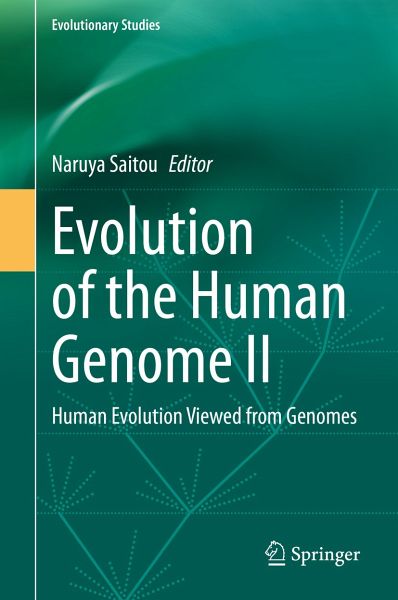
This two-volume set provides a general overview of the evolution of the human genome; The first volume overviews the human genome with descriptions of important gene groups. This second volume provides up-to-date, concise yet ample knowledge on the genome evolution of modern humans. It comprises twelve chapters divided into two parts discussing "Non-neutral Evolution on Human Genes" (Part I) and "Evolution of Modern Human Populations" (Part II.)
The most significant feature of this book is the continent-wise discussion of modern human dispersal using human genomic data in Part II. Recent results such as introgression of paleogenomes to modern humans, new methods such as computer simulation of global human dispersals, and new information on genes for humanness will be of particular interest to the readers.
Since the euchromatin regions of the human genome was sequenced in 2003, a huge number of research papers were published on modern human evolution for a variety ofpopulations. It is now time to summarize these achievements.
This book stands out as the most comprehensive book on the modern human evolution, focusing on genomic points of view with a broad scope. Primary target audiences are researchers and graduate students in evolutionary biology.
The most significant feature of this book is the continent-wise discussion of modern human dispersal using human genomic data in Part II. Recent results such as introgression of paleogenomes to modern humans, new methods such as computer simulation of global human dispersals, and new information on genes for humanness will be of particular interest to the readers.
Since the euchromatin regions of the human genome was sequenced in 2003, a huge number of research papers were published on modern human evolution for a variety ofpopulations. It is now time to summarize these achievements.
This book stands out as the most comprehensive book on the modern human evolution, focusing on genomic points of view with a broad scope. Primary target audiences are researchers and graduate students in evolutionary biology.
Dieser Download kann aus rechtlichen Gründen nur mit Rechnungsadresse in A, B, BG, CY, CZ, D, DK, EW, E, FIN, F, GR, HR, H, IRL, I, LT, L, LR, M, NL, PL, P, R, S, SLO, SK ausgeliefert werden.