19,99 €
inkl. MwSt.
Sofort per Download lieferbar
0 °P sammeln

Andere Kunden interessierten sich auch für
") Experiments and Observations on Different Kinds of Air (eBook, ePUB)0,49 €
Experiments and Observations on Different Kinds of Air (eBook, ePUB)0,49 €") Conversations on Chemistry, V. 1-2In Which the Elements of that Science Are Familiarly Explained and Illustrated by Experiments (eBook, ePUB)19,99 €
Conversations on Chemistry, V. 1-2In Which the Elements of that Science Are Familiarly Explained and Illustrated by Experiments (eBook, ePUB)19,99 €") Experiments and Considerations Touching Colours (eBook, ePUB)19,99 €
Experiments and Considerations Touching Colours (eBook, ePUB)19,99 €") An Introduction to Chemical Science (eBook, ePUB)19,99 €
An Introduction to Chemical Science (eBook, ePUB)19,99 €") Some Experiments Concerning Mercury (eBook, ePUB)19,99 €
Some Experiments Concerning Mercury (eBook, ePUB)19,99 €") Traité élémentaire de chimie, tomes 1 & 2 (eBook, ePUB)19,99 €
Traité élémentaire de chimie, tomes 1 & 2 (eBook, ePUB)19,99 €") Creative Chemistry (eBook, ePUB)19,99 €
Creative Chemistry (eBook, ePUB)19,99 €
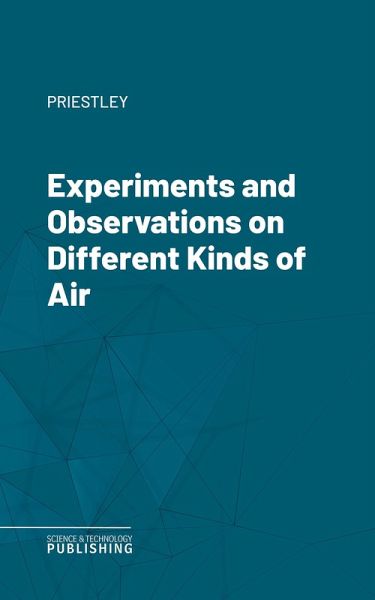
Experiments and Observations on Different Kinds of Air is a groundbreaking scientific work by Joseph Priestley, first published in the late 18th century. This seminal book documents Priestley's pioneering experiments with gases, which he referred to as "airs," and marks a turning point in the history of chemistry and the understanding of the composition of the atmosphere. Through a series of meticulous experiments, Priestley investigates the properties, production, and effects of various gases, including what he famously identified as "dephlogisticated air," now known as oxygen. The book is structured as a collection of detailed experimental reports, observations, and reflections, providing readers with both the methods and the reasoning behind Priestley's discoveries. He describes the apparatus he used, the substances he experimented with, and the results he obtained, often including diagrams and illustrations to clarify his procedures. Priestley's narrative is both methodical and accessible, offering insights into the scientific process and the spirit of inquiry that defined the Enlightenment era. Among the many gases Priestley explores are fixed air (carbon dioxide), nitrous air (nitric oxide), and inflammable air (hydrogen). He examines their interactions with water, plants, and animals, and discusses their implications for respiration, combustion, and the maintenance of life. Priestley's observations on the role of plants in restoring air made unfit for breathing were particularly influential, laying the groundwork for later discoveries in plant physiology and photosynthesis. Throughout the book, Priestley engages with the scientific theories of his time, such as the phlogiston theory, and debates with contemporaries like Henry Cavendish and Antoine Lavoisier. His openness to new ideas and willingness to revise his conclusions in light of new evidence exemplify the evolving nature of scientific understanding. Experiments and Observations on Different Kinds of Air is not only a record of scientific achievement but also a testament to the power of curiosity and experimentation. It remains a classic in the history of science, offering modern readers a window into the birth of modern chemistry and the intellectual excitement of discovery.
Dieser Download kann aus rechtlichen Gründen nur mit Rechnungsadresse in A, B, BG, CY, CZ, D, DK, EW, E, FIN, F, GR, HR, H, IRL, I, LT, L, LR, M, NL, PL, P, R, S, SLO, SK ausgeliefert werden.