48,95 €
48,95 €
inkl. MwSt.
Sofort per Download lieferbar

24 °P sammeln
48,95 €
Als Download kaufen
48,95 €
inkl. MwSt.
Sofort per Download lieferbar
24 °P sammeln
Jetzt verschenken
Alle Infos zum eBook verschenken
48,95 €
inkl. MwSt.
Sofort per Download lieferbar
Alle Infos zum eBook verschenken
24 °P sammeln

Andere Kunden interessierten sich auch für
") Arguments for a Better World: Essays in Honor of Amartya Sen (eBook, PDF)60,95 €
Arguments for a Better World: Essays in Honor of Amartya Sen (eBook, PDF)60,95 €") Arguments for a Better World: Essays in Honor of Amartya Sen (eBook, PDF)60,95 €
Arguments for a Better World: Essays in Honor of Amartya Sen (eBook, PDF)60,95 €") Exploitation (eBook, PDF)20,95 €
Exploitation (eBook, PDF)20,95 €") A Question of Inequality (eBook, PDF)27,95 €
A Question of Inequality (eBook, PDF)27,95 €") Domination and Global Political Justice (eBook, PDF)46,95 €
Domination and Global Political Justice (eBook, PDF)46,95 €") Hannah Arendt and the Limits of Total Domination (eBook, PDF)43,95 €
Hannah Arendt and the Limits of Total Domination (eBook, PDF)43,95 €") Exploitation and Economic Justice in the Liberal Capitalist State (eBook, PDF)49,95 €
Exploitation and Economic Justice in the Liberal Capitalist State (eBook, PDF)49,95 €


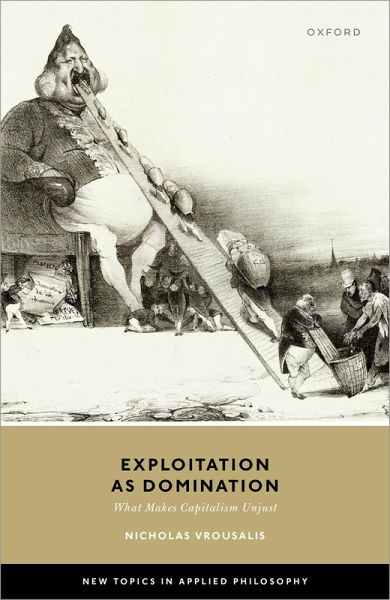
This is an open access title available under the terms of a CC BY-NC-ND 4.0 International license. It is offered as a free PDF download from OUP and selected open access locations. Exploitation is a globally pervasive phenomenon. Slavery, serfdom, and the patriarchy are part of its lineage. Temporary and sex workers, commercial surrogacy, precarious labour contracts, sweatshops, and markets in blood, vaccines or human organs, are some contemporary manifestations of exploitation. What makes these exploitative transactions unjust? And is capitalism inherently exploitative? This book offers answers to these two questions. Nicholas Vrousalis argues that exploitation is a form of domination, self-enrichment through the domination of others. On the domination view, exploitation complaints are not, fundamentally, about harm, coercion or unfairness. Rather, they are about who serves whom and why. Exploitation, in a word, is a dividend of servitude: the dividend the powerful extract from the servitude of the vulnerable. Vrousalis claims that this servitude is inherent to capitalist relations between consenting adults whereby capital is monetary control over the labour capacity of others. It follows that capitalism, the mode of production where capital predominates, is an inherently unjust social structure.
Dieser Download kann aus rechtlichen Gründen nur mit Rechnungsadresse in A, B, BG, CY, CZ, D, DK, EW, E, FIN, F, GR, HR, H, IRL, I, LT, L, LR, M, NL, PL, P, R, S, SLO, SK ausgeliefert werden.