Dieser Download kann aus rechtlichen Gründen nur mit Rechnungsadresse in A, B, BG, CY, CZ, D, DK, EW, E, FIN, F, GR, HR, H, IRL, I, LT, L, LR, M, NL, PL, P, R, S, SLO, SK ausgeliefert werden.
Herstellerkennzeichnung
Die Herstellerinformationen sind derzeit nicht verfügbar.
Autorenporträt
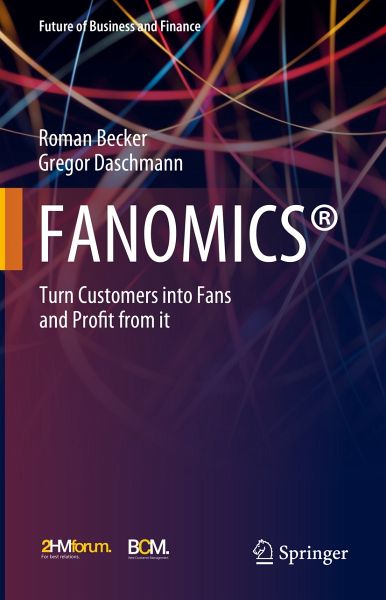
Roman Becker is the founder and managing partner of the market research and consulting company "2HMforum. For best relationships." in Mainz (Germany). He is a pioneer in the analysis and optimization of emotional customer loyalty and employee loyalty. Over the past 25 years, he has helped decision-makers at national and international companies to optimize customer and employee relationships with the help of FANOMICS and thus become more successful. Roman Becker is also the initiator of the benchmark studies "Fanfocus Germany" and "Employee Focus Germany" as well as the renowned company competition "Germany's Customer Champions." He studied journalism and economics at Johannes Gutenberg University in Mainz, where he also worked for many years as a lecturer for statistics. He is a fan of the football club Mainz 05 and is passionate about winter sports.
Gregor Daschmann is a Full Professor of Media Effects at the Department of Communication Studies and Dean of the Faculty of Social Sciences, Media, and Sports at Johannes Gutenberg University Mainz (Germany). He is also an academic advisor to "2HMforum. For Best Relationships." His work focuses, among other things, on media psychology, media effects, and empirical methods. After studying Communication, Politics, and Psychology, Prof. Daschmann worked as a journalist in various broadcasting stations. Gregor Daschmann is a fan of the football club Mainz 05 and plays bass guitar in the Rockin' Blues Band.
Inhaltsangabe
Chapter 1 The Fan Principle: Fans and Fan Customers.- 1.1 What it is about.- 1.2 What is a fan?.- 1.3 From Fan Principle to FANOMICS: What is a Fan Customer?.- 1.4 The FANOMICS Basis: The Fan Indicator.- 1.5 The Fan Rate as a KPI.- 1.6 The Fan Portfolio.- 1.7 Bibliography.- Chapter 2 The value of fan customers.- 2.1 The fan as a growth driver.- 2.2 Fans and Market Penetration: Growth with existing customers in existing business.- 2.3 Fans and Market development: Growth through the acquisition of new customers in existing business.- 2.4 Fans and product development: Growth with existing customers through expansion of the product range.- 2.5 Fans and product diversification: Growth by attracting new customers for new products.- 2.6 Summary: The Fan Rate as the central growth factor.- 2.7 Increasing customer value through FANOMICS.- 2.8 Bibliography.- Chapter 3 FANOMICS - The Economics of the Fan Principle.- 3.1 Focus generates identification.- 3.2 Orchestration creates perceived uniqueness.- 3.3 Definition of FANOMICS.- 3.4 Example VI: ALDI South - the simple principle.- 3.5 Examples VII: Miele - Orchestration of performance and communication.- 3.6 FANOMICS: From development to implementation.- 3.7 Bibliography.- Chapter 4 How do I really turn customers into fans?.- 4.1 Positioning.- 4.2 Orchestration.- 4.3 Employees as Fan Makers.- 4.4 Customer value-based control.- 4.5 Bibliography.- Chapter 5 FANOMICS: More than controlling relationship quality.- 5.1 Customer value-based segmentation with the Fan Portfolio.- 5.2 FANOMICS as an instrument for efficient new customer acquisition.- 5.3 Dovetailing of NPS and FANOMICS to form "NPSplus Insights".- 5.4 Bibliography.- Chapter 6 Success Factors of FANOMICS.- 6.1 Building awareness and acceptance.- 6.2 Validation of success effectiveness by measuring the customer value of Fans.- 6.3 Continuous measurement and goal systems for managing success.- 6.4 Bibliography.
Chapter 1 The Fan Principle: Fans and Fan Customers.- 1.1 What it is about.- 1.2 What is a fan?.- 1.3 From Fan Principle to FANOMICS: What is a Fan Customer?.- 1.4 The FANOMICS Basis: The Fan Indicator.- 1.5 The Fan Rate as a KPI.- 1.6 The Fan Portfolio.- 1.7 Bibliography.- Chapter 2 The value of fan customers.- 2.1 The fan as a growth driver.- 2.2 Fans and Market Penetration: Growth with existing customers in existing business.- 2.3 Fans and Market development: Growth through the acquisition of new customers in existing business.- 2.4 Fans and product development: Growth with existing customers through expansion of the product range.- 2.5 Fans and product diversification: Growth by attracting new customers for new products.- 2.6 Summary: The Fan Rate as the central growth factor.- 2.7 Increasing customer value through FANOMICS.- 2.8 Bibliography.- Chapter 3 FANOMICS - The Economics of the Fan Principle.- 3.1 Focus generates identification.- 3.2 Orchestration creates perceived uniqueness.- 3.3 Definition of FANOMICS.- 3.4 Example VI: ALDI South - the simple principle.- 3.5 Examples VII: Miele - Orchestration of performance and communication.- 3.6 FANOMICS: From development to implementation.- 3.7 Bibliography.- Chapter 4 How do I really turn customers into fans?.- 4.1 Positioning.- 4.2 Orchestration.- 4.3 Employees as Fan Makers.- 4.4 Customer value-based control.- 4.5 Bibliography.- Chapter 5 FANOMICS: More than controlling relationship quality.- 5.1 Customer value-based segmentation with the Fan Portfolio.- 5.2 FANOMICS as an instrument for efficient new customer acquisition.- 5.3 Dovetailing of NPS and FANOMICS to form "NPSplus Insights".- 5.4 Bibliography.- Chapter 6 Success Factors of FANOMICS.- 6.1 Building awareness and acceptance.- 6.2 Validation of success effectiveness by measuring the customer value of Fans.- 6.3 Continuous measurement and goal systems for managing success.- 6.4 Bibliography.
Es gelten unsere Allgemeinen Geschäftsbedingungen: www.buecher.de/agb
Impressum
www.buecher.de ist ein Internetauftritt der buecher.de internetstores GmbH
Geschäftsführung: Monica Sawhney | Roland Kölbl | Günter Hilger
Sitz der Gesellschaft: Batheyer Straße 115 - 117, 58099 Hagen
Postanschrift: Bürgermeister-Wegele-Str. 12, 86167 Augsburg
Amtsgericht Hagen HRB 13257
Steuernummer: 321/5800/1497
USt-IdNr: DE450055826