72,95 €
inkl. MwSt.
Sofort per Download lieferbar
36 °P sammeln

Andere Kunden interessierten sich auch für
") Pattern Recognition in Bioinformatics (eBook, PDF)32,95 €
Pattern Recognition in Bioinformatics (eBook, PDF)32,95 €") Pattern Recognition in Bioinformatics (eBook, PDF)40,95 €
Pattern Recognition in Bioinformatics (eBook, PDF)40,95 €") Information-Theoretic Evaluation for Computational Biomedical Ontologies (eBook, PDF)40,95 €
Information-Theoretic Evaluation for Computational Biomedical Ontologies (eBook, PDF)40,95 €") Case Studies in Ethics and HIV Research (eBook, PDF)40,95 €
Case Studies in Ethics and HIV Research (eBook, PDF)40,95 €") Bioinformatics and Biomedical Engineering (eBook, PDF)40,95 €
Bioinformatics and Biomedical Engineering (eBook, PDF)40,95 €") Fractals in Biology and Medicine (eBook, PDF)30,95 €
Fractals in Biology and Medicine (eBook, PDF)30,95 €") Twelve Diseases that Changed Our World (eBook, PDF)26,99 €
Twelve Diseases that Changed Our World (eBook, PDF)26,99 €




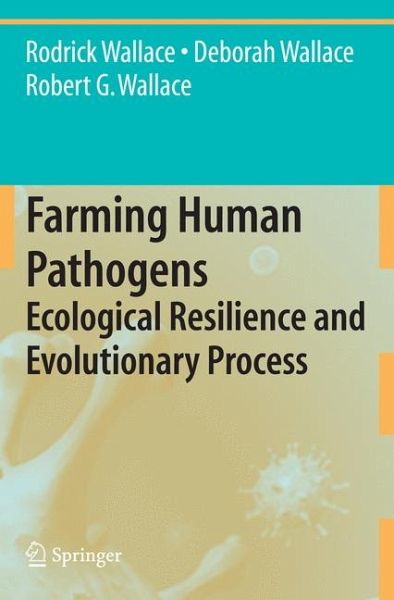
Farming Human Pathogens: Ecological Resilience and Evolutionary Process introduces a cutting-edge mathematical formalism based on the asymptotic limit theorems of information theory to describe how punctuated shifts in mesoscale ecosystems can entrain patterns of gene expression and organismal evolution. The authors apply the new formalism toward characterizing a number of infectious diseases that have evolved in response to the world as humans have made it. Many of the human pathogens that are emerging out from underneath epidemiological control are 'farmed' in the metaphorical sense, as the evolution of drug-resistant HIV makes clear, but also quite literally, as demonstrated by avian influenza's emergence from poultry farms in southern China. The most successful pathogens appear able to integrate selection pressures humans have imposed upon them from a variety of socioecological scales. The book also presents a related treatment of Eigen's Paradox and the RNA 'error catastrophe' that bedevils models of the origins of viruses and of biological life itself.
Dieser Download kann aus rechtlichen Gründen nur mit Rechnungsadresse in A, B, BG, CY, CZ, D, DK, EW, E, FIN, F, GR, HR, H, IRL, I, LT, L, LR, M, NL, PL, P, R, S, SLO, SK ausgeliefert werden.