39,95 €
inkl. MwSt.
Sofort per Download lieferbar
20 °P sammeln

Andere Kunden interessierten sich auch für
") Faxton (eBook, PDF)39,95 €
Faxton (eBook, PDF)39,95 €") Medieval Tastes (eBook, ePUB)21,95 €
Medieval Tastes (eBook, ePUB)21,95 €") Negotiating the North (eBook, ePUB)0,00 €
Negotiating the North (eBook, ePUB)0,00 €") King Arthur (eBook, ePUB)39,95 €
King Arthur (eBook, ePUB)39,95 €") Medieval Southampton (eBook, ePUB)55,95 €
Medieval Southampton (eBook, ePUB)55,95 €") Life in a Medieval Village (eBook, ePUB)7,99 €
Life in a Medieval Village (eBook, ePUB)7,99 €") The Archaeology of the Medieval English Monarchy (eBook, ePUB)44,95 €
The Archaeology of the Medieval English Monarchy (eBook, ePUB)44,95 €

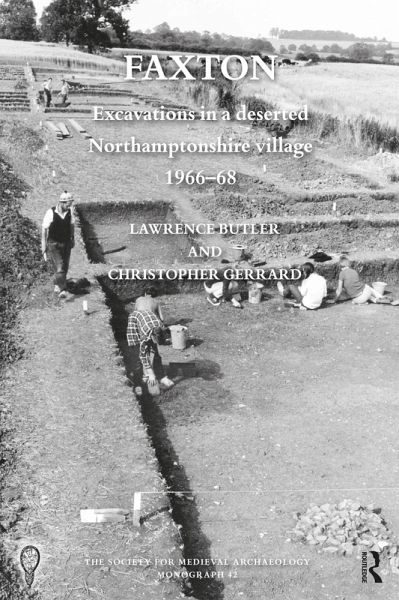
The village of Faxton in Northamptonshire was only finally deserted in the second half of the 20th century. Shortly afterwards, between 1966 and 1968, its medieval crofts were investigated under the direction of archaeologist Lawrence Butler. At the time this was one of the most ambitious excavations of a deserted medieval settlement to have been conducted and, although the results were only published as interim reports and summaries, Butler's observations at Faxton were to have significant influence on the growing academic and popular literature about village origins and desertion and the nature of medieval peasant crofts and buildings. In contrast to regions with abundant building stone, Faxton revealed archaeological evidence of a long tradition of earthen architecture in which so-called 'mud-walling' was successfully combined with other structural materials.
The 'rescue' excavations at Faxton were originally promoted by the Deserted Medieval Village Research Group and funded by the Ministry of Public Buildings and Works after the extensive earthworks at the site came under threat from agriculture. Three areas were excavated covering seven crofts. In 1966 Croft 29 at the south-east corner of the village green revealed a single croft in detail with its barns, yards and corn driers; in 1967 four crofts were examined together in the north-west corner of the village in an area badly damaged by recent ploughing and, finally, an area immediately east of the church was opened up in 1968. In all, some 4000m2 were investigated in 140 days over three seasons.
The post-excavation process for Faxton was beset by delay. Of the 12 chapters presented in this monograph, only two were substantially complete at the time of the director's death in 2014. The others have had to be pieced together from interim summaries, partial manuscripts, sound recordings, handwritten notes and on-site records. Building on this evidence, a new team of scholars have re-considered the findings in order to set the excavations at Faxton into the wider context of modern research. Their texts reflect on the settlement's disputed pre-Conquest origins, probable later re-planning and expansion, the reasons behind the decline and abandonment of the village, the extraordinary story behind the destruction of its church, the development of the open fields and the enclosure process, as well as new evidence about Faxton's buildings and the finds discovered there. Once lauded, then forgotten, the excavations at Faxton now make a new contribution to our knowledge of medieval life and landscape in the East Midlands.
The 'rescue' excavations at Faxton were originally promoted by the Deserted Medieval Village Research Group and funded by the Ministry of Public Buildings and Works after the extensive earthworks at the site came under threat from agriculture. Three areas were excavated covering seven crofts. In 1966 Croft 29 at the south-east corner of the village green revealed a single croft in detail with its barns, yards and corn driers; in 1967 four crofts were examined together in the north-west corner of the village in an area badly damaged by recent ploughing and, finally, an area immediately east of the church was opened up in 1968. In all, some 4000m2 were investigated in 140 days over three seasons.
The post-excavation process for Faxton was beset by delay. Of the 12 chapters presented in this monograph, only two were substantially complete at the time of the director's death in 2014. The others have had to be pieced together from interim summaries, partial manuscripts, sound recordings, handwritten notes and on-site records. Building on this evidence, a new team of scholars have re-considered the findings in order to set the excavations at Faxton into the wider context of modern research. Their texts reflect on the settlement's disputed pre-Conquest origins, probable later re-planning and expansion, the reasons behind the decline and abandonment of the village, the extraordinary story behind the destruction of its church, the development of the open fields and the enclosure process, as well as new evidence about Faxton's buildings and the finds discovered there. Once lauded, then forgotten, the excavations at Faxton now make a new contribution to our knowledge of medieval life and landscape in the East Midlands.
Dieser Download kann aus rechtlichen Gründen nur mit Rechnungsadresse in A, B, BG, CY, CZ, D, DK, EW, E, FIN, F, GR, HR, H, IRL, I, LT, L, LR, M, NL, PL, P, R, S, SLO, SK ausgeliefert werden.