20,95 €
inkl. MwSt.
Sofort per Download lieferbar
10 °P sammeln

Andere Kunden interessierten sich auch für
") The Feeling Body (eBook, ePUB)22,95 €
The Feeling Body (eBook, ePUB)22,95 €") Emotion as Feeling Towards Value (eBook, ePUB)34,95 €
Emotion as Feeling Towards Value (eBook, ePUB)34,95 €") Feeling Beauty (eBook, ePUB)22,95 €
Feeling Beauty (eBook, ePUB)22,95 € (eBook, ePUB)") The Philosophy of Meaning: Why Does Anything Matter? (Whispers of Reason, #3) (eBook, ePUB)6,49 €
The Philosophy of Meaning: Why Does Anything Matter? (Whispers of Reason, #3) (eBook, ePUB)6,49 €") The Foundations of Feeling Good (eBook, ePUB)7,99 €
The Foundations of Feeling Good (eBook, ePUB)7,99 €") Cognitive Systems and the Extended Mind (eBook, ePUB)20,95 €
Cognitive Systems and the Extended Mind (eBook, ePUB)20,95 €") Mind Without Brain: A Proposal (eBook, ePUB)5,49 €
Mind Without Brain: A Proposal (eBook, ePUB)5,49 €




A new view of the extended mind thesis argues that a stark binary opposition between really extending and seeming to extend oversimplifies the issue.
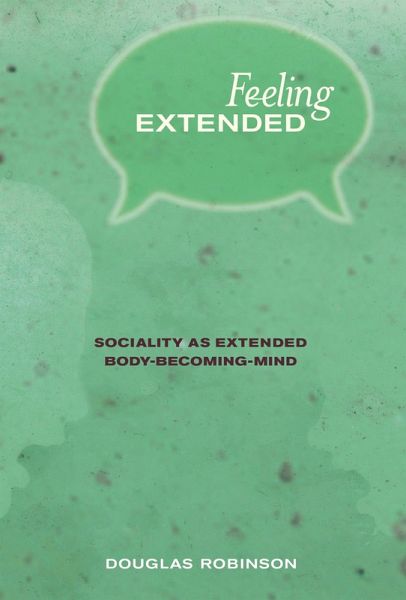
The extended-mind thesis (EMT), usually attributed to Andy Clark and David Chalmers, proposes that in specific kinds of mind-body-world interaction there emerges an extended cognitive system incorporating such extracranial supports as pencils, papers, computers, and other objects and environments in the world. In Feeling Extended, Douglas Robinson accepts the thesis, but argues that the usual debate over EMTwhich centers on whether mind really (literally, actually, materially) extends to body and world or only seems tooversimplifies the issue. When we say that mind feels as if it extends, Robinson argues, what extends is precisely feelingand mind, insofar as it arises out of feeling.
Robinson explores the world of affect and conation as intermediate realms of being between the physical movements of body and the qualitative movements of mind. He shows that affect is transcranial and tends to become interpersonal conation. Affective-becoming-conative sociality, he argues, is in fact the primary area in which body-becoming-mind extends. To make his case, Robinson draws on a wide spectrum of philosophical thoughtfrom the EMT and qualia debates among cognitivists to the prehistory of such debates in the work of Hegel and Peirce to continental challenges to Hegelianism from Bakhtin and Derridaas well as on extensive empirical research in social psychology and important sociological theories of face (Goffman), ritual (Connerton), and habitus (Bourdieu).
The extended-mind thesis (EMT), usually attributed to Andy Clark and David Chalmers, proposes that in specific kinds of mind-body-world interaction there emerges an extended cognitive system incorporating such extracranial supports as pencils, papers, computers, and other objects and environments in the world. In Feeling Extended, Douglas Robinson accepts the thesis, but argues that the usual debate over EMTwhich centers on whether mind really (literally, actually, materially) extends to body and world or only seems tooversimplifies the issue. When we say that mind feels as if it extends, Robinson argues, what extends is precisely feelingand mind, insofar as it arises out of feeling.
Robinson explores the world of affect and conation as intermediate realms of being between the physical movements of body and the qualitative movements of mind. He shows that affect is transcranial and tends to become interpersonal conation. Affective-becoming-conative sociality, he argues, is in fact the primary area in which body-becoming-mind extends. To make his case, Robinson draws on a wide spectrum of philosophical thoughtfrom the EMT and qualia debates among cognitivists to the prehistory of such debates in the work of Hegel and Peirce to continental challenges to Hegelianism from Bakhtin and Derridaas well as on extensive empirical research in social psychology and important sociological theories of face (Goffman), ritual (Connerton), and habitus (Bourdieu).
Dieser Download kann aus rechtlichen Gründen nur mit Rechnungsadresse in A, B, BG, CY, CZ, D, DK, EW, E, FIN, F, GR, HR, H, IRL, I, LT, L, LR, M, NL, PL, P, R, S, SLO, SK ausgeliefert werden.