165,95 €
inkl. MwSt.
Sofort per Download lieferbar
0 °P sammeln

Andere Kunden interessierten sich auch für
") Consorting with Saints (eBook, PDF)121,95 €
Consorting with Saints (eBook, PDF)121,95 €") Contesting the Middle Ages (eBook, PDF)44,95 €
Contesting the Middle Ages (eBook, PDF)44,95 €") Gender and Holiness (eBook, PDF)45,95 €
Gender and Holiness (eBook, PDF)45,95 €") Mobile Saints (eBook, PDF)39,95 €
Mobile Saints (eBook, PDF)39,95 €") Saints and cities in medieval Italy (eBook, PDF)15,95 €
Saints and cities in medieval Italy (eBook, PDF)15,95 €") The Feeling Heart in Medieval and Early Modern Europe (eBook, PDF)87,95 €
The Feeling Heart in Medieval and Early Modern Europe (eBook, PDF)87,95 €") Medieval Work, Worship, and Power (eBook, PDF)42,95 €
Medieval Work, Worship, and Power (eBook, PDF)42,95 €




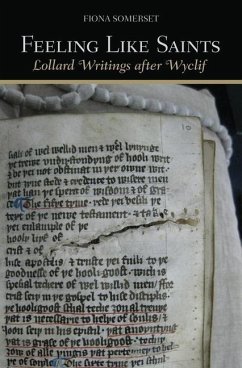
"e;Lollard"e; is the name given to followers of John Wyclif, the English dissident theologian who was dismissed from Oxford University in 1381 for his arguments regarding the eucharist. A forceful and influential critic of the ecclesiastical status quo in the late fourteeth century, Wyclif's thought was condemned at the Council of Constance in 1415. While lollardy has attracted much attention in recent years, much of what we think we know about this English religious movement is based on records of heresy trials and anti-lollard chroniclers. In Feeling Like Saints, Fiona Somerset demonstrates that this approach has limitations. A better basis is the five hundred or so manuscript books from the period (1375-1530) containing materials translated, composed, or adapted by lollard writers themselves.These writings provide rich evidence for how lollard writers collaborated with one another and with their readers to produce a distinctive religious identity based around structures of feeling. Lollards wanted to feel like saints. From Wyclif they drew an extraordinarily rigorous ethic of mutual responsibility that disregarded both social status and personal risk. They recalled their commitment to this ethic by reading narratives of physical suffering and vindication, metaphorically martyring themselves by inviting scorn for their zeal, and enclosing themselves in the virtues rather than the religious cloister. Yet in many ways they were not that different from their contemporaries, especially those with similar impulses to exceptional holiness.
Dieser Download kann aus rechtlichen Gründen nur mit Rechnungsadresse in A, B, BG, CY, CZ, D, DK, EW, E, FIN, F, GR, HR, H, IRL, I, LT, L, LR, M, NL, PL, P, R, S, SLO, SK ausgeliefert werden.