88,95 €
inkl. MwSt.
Sofort per Download lieferbar

44 °P sammeln

- Format: PDF
- Merkliste
- Auf die Merkliste
- Bewerten Bewerten
- Teilen
- Produkt teilen
- Produkterinnerung
- Produkterinnerung

Bitte loggen Sie sich zunächst in Ihr Kundenkonto ein oder registrieren Sie sich bei
bücher.de, um das eBook-Abo tolino select nutzen zu können.
Hier können Sie sich einloggen
Sie sind bereits eingeloggt. Klicken Sie auf 2. tolino select Abo, um fortzufahren.

Bitte loggen Sie sich zunächst in Ihr Kundenkonto ein oder registrieren Sie sich bei bücher.de, um das eBook-Abo tolino select nutzen zu können.
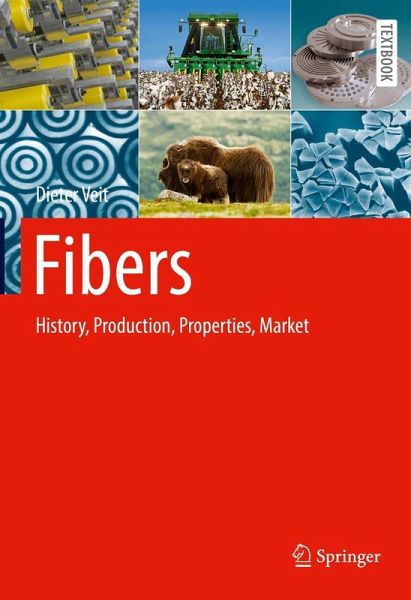
This textbook covers the production of all relevant natural and man-made fibers, their inner structure, properties, applications, markets and historic development. More than 1,600 photos, maps and sketches complement the text. The properties of important fibers are compared in a large number of tables and graphics to simplify selecting an appropriate fiber for a given application.
- Geräte: PC
- ohne Kopierschutz
- eBook Hilfe
- Größe: 97.62MB
Andere Kunden interessierten sich auch für
John StarkProduct Lifecycle Management (Volume 1) (eBook, PDF)96,95 €
Annamaria BehúnováCompany Controlling (eBook, PDF)72,95 €
New Trends in Educational Activity in the Field of Mechanism and Machine Theory (eBook, PDF)112,95 €
Challenges in Mechanics of Time Dependent Materials, Volume 2 (eBook, PDF)112,95 €
Martin BonnetKunststofftechnik (eBook, PDF)29,99 €
Maschinenbau (eBook, PDF)66,99 €
Emerging Trends in Mechanical Engineering (eBook, PDF)112,95 €-
-
-
This textbook covers the production of all relevant natural and man-made fibers, their inner structure, properties, applications, markets and historic development. More than 1,600 photos, maps and sketches complement the text. The properties of important fibers are compared in a large number of tables and graphics to simplify selecting an appropriate fiber for a given application.
Dieser Download kann aus rechtlichen Gründen nur mit Rechnungsadresse in A, B, BG, CY, CZ, D, DK, EW, E, FIN, F, GR, HR, H, IRL, I, LT, L, LR, M, NL, PL, P, R, S, SLO, SK ausgeliefert werden.
Produktdetails
- Produktdetails
- Verlag: Springer International Publishing
- Seitenzahl: 1040
- Erscheinungstermin: 9. Januar 2023
- Englisch
- ISBN-13: 9783031153099
- Artikelnr.: 67269533
- Verlag: Springer International Publishing
- Seitenzahl: 1040
- Erscheinungstermin: 9. Januar 2023
- Englisch
- ISBN-13: 9783031153099
- Artikelnr.: 67269533
- Herstellerkennzeichnung Die Herstellerinformationen sind derzeit nicht verfügbar.
Dieter Veit has studied mechanical engineering with a major in textiles at RWTH Aachen University. After completing his Dr.-Ing., he worked in man-made fiber plant engineering and since 2001 he has been giving lectures on natural and man-made fibers at RWTH Aachen University. He authored and edited several books on textile technology and artificial intelligence.
Part 1. Fundamentals.- Chapter 1. Definitions.- Chapter 2. History.- Chapter 3. Market.- Chapter 4. Inner Structure of Fibers.- Part 2. Natural Fibers.- Chapter 5. Cotton.- Chapter 6. Bast Fibers.- Chapter 7. Hard Fibers.- Chapter 8. Fruit Fibers.- Chapter 9. Wool.- Chapter 10. Fine Animal Hair.- Chapter 11. Silk.- Chapter 12. Asbestos.- Chapter 13. Other Natural Fibers.- Part 3. Chemical Fibers - Processes and Machines.- Chapter 14. Synthetic Man-made Fibers - Polymer Formation Processes.- Chapter 15. Aggregates for Polymer Formation.- Chapter 16. Processes for the Production of Man-made Fibers.- Chapter 17. Aggregates for the Production of Synthetic Filaments.- Chapter 18. Aggregates for the Production of Solution Spun Man-made Fibers.- Chapter 19. Processes for the Production of Textile Filament Yarns.- Chapter 20. Processes for the Production of Industrial Yarns.- Chapter 21. Process for the Production of Monofilaments.- Chapter 22. Process for the Production of Carpet Yarns.- Chapter 23. Process for the Production of Film Yarns.- Chapter 24. Processes for the Production of Staple Fibers.- Chapter 25. Processes for the Production of Nonwovens.- Chapter 26. Bicomponent Fibers.- Chapter 27. Fine Fibers.- Chapter 28. Aerogels.- Chapter 29. Texturing.- Part 4. Synthetic Chemical Fibers - Production and Properties.- Chapter 30. Polyester.- Chapter 31. Polyamide.- Chapter 32. Aramid.- Chapter 33. Polyolefins.- Chapter 34. Polyacrylonitrile.- Chapter 35. Polylactic Acid.- Chapter 36. Elastane.- Chapter 37. High Performance Fibers.- Chapter 38. Carbon Fibers.- Chapter 39. Carbon Nanotubes and Graphene.- Chapter 40. Optical Fibers.- Part 5. Cellulosic Chemical Fibers - Production and Properties.- Chapter 41. Cellulosic Man-made Fibers.- Part 6. Biopolymers.- Chapter 42. Biopolymers.- Part 7. Inorganic Fibers.- Chapter 43. Glass Fibers.- Chapter 44. Basalt Fibers.- Chapter 45. Ceramic Fibers.- Part 8. Metal Fibers.- Chapter 46. Metal Fibers.- Part 9. Test Methods.- Chapter 47. Test Methods.- Part 10. Properties of Natural and Chemical Fibers.- Chapter 48. Properties.- Part 11. Producers and Trade Names.- Chapter 49. Producers and Trade Names.- Part 12. Outlook and Trends.- Chapter 50. Outlook and Trends.