Sie sind bereits eingeloggt. Klicken Sie auf 2. tolino select Abo, um fortzufahren.
Bitte loggen Sie sich zunächst in Ihr Kundenkonto ein oder registrieren Sie sich bei bücher.de, um das eBook-Abo tolino select nutzen zu können.
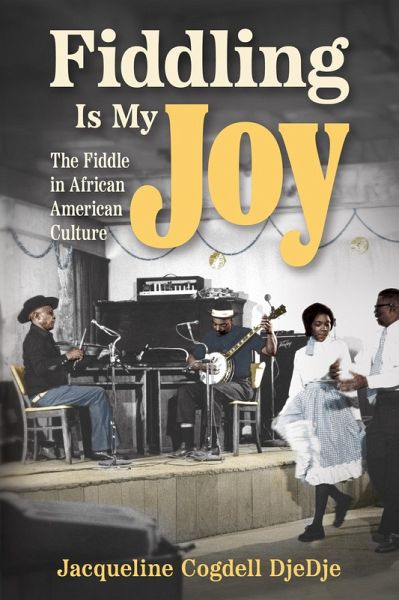
In Fiddling Is My Joy , Jacqueline Cogdell DjeDje examines the history of fiddling among African Americans from the seventeenth to the mid-twentieth century. Although music historians acknowledge a prominent African American fiddle tradition during the era of slavery, only recently have researchers begun to closely examine the history and social implications of these musical practices. Research on African music reveals a highly developed tradition in West Africa, which dates to the eleventh or twelfth century and continues today. From these West African roots, fiddling was prominent in many…mehr
In Fiddling Is My Joy, Jacqueline Cogdell DjeDje examines the history of fiddling among African Americans from the seventeenth to the mid-twentieth century. Although music historians acknowledge a prominent African American fiddle tradition during the era of slavery, only recently have researchers begun to closely examine the history and social implications of these musical practices. Research on African music reveals a highly developed tradition in West Africa, which dates to the eleventh or twelfth century and continues today. From these West African roots, fiddling was prominent in many African American communities between the seventeenth and nineteenth centuries, and the fiddle became an important instrument in early twentieth-century blues, jazz, and jug bands. While less common in late twentieth-century African American jazz and popular music groups, the fiddle remained integral to the musicking of some Black musicians in the rural South.
Featured in Fiddling Is My Joy is access to a comprehensive online eScholarship Companion that contains maps, photographs, audiovisual examples, and other materials to expand the work of this enlightening and significant study. To understand the immense history of fiddling, DjeDje uses geography to weave together a common thread by profiling the lives and contributions of Black fiddlers in various parts of the rural South and Midwest, including the mountains and along the Atlantic and Gulf coasts. In addition to exploring the extent that musical characteristics and aesthetics identified with African and European cultures were maintained or reinterpreted in Black fiddling, she also investigates how the sharing of musical ideas between Black and white fiddlers affected the development of both traditions. Most importantly, she considers the contradiction in representation. Historical evidence suggests that the fiddle may be one of the oldest uninterrupted instrumental traditions in African American culture, yet most people in the United States, including African Americans, do not identify it with Black music.
Dieser Download kann aus rechtlichen Gründen nur mit Rechnungsadresse in A, D ausgeliefert werden.
Die Herstellerinformationen sind derzeit nicht verfügbar.
Autorenporträt
Jacqueline Cogdell DjeDje is professor emerita, former chair of the UCLA Department of Ethnomusicology, and former director of the UCLA Ethnomusicology Archive. She is author of numerous articles and books, including Fiddling in West Africa: Touching the Spirit in Fulbe, Hausa, and Dagbamba Cultures, which won both the Alan Merriam Prize and the Kwabena Nketia Book Prize from the Society for Ethnomusicology.
Inhaltsangabe
Acknowledgments About Fiddling Is My Joy Companion on eScholarship Prologue Section One—Pre–Twentieth Century: The Beginnings and Rise in Popularity of Black Fiddling Introduction Chapter 1—The Earliest Evidence: Black Fiddling During the 1600s and 1700s Polydor Gardiner Rhode Island Caesar, Cato, and Robert Prim Connecticut Othello and Sampson Massachusetts Cuffee, Jamaica, and John Marrant New York Peter Philadelphia Derby, Peter, Robert, Sambo, Simeon Gilliat, Devereux Jarratt, and George Walker Virginia Clarinda South Carolina Chapter 2—A General Overview: Black Fiddling During the 1800s Chapter 3—A Regional Perspective: Black Fiddling During the 1800s The Snowden Family Band Ohio James Thomas Tennessee Ben Guyton Alabama George Morris West Virginia Augustus "Gus" Cochran Alabama Solomon Northup New York, Louisiana Gus Rhodes Alabama The Owens Family Mississippi Charles Lipscomb Texas Section Two—Early Twentieth Century: The Decline in Prominence of Black Fiddling Introduction Chapter 4—Black Fiddling and Secular Music in the Rural South Central Appalachian Mountains and Neighboring Regions Chapter 5—Maryland, Virginia, West Virginia William Adams Jr. Maryland George Leonard Bowles Virginia Carl Choice Martin Virginia Posey Foddrell Virginia Stephen Tarter Virginia Mert Perkins West Virginia Jilly Grace West Virginia Chapter 6—Kentucky Owen Walker James "Jim" D. Booker Jr. Arnold Shultz Ella Shultz Griffin Shell Coffey and Charlie Buster William "Bill" Livers Chapter 7—Tennessee Frank Patterson Jr. John Lusk Bennie "Cuje" Bertram Walter Greer Joel Rice Chapter 8—North Carolina Madison Boone Joseph Thompson Southern Appalachian Mountains and Neighboring Regions Chapter 9—South Carolina, Georgia, Alabama, Mississippi Henry J. Bryant South Carolina Andrew Baxter Georgia Fort Valley College Music Festival Georgia Elbert J. Freeman Georgia Joe Kinney Rakestraw Georgia Alfred Thomas Georgia George Hollis Georgia Earnest Mostella Alabama Sidney Hemphill Mississippi Robert "Bob" Pratcher Mississippi Thomas Jefferson Dumas Mississippi The Ozark Mountains Chapter 10—Missouri Ace Donell Sr. William "Bill" Katon William "Bill" Alexander Driver Jr. South Atlantic and Gulf Coasts and Neighboring Regions Chapter 11—Virginia, North Carolina, South Carolina, Georgia, Florida, Alabama, Mississippi, Arkansas Fred Perry Florida Eddie West Alabama Bo Chatmon [Carter], Harry Chatmon Mississippi Lonnie Chatmon Mississippi Henry "Son" Simms Mississippi Blind Pete Arkansas Chapter 12—Louisiana, Texas James "Butch" Cage Mississippi/Louisiana Morris Chenier Louisiana Douglas Bellard Louisiana Joseph "Bébé" Carrière Louisiana Calvin Carrière Louisiana Canray Fontenot Louisiana Charlie Thomas Texas Oscar William Nelson Texas Teodar Jackson Texas Epilogue Howard Armstrong Tennessee References Cited: Print Sources, Interviews, Personal/Email Communication References Cited: Discography, Film and Video, Radio, Websites Index
Es gelten unsere Allgemeinen Geschäftsbedingungen: www.buecher.de/agb
Impressum
www.buecher.de ist ein Internetauftritt der buecher.de internetstores GmbH
Geschäftsführung: Monica Sawhney | Roland Kölbl | Günter Hilger
Sitz der Gesellschaft: Batheyer Straße 115 - 117, 58099 Hagen
Postanschrift: Bürgermeister-Wegele-Str. 12, 86167 Augsburg
Amtsgericht Hagen HRB 13257
Steuernummer: 321/5800/1497
USt-IdNr: DE450055826