46,95 €
inkl. MwSt.
Sofort per Download lieferbar
23 °P sammeln

Andere Kunden interessierten sich auch für
") Field Experiments in Political Science and Public Policy (eBook, ePUB)46,95 €
Field Experiments in Political Science and Public Policy (eBook, ePUB)46,95 €") Routledge Handbook of Research Methods in Military Studies (eBook, PDF)61,95 €
Routledge Handbook of Research Methods in Military Studies (eBook, PDF)61,95 €") Researching the Far Right (eBook, PDF)41,95 €
Researching the Far Right (eBook, PDF)41,95 €") The Spiralling of the Securitisation of Migration in the European Union (eBook, PDF)41,95 €
The Spiralling of the Securitisation of Migration in the European Union (eBook, PDF)41,95 €") Interviewing in Social Science Research (eBook, PDF)40,95 €
Interviewing in Social Science Research (eBook, PDF)40,95 €") Rethinking Migration and Return in Southeastern Europe (eBook, PDF)0,00 €
Rethinking Migration and Return in Southeastern Europe (eBook, PDF)0,00 €") Sociology Saves the Planet (eBook, PDF)38,95 €
Sociology Saves the Planet (eBook, PDF)38,95 €



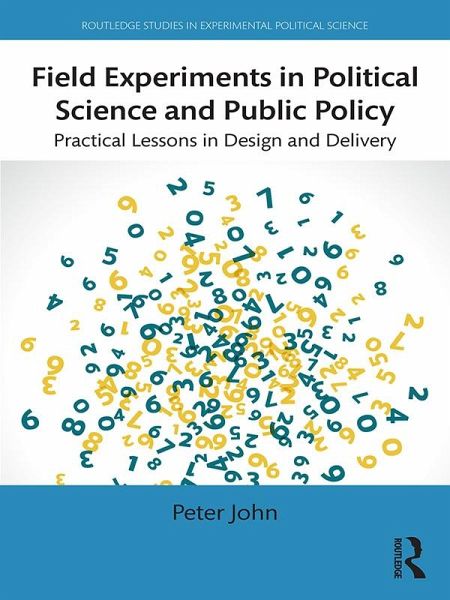
Field experiments -- randomized controlled trials -- have become ever more popular in political science, as well as in other disciplines, such as economics, social policy and development. Policy-makers have also increasingly used randomization to evaluate public policies, designing trials of tax reminders, welfare policies and international aid programs to name just a few of the interventions tested in this way. Field experiments have become successful because they assess causal claims in ways that other methods of evaluation find hard to emulate.
Social scientists and evaluators have rediscovered how to design and analyze field experiments, but they have paid much less attention to the challenges of organizing and managing them. Field experiments pose unique challenges and opportunities for the researcher and evaluator which come from working in the field. The research experience can be challenging and at times hard to predict. This book aims to help researchers and evaluators plan and manage their field experiments so they can avoid common pitfalls. It is also intended to open up discussion about the context and backdrop to trials so that these practical aspects of field experiments are better understood.
The book sets out ten steps researchers can use to plan their field experiments, then nine threats to watch out for when they implement them. There are cases studies of voting and political participation, elites, welfare and employment, nudging citizens, and developing countries.
Social scientists and evaluators have rediscovered how to design and analyze field experiments, but they have paid much less attention to the challenges of organizing and managing them. Field experiments pose unique challenges and opportunities for the researcher and evaluator which come from working in the field. The research experience can be challenging and at times hard to predict. This book aims to help researchers and evaluators plan and manage their field experiments so they can avoid common pitfalls. It is also intended to open up discussion about the context and backdrop to trials so that these practical aspects of field experiments are better understood.
The book sets out ten steps researchers can use to plan their field experiments, then nine threats to watch out for when they implement them. There are cases studies of voting and political participation, elites, welfare and employment, nudging citizens, and developing countries.
Dieser Download kann aus rechtlichen Gründen nur mit Rechnungsadresse in A, B, BG, CY, CZ, D, DK, EW, E, FIN, F, GR, HR, H, IRL, I, LT, L, LR, M, NL, PL, P, R, S, SLO, SK ausgeliefert werden.
'In this lively and accessible book, Peter John has shared with readers a wealth of practical guidance that comes from years and years of field experimentation in political science and public policy. Every researcher should heed its advice before venturing into the field.' - Donald P. Green, Columbia University, USA
'Experiments are revolutionizing what we think we know about many aspects of politics. This volume contributes nicely to this body of work by extending the focus to critical questions of public policy. This is a timely and important book.' - Costas Panagopoulos, Fordham University, USA
'Experiments are revolutionizing what we think we know about many aspects of politics. This volume contributes nicely to this body of work by extending the focus to critical questions of public policy. This is a timely and important book.' - Costas Panagopoulos, Fordham University, USA