124,99 €
inkl. MwSt.
Sofort per Download lieferbar
0 °P sammeln

Andere Kunden interessierten sich auch für
") Field-Flow Fractionation (eBook, ePUB)124,99 €
Field-Flow Fractionation (eBook, ePUB)124,99 €") Aptamers for Analytical Applications (eBook, PDF)133,99 €
Aptamers for Analytical Applications (eBook, PDF)133,99 €") Elektrophorese leicht gemacht (eBook, PDF)84,99 €
Elektrophorese leicht gemacht (eBook, PDF)84,99 €") Chromatography (eBook, PDF)92,99 €
Chromatography (eBook, PDF)92,99 €") Gradient HPLC for Practitioners (eBook, PDF)85,99 €
Gradient HPLC for Practitioners (eBook, PDF)85,99 €") Handbook of Ion Chromatography (eBook, PDF)494,99 €
Handbook of Ion Chromatography (eBook, PDF)494,99 €") The HPLC Expert (eBook, PDF)102,99 €
The HPLC Expert (eBook, PDF)102,99 €

Comprehensive, up-to-date, and user-centered one-stop reference on the principles and applications of Field-Flow Fractionation (FFF), a highly versatile separation technology
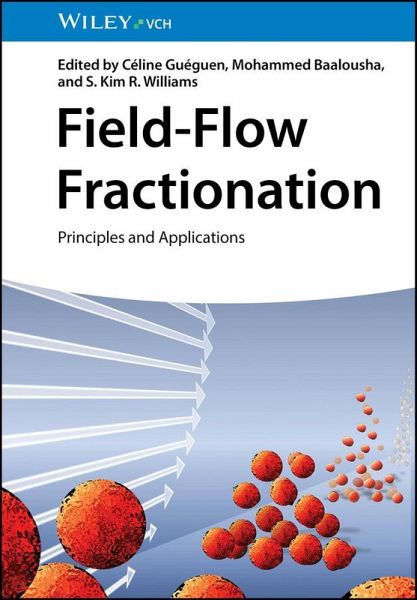
Field-Flow Fractionation: Principles and Applications offers a comprehensive and topical one-stop reference on Field-Flow Fractionation (FFF), an important separation technique which has been proven successful in the analysis of natural and engineered nanoparticles, pharmaceuticals, proteins, polymers, soils, and food.
After introductory chapters on theory, principles, and instrumentation, a tutorial-style user guide addresses typical users' questions and problems. In the application part, the separation of all relevant particle classes is discussed by international experts.
Sample topics covered in Field-Flow Fractionation: Principles and Applications include:
Both beginners and experienced chemists and researchers can confidently rely on Field-Flow Fractionation: Principles and Applications to confirm their own understanding and to improve their FFF methods and interpretation of their results.
Field-Flow Fractionation: Principles and Applications offers a comprehensive and topical one-stop reference on Field-Flow Fractionation (FFF), an important separation technique which has been proven successful in the analysis of natural and engineered nanoparticles, pharmaceuticals, proteins, polymers, soils, and food.
After introductory chapters on theory, principles, and instrumentation, a tutorial-style user guide addresses typical users' questions and problems. In the application part, the separation of all relevant particle classes is discussed by international experts.
Sample topics covered in Field-Flow Fractionation: Principles and Applications include:
- Historical perspectives of the technique, normal versus steric versus hyperlayer modes, retention resolution, and fractionation power
- FFF techniques, including flow (asymmetric, frit inlet, and outlet), sedimentation, thermal, electric, and other novel techniques such as 2D
- How to determine if FFF is the correct choice and if it is being implemented correctly, along with general optimization strategies including carrier fluid, calibration, and reproducibility
- Sample overloading and recovery, detector selection, troubleshooting, and performance of other fractionation techniques
Both beginners and experienced chemists and researchers can confidently rely on Field-Flow Fractionation: Principles and Applications to confirm their own understanding and to improve their FFF methods and interpretation of their results.
Dieser Download kann aus rechtlichen Gründen nur mit Rechnungsadresse in D ausgeliefert werden.