21,95 €
21,95 €
inkl. MwSt.
Sofort per Download lieferbar

11 °P sammeln
21,95 €
Als Download kaufen
21,95 €
inkl. MwSt.
Sofort per Download lieferbar
11 °P sammeln
Jetzt verschenken
Alle Infos zum eBook verschenken
21,95 €
inkl. MwSt.
Sofort per Download lieferbar
Alle Infos zum eBook verschenken
11 °P sammeln

Andere Kunden interessierten sich auch für
") Film Ecology (eBook, ePUB)21,95 €
Film Ecology (eBook, ePUB)21,95 € (eBook, PDF)") Art, Culture and Enterprise (Routledge Revivals) (eBook, PDF)41,95 €
Art, Culture and Enterprise (Routledge Revivals) (eBook, PDF)41,95 €") Cinema as Weather (eBook, PDF)45,95 €
Cinema as Weather (eBook, PDF)45,95 €") The Routledge Handbook of Ecomedia Studies (eBook, PDF)0,00 €
The Routledge Handbook of Ecomedia Studies (eBook, PDF)0,00 €") The Anthropocene in Global Media (eBook, PDF)41,95 €
The Anthropocene in Global Media (eBook, PDF)41,95 €") Ecocinema Theory and Practice 2 (eBook, PDF)0,00 €
Ecocinema Theory and Practice 2 (eBook, PDF)0,00 €") Cinema of/for the Anthropocene (eBook, PDF)39,95 €
Cinema of/for the Anthropocene (eBook, PDF)39,95 €
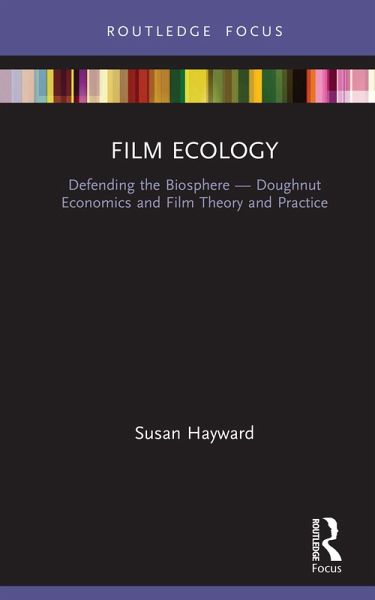
Using the Regenerative economic model - also known as Doughnut Economics - Susan Hayward offers a thought-provoking sketch for a renewed, tentatively revolutionary approach to both film theory and film practice.
This book attempts to answer the questions posed by T.J. Demos (in Against the Anthropocene, 2017): how do we find a way to address planetary harm and the issues it raises within the field of Film Studies? How do we construct a theoretical model that allows us to visualize the ecological transgressions brought about by the growth-model of capitalism which is heavily endorsed by mainstream narrative cinema? By turning to the model set out in Kate Raworth's book Doughnut Economics (2017) and adapting its fundamental principles to a study of narrative cinema, Film Ecology proposes to show how, by using this model, we can usefully plot and investigate films according to criteria that are not genre/star/auteur-led, nor indeed embedded in anthropocentric theoretical models, but principles which are ecologically based. These arguments are brought to life with examples from mainstream narrative films such as The Giant (1956), Mildred Pierce (1945), Erin Brockovich (2000), Wall Street (1987), Hotel Rwanda (2004), and Missing Figures (2016).
This approach will inspire film practitioners, film theorists, critics and analysts, film students and film lovers alike to consider how they might integrate this Doughnut model into their thinking or work as part of their process.
This book attempts to answer the questions posed by T.J. Demos (in Against the Anthropocene, 2017): how do we find a way to address planetary harm and the issues it raises within the field of Film Studies? How do we construct a theoretical model that allows us to visualize the ecological transgressions brought about by the growth-model of capitalism which is heavily endorsed by mainstream narrative cinema? By turning to the model set out in Kate Raworth's book Doughnut Economics (2017) and adapting its fundamental principles to a study of narrative cinema, Film Ecology proposes to show how, by using this model, we can usefully plot and investigate films according to criteria that are not genre/star/auteur-led, nor indeed embedded in anthropocentric theoretical models, but principles which are ecologically based. These arguments are brought to life with examples from mainstream narrative films such as The Giant (1956), Mildred Pierce (1945), Erin Brockovich (2000), Wall Street (1987), Hotel Rwanda (2004), and Missing Figures (2016).
This approach will inspire film practitioners, film theorists, critics and analysts, film students and film lovers alike to consider how they might integrate this Doughnut model into their thinking or work as part of their process.
Dieser Download kann aus rechtlichen Gründen nur mit Rechnungsadresse in A, B, BG, CY, CZ, D, DK, EW, E, FIN, F, GR, HR, H, IRL, I, LT, L, LR, M, NL, PL, P, R, S, SLO, SK ausgeliefert werden.