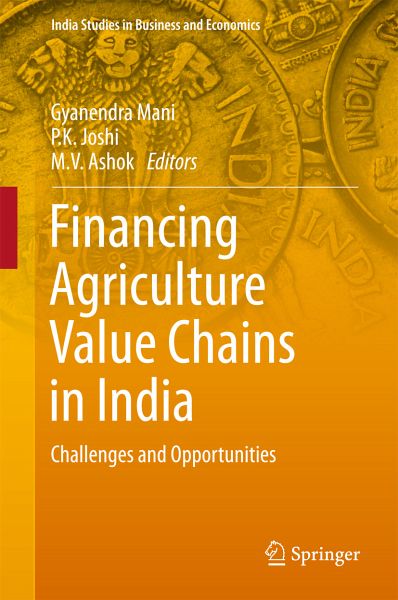
Financing Agriculture Value Chains in India (eBook, PDF)
Challenges and Opportunities
Redaktion: Mani, Gyanendra; Ashok, M. V.; Joshi, P. K.
40,95 €
40,95 €
inkl. MwSt.
Sofort per Download lieferbar

20 °P sammeln
40,95 €
Als Download kaufen
40,95 €
inkl. MwSt.
Sofort per Download lieferbar
20 °P sammeln
Jetzt verschenken
Alle Infos zum eBook verschenken
40,95 €
inkl. MwSt.
Sofort per Download lieferbar
Alle Infos zum eBook verschenken
20 °P sammeln

Financing Agriculture Value Chains in India (eBook, PDF)
Challenges and Opportunities
Redaktion: Mani, Gyanendra; Ashok, M. V.; Joshi, P. K.
- Format: PDF
- Merkliste
- Auf die Merkliste
- Bewerten Bewerten
- Teilen
- Produkt teilen
- Produkterinnerung
- Produkterinnerung

Bitte loggen Sie sich zunächst in Ihr Kundenkonto ein oder registrieren Sie sich bei
bücher.de, um das eBook-Abo tolino select nutzen zu können.
Hier können Sie sich einloggen
Sie sind bereits eingeloggt. Klicken Sie auf 2. tolino select Abo, um fortzufahren.

Bitte loggen Sie sich zunächst in Ihr Kundenkonto ein oder registrieren Sie sich bei bücher.de, um das eBook-Abo tolino select nutzen zu können.
Examines the value chains of various commodities, from theoretical as well as empirical perspectives
Analyzes different models of existing value chains as well as those being conceptualized in India
Provides broader perspective regarding efficiency in production and financing of value chains for different commodities in different conditions
Suggests institutional and policy reforms to push forward the concept of value chain financing
- Geräte: PC
- ohne Kopierschutz
- eBook Hilfe
- Größe: 4.77MB
Andere Kunden interessierten sich auch für
Melissa BarrettHow to Create a Sustainable Food Industry (eBook, PDF)35,95 €
Social Capital and Local Development (eBook, PDF)120,95 €
Agricultural Development in the World Periphery (eBook, PDF)88,95 €
Economics and Ecology of Diversification (eBook, PDF)112,95 €
Jay T. AkridgeAgribusiness Management (eBook, PDF)81,95 €
Closed-Loop Supply Chains (eBook, PDF)94,95 €
N. ChandrasekaranAgribusiness Supply Chain Management (eBook, PDF)103,95 €-
-
-
Examines the value chains of various commodities, from theoretical as well as empirical perspectives
Analyzes different models of existing value chains as well as those being conceptualized in India
Provides broader perspective regarding efficiency in production and financing of value chains for different commodities in different conditions
Suggests institutional and policy reforms to push forward the concept of value chain financing
Analyzes different models of existing value chains as well as those being conceptualized in India
Provides broader perspective regarding efficiency in production and financing of value chains for different commodities in different conditions
Suggests institutional and policy reforms to push forward the concept of value chain financing
Dieser Download kann aus rechtlichen Gründen nur mit Rechnungsadresse in A, B, BG, CY, CZ, D, DK, EW, E, FIN, F, GR, HR, H, IRL, I, LT, L, LR, M, NL, PL, P, R, S, SLO, SK ausgeliefert werden.
Produktdetails
- Produktdetails
- Verlag: Springer Nature Singapore
- Seitenzahl: 263
- Erscheinungstermin: 9. Januar 2018
- Englisch
- ISBN-13: 9789811059575
- Artikelnr.: 53061172
- Verlag: Springer Nature Singapore
- Seitenzahl: 263
- Erscheinungstermin: 9. Januar 2018
- Englisch
- ISBN-13: 9789811059575
- Artikelnr.: 53061172
- Herstellerkennzeichnung Die Herstellerinformationen sind derzeit nicht verfügbar.
Gyanendra Mani is currently the general manager and officer In-charge of the National Bank for Agriculture and Rural Development (NABARD), Arunachal Pradesh Regional Office (RO). He has a Ph.D. in Agricultural Economics from the G B Pant University of Agriculture & Technology, Pantnagar, Uttarakhand. He has conducted about 40 studies on behalf of the NABARD and published around 40 articles/research papers in Indian and International journals. He has handled several consultancy projects on behalf of the NABARD including 'Evaluation of SGSY Scheme' for the Ministry of Rural Development, Government of India (GOI). He also conceived the idea of and launched the 'THE MICROFINANCE REVIEW' Journal on behalf of the Bankers Institute of Rural Development (BIRD), Lucknow and was its managing editor from 2009 to 2015. As faculty of BIRD, he conducted two exposure visits of senior bankers to Israel and Netherlands. He is also a National Resource Person for the 'Design of Training' programme being conducted by the Department of Personnel and Training (DoPT), Government of India. P.K. Joshi is the director of the International Food Policy Research Institute (IFPRI) South Asia. Dr. Joshi has received several awards, including: the National Academy of Agricultural Sciences' Dr. M.S. Randhawa Memorial Award of (2009-11); and the Indian Society of Agricultural Economics' Prof R C Agarwal Lifetime Achievement Award and DK Desai Award. Dr. Joshi has also served as the chairman of the SAARC Agricultural Centre's governing board in Dhaka, Bangladesh (2006-08); chairman of the United Nations Centre for Alleviation of Poverty through Sustainable Agriculture (UN-CAPSA) governing board in Bogor, Indonesia (2007); and a member of the intergovernmental panel on the World Bank's International Assessment of Agricultural Science and Technology for Development (2007-08). He was a member of the International Steering Committee for the Climate Change, Agriculture and Food Security Challenge Program, led by the Earth System Science Partnership (ESSP) Science Community and the Consultative Group on International Agricultural Research (CGIAR) (2009-11). He is also president of the Agricultural Economics Research Association (India). M.V. Ashok is currently the chief general manager heading the Department of Economic Analysis & Research at the National Bank for Agriculture and Rural Development (NABARD) Head Office, Mumbai. He is a postgraduate in Agriculture from the Indian Agricultural Research Institute (IARI), New Delhi with additional qualifications in financing micro-enterprises from the UK, as well as financing agri-business management from the USA. His development banking experience spans 34 years with different banks like Canara Bank, Reserve Bank of India (RBI) and he has been with the NABARD since 1983. He has extensive contact with the rural finance sector in several countries including Thailand, Kenya, China, Germany, England and the USA.
PART A: Agriculture Value Chain Financing: Theoretical Framework.- Chapter 1. Financing Agricultural Value Chains: An Overview of Issues, Lessons Leant and Policy Implications.- Chapter 2. Elements of Agriculture Value Chain Financing.- Chapter 3. Different Models of Financing Small Farmers' Agricultural Value Chains.- PART B: Agriculture Value Chain Financing in Case of Select Commodities.- Chapter 4. Efficiency, Inclusiveness and Financing of Dairy Value Chains in India.- Chapter 5. Smallholder Participation in Supermarket Driven Agri-food Supply Chain: A Case Study of Reliance Fresh.- Chapter 6. Supermarkets and Small Farmers: A Case Study of Reliance Fresh in Punjab.- Chapter 7. Value Chain Analysis of Tomato Marketing Systems in Karnataka.- Chapter 8. Value Chain Analysis of Dry Fish in North East Region of India.- Chapter 9. Broiler Value Chain Model for Empowerment of Poor Tribal Women: A Case Study from Jharkhand.- Chapter 10. Strengthening Value Chain of Compound Cattle Feed.-Chapter 11. Potato Value Chain Analysis in Selected States: Tamil Nadu, Uttar Pradesh and Bihar.- PART C: Institutional Framework for Agriculture Value Chain Financing.- Chapter 12. Elements of a National Common Agricultural Market.- Chapter 13. Optimal Institutional Architecture of Farmer Producer Organizations for Sustainable Value Creation for Small Farmers.- Chapter 14. Impact of Market Reforms on Integration of Food Markets in India.