Sie sind bereits eingeloggt. Klicken Sie auf 2. tolino select Abo, um fortzufahren.
Bitte loggen Sie sich zunächst in Ihr Kundenkonto ein oder registrieren Sie sich bei bücher.de, um das eBook-Abo tolino select nutzen zu können.
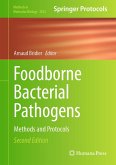
This graduate-level textbook focuses on the very latest information on the molecular and cellular mechanism of several major foodborne bacterial pathogens. For the first time this book links foodborne illness and immunology. It also covers virulence genes and their regulation in the host or the food environment, pathogenicity testing models, clinical symptoms and prevention and control strategies. A prerequisite to understanding the disease process is an understanding of the role of the immune system in that process. Thus, unlike other textbooks this one also covers the host/parasite…mehr
This graduate-level textbook focuses on the very latest information on the molecular and cellular mechanism of several major foodborne bacterial pathogens. For the first time this book links foodborne illness and immunology. It also covers virulence genes and their regulation in the host or the food environment, pathogenicity testing models, clinical symptoms and prevention and control strategies. A prerequisite to understanding the disease process is an understanding of the role of the immune system in that process. Thus, unlike other textbooks this one also covers the host/parasite interaction to a level where readers have a real appreciation of the disease mechanism. Now, more food microbiology training courses have begun to emphasize the importance of basic research and its power to solve practical problems. Thus it is imperative to acquire a better understanding of foodborne pathogens. And this is what this brilliant and timely contribution to the subject offers.
Dieser Download kann aus rechtlichen Gründen nur mit Rechnungsadresse in A, B, BG, CY, CZ, D, DK, EW, E, FIN, F, GR, HR, H, IRL, I, LT, L, LR, M, NL, PL, P, R, S, SLO, SK ausgeliefert werden.
Die Herstellerinformationen sind derzeit nicht verfügbar.
Autorenporträt
Arun K. Bhunia, B.V.Sc., Ph.D., is a professor of molecular food microbiology in the Department of Food Science at Purdue University, West Lafayette, Indiana. Prof. Bhunia received his PhD from University of Wyoming. He received his Bachelor of Veterinary Medicine degree from Bidhan Chandra Krishi Viswa Vidyalaya (currently West Bengal University of Fishery and Animal Sciences), West Bengal, India. He received his postdoctoral training from University of Arkansas, Fayetteville, AR, in 1994 and then joined Alabama A&M University as an Assistant Professor in 1995. In 1998, he joined the Department of Food Science at Purdue University. He teaches two graduate level courses: Microbial Foodborne Pathogen - this course deals with mechanism of pathogenesis of foodborne pathogens and toxins and the host immune response to infections. Microbial Techniques for Food Pathogen is a laboratory course that incorporates rapid methods employing immunoassays, genetic and biosensor tools. In addition, he co-directs a graduate level seminar course - "Gut Microbiology Journal Club. He conducts research in the area of foodborne pathogens with major emphasis on pathogen detection utilizing biosensor, cell-based sensor, immunosensor, immunoassays and genetic tools. The primary target organisms are Listeriamonocytogenes, Escherichia coli, Salmonella, and Bacillus cereus. In addition, he conducts research to investigate pathogenic mechanism especially the intestinal phase of infection for Listeria monocytogenes. He is also involved in developing mammalian cell culture-based rapid assays for foodborne pathogens. His research has been funded by grants from US Department of Agriculture, National Science Foundation, and Center for Food Safety Engineering at Purdue University.
To date, Prof. Bhunia has published 86 refereed and 21 proceedings articles, coauthored a text book "Fundamental Food Microbiology,4th Edition, CRC Press, and co-edited two books (Foodborne Pathogens: Microbiology and Molecular Biology, 2005; Caister Academic Press, and The Science of Homeland Security, 2006, Purdue University Press). He has written eight book chapters, and presented over 100 presentations in national and international meetings or institutions. He is a member of American Association for the Advancement of Science, American Society for Microbiology, Institute of Food Technologists, and Society for Photo Optical Engineers, and he currently serves as editorial board member for two refereed journals; Journal of Food Protection, Journal of Food, Agriculture and Environment. In 2003, Prof. Bhunia received a prestigious Purdue Agricultural Research Award, in 2005, he was selected as University Faculty Scholar and his research team received "2006 Agriculture Team Award" from Purdue University.
Inhaltsangabe
to Foodborne Pathogens.- Biology of Microbes Associated with Food.- Host Defense Against Foodborne Pathogens.- General Mechanism of Pathogenesis for Foodborne Pathogens.- Animal and Cell Culture Models to Study Foodborne Pathogen Interaction.- Staphylococcus aureus.- Bacillus cereus and Bacillus anthracis.- Clostridium botulinum and Clostridium perfringens.- Listeria monocytogenes.- Escherichia coli.- Salmonella enterica.- Campylobacter and Arcobacter.- Yersinia enterocolitica and Yersinia pestis.- Vibrio cholerae, V. parahaemolyticus, V. vulnificus.- Shigella species.
to Foodborne Pathogens.- Biology of Microbes Associated with Food.- Host Defense Against Foodborne Pathogens.- General Mechanism of Pathogenesis for Foodborne Pathogens.- Animal and Cell Culture Models to Study Foodborne Pathogen Interaction.- Staphylococcus aureus.- Bacillus cereus and Bacillus anthracis.- Clostridium botulinum and Clostridium perfringens.- Listeria monocytogenes.- Escherichia coli.- Salmonella enterica.- Campylobacter and Arcobacter.- Yersinia enterocolitica and Yersinia pestis.- Vibrio cholerae, V. parahaemolyticus, V. vulnificus.- Shigella species.
Rezensionen
From the reviews: "A well-organized work covering a variety of foodborne microorganisms. ... Figures and tables are used well throughout the book to illustrate topics, and references are included at the end of each chapter. Readers without a thorough knowledge of immunology and microbiology will find this a useful resource, as the author provides enough information for them to understand the concepts presented. Summing Up: Recommended. General readers; lower-division undergraduates." (P. M. Watt, CHOICE, Vol. 45 (11), August, 2008)
Es gelten unsere Allgemeinen Geschäftsbedingungen: www.buecher.de/agb
Impressum
www.buecher.de ist ein Internetauftritt der buecher.de internetstores GmbH
Geschäftsführung: Monica Sawhney | Roland Kölbl | Günter Hilger
Sitz der Gesellschaft: Batheyer Straße 115 - 117, 58099 Hagen
Postanschrift: Bürgermeister-Wegele-Str. 12, 86167 Augsburg
Amtsgericht Hagen HRB 13257
Steuernummer: 321/5800/1497
USt-IdNr: DE450055826