0,00 €
inkl. MwSt.
Sofort per Download lieferbar
0 °P sammeln

Andere Kunden interessierten sich auch für
") Force Short of War in Modern Conflict (eBook, ePUB)22,95 €
Force Short of War in Modern Conflict (eBook, ePUB)22,95 €") Settler Military Politics (eBook, PDF)65,95 €
Settler Military Politics (eBook, PDF)65,95 €") Reluctant Remilitarisation (eBook, PDF)65,95 €
Reluctant Remilitarisation (eBook, PDF)65,95 €") Mobilising China's One-Child Generation (eBook, PDF)65,95 €
Mobilising China's One-Child Generation (eBook, PDF)65,95 €") Resisting Militarism (eBook, PDF)0,00 €
Resisting Militarism (eBook, PDF)0,00 €") United States and the Iranian Nuclear Programme (eBook, PDF)0,00 €
United States and the Iranian Nuclear Programme (eBook, PDF)0,00 €") Practical Turn in Political Theory (eBook, PDF)0,00 €
Practical Turn in Political Theory (eBook, PDF)0,00 €





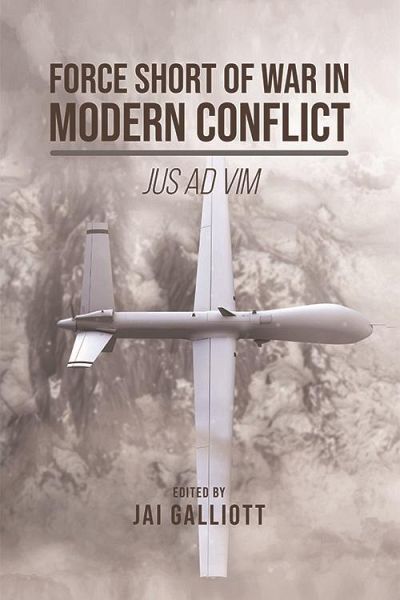
Provides a new analysis for bringing the rules of war into alignment with contemporary means of warfare
These essays explore the overarching phenomenon of how force short of war is being used in modern conflict, and how it impacts just war theory. They show that we need to bring the rules of war into alignment with increasingly digital means of conducting kinetic warfare through the force short of war paradigm.
The use of force short of war is now commonplace, in large part owing to casualty averseness and the explosion of emerging technologies, most notably drones, autonomous robotics and cyberwarfare. It often involves the selective or limited use of military force to achieve political objectives and assumes many forms. These include targeted killing, assassination, special-forces raids, limited duration bombing campaigns or missile strikes, and ''low intensity'' counterterrorism and counterinsurgency operations.
Key Features
Contributors
Eamon Aloyo, Lecturer at Leiden University and Senior Researcher at The Hague Institute of Global Justice.
Christian Braun, Research Fellow in Philosophy at Durham Univeristy.
Megan Braun, a Rhodes Scholar pursuing International Relations at Oxford University.
Daniel Brunstetter, Associate Professor of Political Science at the University of California, Irvine.
Helen Frowe, Professor of Practical Philosophy and Director of the Stockholm Centre for the Ethics of War and Peace.
Cassitie Galliott, PhD candidate at the Monash University.
Jai Galliott, Research Group Leader - Values in Defence & Security Technology at the University of New South Wales at the Australian Defence Force Academy and Visiting Fellow at Centre for Technology and Global Affairs in the Department of Politics and International Relations at Oxford University.
James Gillcrist, Researcher in the Department of Philosophy at The University of Kansas.
Shawn Kaplan, Associate Professor and Chair of Philosophy at Adelphi University.
Christopher Ketcham, Research Fellow in the Values in Defence & Security Technology Group at the University of New South Wales at the Australian Defence Force Academy.
John Lango, Emeritus Professor of Philosophy at Hunter College, City University of New York.
Nick Lloyd, Reader in Military and Imperial History at Kings College, London.
Danielle Lupton, Assistant Professor of Political Science at Colgate University.
Seumas Miller, Professorial Research Fellow at Charles Sturt University and the 3TU Centre for Ethics and Technology at Delft University of Technology, The Hague.
Valerie Morkevicius, Associate Professor of Political Science at Colgate University.
Dieser Download kann aus rechtlichen Gründen nur mit Rechnungsadresse in A, B, BG, CY, CZ, D, DK, EW, E, FIN, F, GR, HR, H, IRL, I, LT, L, LR, M, NL, PL, P, R, S, SLO, SK ausgeliefert werden.