49,95 €
49,95 €
inkl. MwSt.
Sofort per Download lieferbar

25 °P sammeln
49,95 €
Als Download kaufen
49,95 €
inkl. MwSt.
Sofort per Download lieferbar
25 °P sammeln
Jetzt verschenken
Alle Infos zum eBook verschenken
49,95 €
inkl. MwSt.
Sofort per Download lieferbar
Alle Infos zum eBook verschenken
25 °P sammeln

Andere Kunden interessierten sich auch für
") Sustainable Intensification of Agriculture (eBook, PDF)39,95 €
Sustainable Intensification of Agriculture (eBook, PDF)39,95 €") Coffee Agroecology (eBook, PDF)51,95 €
Coffee Agroecology (eBook, PDF)51,95 €") UNESCO Biosphere Reserves (eBook, PDF)49,95 €
UNESCO Biosphere Reserves (eBook, PDF)49,95 €") The Rise and Fall of Countryside Management (eBook, PDF)49,95 €
The Rise and Fall of Countryside Management (eBook, PDF)49,95 €") Forgotten Agricultural Heritage (eBook, ePUB)49,95 €
Forgotten Agricultural Heritage (eBook, ePUB)49,95 €") Peatlands (eBook, PDF)39,95 €
Peatlands (eBook, PDF)39,95 €") Ecological Sustainability for Non-timber Forest Products (eBook, PDF)45,95 €
Ecological Sustainability for Non-timber Forest Products (eBook, PDF)45,95 €
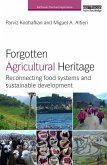

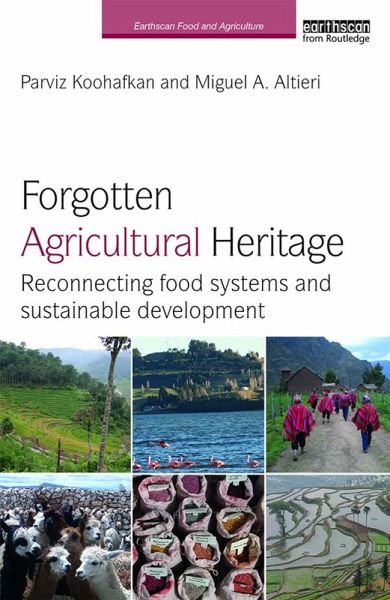
Contemporary agriculture is often criticized for its industrial scale, adverse effects on nutrition, rural employment and the environment, and its disconnectedness from nature and culture. Yet there are many examples of traditional smaller scale systems that have survived the test of time and provide more sustainable solutions while still maintaining food security in an era of climate change. This book provides a unique compilation of this forgotten agricultural heritage and is based on objective scientific evaluation and evidence of the value of these systems for present and future generations.
The authors refer to many of these systems as Globally Important Agricultural Heritage Systems (GIAHS) and show how they are related to the concepts of heritage and the World Heritage Convention. They demonstrate how GIAHS based on family farms, traditional indigenous knowledge and agroecological principles can contribute to food and nutrition security and the maintenance of agro-biodiversity and environmental resilience, as well as sustain local cultures, economies and societies.
Two substantial chapters are devoted to descriptions and assessments of some 50 examples of designated and potential GIAHS from around the world, including rice-fish culture in China, mountain terrace systems in Asia, coffee agroforestry in Latin America, irrigation systems and land and water management in Iran and India, pastoralism in East Africa, and the dehesa agrosilvopastoral system of Spain and Portugal. The book concludes by providing policy and technical solutions for sustainable agriculture and rural development through the enhancement of these systems.
The authors refer to many of these systems as Globally Important Agricultural Heritage Systems (GIAHS) and show how they are related to the concepts of heritage and the World Heritage Convention. They demonstrate how GIAHS based on family farms, traditional indigenous knowledge and agroecological principles can contribute to food and nutrition security and the maintenance of agro-biodiversity and environmental resilience, as well as sustain local cultures, economies and societies.
Two substantial chapters are devoted to descriptions and assessments of some 50 examples of designated and potential GIAHS from around the world, including rice-fish culture in China, mountain terrace systems in Asia, coffee agroforestry in Latin America, irrigation systems and land and water management in Iran and India, pastoralism in East Africa, and the dehesa agrosilvopastoral system of Spain and Portugal. The book concludes by providing policy and technical solutions for sustainable agriculture and rural development through the enhancement of these systems.
Dieser Download kann aus rechtlichen Gründen nur mit Rechnungsadresse in A, B, BG, CY, CZ, D, DK, EW, E, FIN, F, GR, HR, H, IRL, I, LT, L, LR, M, NL, PL, P, R, S, SLO, SK ausgeliefert werden.