22,95 €
inkl. MwSt.
Sofort per Download lieferbar
11 °P sammeln

Andere Kunden interessierten sich auch für
") The Invention of Party Politics (eBook, ePUB)22,95 €
The Invention of Party Politics (eBook, ePUB)22,95 €") The American State Constitutional Tradition (eBook, ePUB)28,95 €
The American State Constitutional Tradition (eBook, ePUB)28,95 €") Democratic Beginnings (eBook, ePUB)22,95 €
Democratic Beginnings (eBook, ePUB)22,95 €") American Government (eBook, ePUB)39,95 €
American Government (eBook, ePUB)39,95 €") American Government (eBook, ePUB)62,95 €
American Government (eBook, ePUB)62,95 €") The Struggle and the Urban South (eBook, ePUB)24,95 €
The Struggle and the Urban South (eBook, ePUB)24,95 €") The Supreme Court and the American Elite, 1789-2020 (eBook, ePUB)31,95 €
The Supreme Court and the American Elite, 1789-2020 (eBook, ePUB)31,95 €







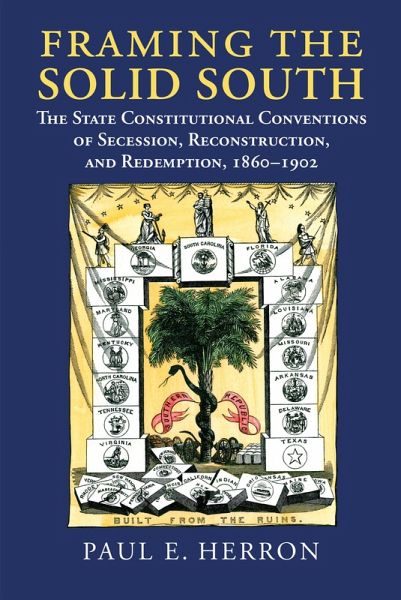
The South was not always the South. In the eighteenth and early nineteenth centuries, those below the Potomac River, for all their cultural and economic similarities, did not hold a separate political identity. How this changed, and how the South came to be a political entity that coheres to this day, emerges clearly in this bookthe first comprehensive account of the Civil War Era and late nineteenth century state constitutional conventions that forever transformed southern politics.
From 1860 to the turn of the twentieth century, southerners in eleven states gathered forty-four times to revise their constitutions. Framing the Solid South traces the consolidation of the southern states through these conventions in three waves of development: Secession, Reconstruction, and Redemption. Secession conventions, Paul Herron finds, did much more than dissolve the Union; they acted in concert to raise armies, write law, elect delegates to write a Confederate Constitution, ratify that constitution, and rewrite state constitutions. During Reconstruction, the national government forced the southern states to write and rewrite constitutions to permit re-entry into the Unionrecognizing federal supremacy, granting voting rights to African Americans, enshrining a right to public education, and opening the political system to broader participation. Black southerners were essential participants in democratizing the region and reconsidering the nature of federalism in light of the devastation brought by proponents of states' rights and sovereignty. Many of the changes by the postwar conventions, Herron shows, were undermined if not outright abolished in the following period, as Redeemers enshrined a system of weak states, the rule of a white elite, and the suppression of black rights. Southern constitution makers in all three waves were connected to each other and to previous conventions unlike any others in American history. These connections affected the content of the fundamental law and political development in the region.
Southern politics, to an unusual degree, has been a product of the process Herron traces. What his book tells us about these constitutional conventions and the documents they produced is key to understanding southern history and the South today.
From 1860 to the turn of the twentieth century, southerners in eleven states gathered forty-four times to revise their constitutions. Framing the Solid South traces the consolidation of the southern states through these conventions in three waves of development: Secession, Reconstruction, and Redemption. Secession conventions, Paul Herron finds, did much more than dissolve the Union; they acted in concert to raise armies, write law, elect delegates to write a Confederate Constitution, ratify that constitution, and rewrite state constitutions. During Reconstruction, the national government forced the southern states to write and rewrite constitutions to permit re-entry into the Unionrecognizing federal supremacy, granting voting rights to African Americans, enshrining a right to public education, and opening the political system to broader participation. Black southerners were essential participants in democratizing the region and reconsidering the nature of federalism in light of the devastation brought by proponents of states' rights and sovereignty. Many of the changes by the postwar conventions, Herron shows, were undermined if not outright abolished in the following period, as Redeemers enshrined a system of weak states, the rule of a white elite, and the suppression of black rights. Southern constitution makers in all three waves were connected to each other and to previous conventions unlike any others in American history. These connections affected the content of the fundamental law and political development in the region.
Southern politics, to an unusual degree, has been a product of the process Herron traces. What his book tells us about these constitutional conventions and the documents they produced is key to understanding southern history and the South today.
Dieser Download kann aus rechtlichen Gründen nur mit Rechnungsadresse in A, D ausgeliefert werden.