16th International Conference on Simulation of Adaptive Behavior, SAB 2022, Cergy-Pontoise, France, September 20-23, 2022, Proceedings Redaktion: Cañamero, Lola; Cuperlier, Nicolas; Boucenna, Sofiane; Wilson, Myra; Gaussier, Philippe
16th International Conference on Simulation of Adaptive Behavior, SAB 2022, Cergy-Pontoise, France, September 20-23, 2022, Proceedings Redaktion: Cañamero, Lola; Cuperlier, Nicolas; Boucenna, Sofiane; Wilson, Myra; Gaussier, Philippe
Sie sind bereits eingeloggt. Klicken Sie auf 2. tolino select Abo, um fortzufahren.
Bitte loggen Sie sich zunächst in Ihr Kundenkonto ein oder registrieren Sie sich bei bücher.de, um das eBook-Abo tolino select nutzen zu können.
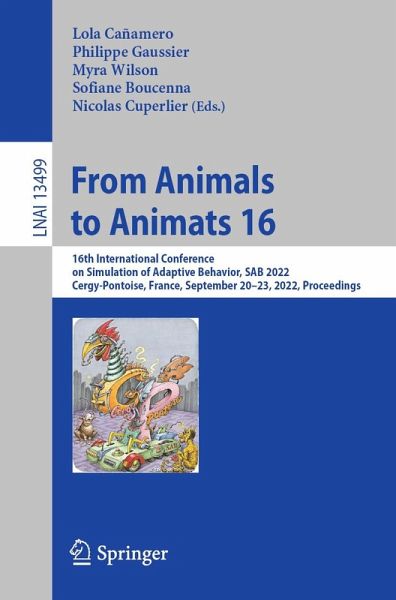
This book constitutes the refereed proceedings of the 16th International Conference on Simulation of Adaptive Behavior, SAB 2022, held in Cergy-Pontoise, France, in September 2022. The 17 papers presented in this volume were carefully reviewed and selected from 23 submissions. They were organized in topical sections as follows: Embodiment; Brain-Inspired Control, Adaptation, and Learning; Bio-inspired Vision and navigation; Affective and Social Cognition and Collective Intelligence.
This book constitutes the refereed proceedings of the 16th International Conference on Simulation of Adaptive Behavior, SAB 2022, held in Cergy-Pontoise, France, in September 2022.
The 17 papers presented in this volume were carefully reviewed and selected from 23 submissions. They were organized in topical sections as follows: Embodiment; Brain-Inspired Control, Adaptation, and Learning; Bio-inspired Vision and navigation; Affective and Social Cognition and Collective Intelligence.
Dieser Download kann aus rechtlichen Gründen nur mit Rechnungsadresse in A, B, BG, CY, CZ, D, DK, EW, E, FIN, F, GR, HR, H, IRL, I, LT, L, LR, M, NL, PL, P, R, S, SLO, SK ausgeliefert werden.
Die Herstellerinformationen sind derzeit nicht verfügbar.
Inhaltsangabe
Embodiment.- How to Design Morphologies. A Design Process for Autonomous Robots.- Exploring sensitization in the context of extending the behavior of an artificial agent.- Investigating a Minimal Categorical Perception Task with a Node-Based Sensorimotor Map.- Deep Gaussian Processes for Angle and Position Discrimination in Active Touch Sensing.- Neural Body Bending Control with Temporal Delays for Millipede-Like Turning Behaviour of a Multi-Segmented, Legged Robot.- Brain-Inspired Control, Adaptation, and Learning.- Yoking-Based Identification of Learning Behavior in Artificial and Biological Agents.- Is free energy an organizational principle in spiking neural networks?.- Create Efficient and Complex Reservoir Computing Architectures with ReservoirPy.- Adaptive Inhibition for Optimal Energy Consumption by Animals, Robots and Neurocomputers.- Adapting to Environment Changes through Neuromodulation of Reinforcement Learning.- Multi-task learning with modular reinforcement learning.- Bio-inspired Vision and navigation.- Same/different concept: an embodied spiking neural model in a learning context.- Sparse and topological coding for visual localisation of autonomous vehicles.- Contribution of the retrosplenial cortex to path integration signatures and spatial codes.- Flexible Path Planning in a Spiking Model of Replay and VicariousTrial and Error.- Affective and Social Cognition and Collective Intelligence.- Impact of the Update Time on the Aggregation of Robotic Swarms through Informed Robots.- On the Adaptive Value of Mood and Mood Contagion.
Embodiment.- How to Design Morphologies. A Design Process for Autonomous Robots.- Exploring sensitization in the context of extending the behavior of an artificial agent.- Investigating a Minimal Categorical Perception Task with a Node-Based Sensorimotor Map.- Deep Gaussian Processes for Angle and Position Discrimination in Active Touch Sensing.- Neural Body Bending Control with Temporal Delays for Millipede-Like Turning Behaviour of a Multi-Segmented, Legged Robot.- Brain-Inspired Control, Adaptation, and Learning.- Yoking-Based Identification of Learning Behavior in Artificial and Biological Agents.- Is free energy an organizational principle in spiking neural networks?.- Create Efficient and Complex Reservoir Computing Architectures with ReservoirPy.- Adaptive Inhibition for Optimal Energy Consumption by Animals, Robots and Neurocomputers.- Adapting to Environment Changes through Neuromodulation of Reinforcement Learning.- Multi-task learning with modular reinforcement learning.- Bio-inspired Vision and navigation.- Same/different concept: an embodied spiking neural model in a learning context.- Sparse and topological coding for visual localisation of autonomous vehicles.- Contribution of the retrosplenial cortex to path integration signatures and spatial codes.- Flexible Path Planning in a Spiking Model of Replay and VicariousTrial and Error.- Affective and Social Cognition and Collective Intelligence.- Impact of the Update Time on the Aggregation of Robotic Swarms through Informed Robots.- On the Adaptive Value of Mood and Mood Contagion.
Es gelten unsere Allgemeinen Geschäftsbedingungen: www.buecher.de/agb
Impressum
www.buecher.de ist ein Internetauftritt der buecher.de internetstores GmbH
Geschäftsführung: Monica Sawhney | Roland Kölbl | Günter Hilger
Sitz der Gesellschaft: Batheyer Straße 115 - 117, 58099 Hagen
Postanschrift: Bürgermeister-Wegele-Str. 12, 86167 Augsburg
Amtsgericht Hagen HRB 13257
Steuernummer: 321/5800/1497
USt-IdNr: DE450055826