Sie sind bereits eingeloggt. Klicken Sie auf 2. tolino select Abo, um fortzufahren.
Bitte loggen Sie sich zunächst in Ihr Kundenkonto ein oder registrieren Sie sich bei bücher.de, um das eBook-Abo tolino select nutzen zu können.
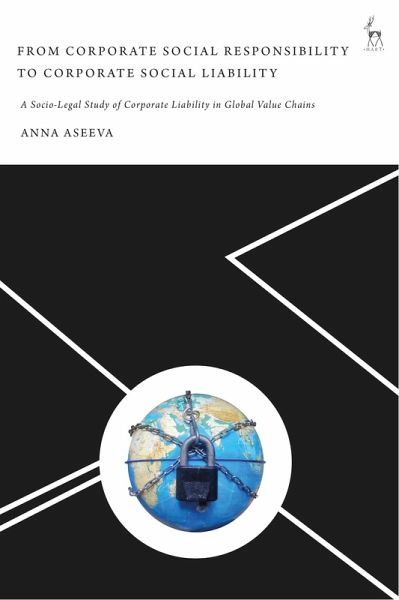
This book provides a critical socio-legal study that brings together the latest scholarly advances on corporate social responsibility, and, at the same time, addresses the pressing issue of corporate liability for harmful acts across the supply and production chains. Corporations have seldom been held responsible and virtually never liable for the acts of their subsidiaries and subcontractors. Actors as different as workers, investors, individual consumers, and shareholder activists claim that corporations should accept greater responsibility for communities and environments affected by their…mehr
This book provides a critical socio-legal study that brings together the latest scholarly advances on corporate social responsibility, and, at the same time, addresses the pressing issue of corporate liability for harmful acts across the supply and production chains. Corporations have seldom been held responsible and virtually never liable for the acts of their subsidiaries and subcontractors. Actors as different as workers, investors, individual consumers, and shareholder activists claim that corporations should accept greater responsibility for communities and environments affected by their activities. The book argues that a global value chain's head corporations remain immune to any liability because of the 'economically dependent-legally independent' relationships between core corporations and their periphery suppliers and subcontractors. To tackle this problem, globally, the author acknowledges that 'we' as a society need to reduce the economic dependence as described above - which is far too excessive - by ensuring a level playing field both economically and socially. More concretely, she argues that in order to realise transnational corporate liability, 'we' as lawyers need to find a way (or ways) to establish legally effective relationships between head corporations and their economically dependent entities. Readers of this book will be able to export the concept of corporate social liability, developed in the context of value chains, and apply it to other contexts involving corporate activities where they need to tackle unrestrained corporate freedom and make global businesses responsible and socially useful.
Die Herstellerinformationen sind derzeit nicht verfügbar.
Autorenporträt
Anna Aseeva is Assistant Professor at the Faculty of Law and Administration at Lazarski University, Warsaw.
Inhaltsangabe
PART I ON THE LIMITS OF LAW AND A LIMITLESS GLOBALISED MARKET 1. Introduction I. Meet Corporate Social Liability II. Why Corporate Social Liability? III. What does Corporate Social Liability Cover? IV. The Book's Approach and Methods V. Structure of the Book 2. Setting the Stage: Corporate Responsibility in Context I. The Corporate Responsibility Debate in its Historical Context II. Ideational Context: The Impact of the Washington Consensus III. Economic Context: Centre, Semi-Periphery and Periphery of Global Value Chains IV. Organisational Context: Global Value Chain Governance V. Social Context: CSR Standards for and within Global Value Chains VI. The Advent of International Standards VII. The Many Shades of Voluntary Standards and Corporate Self-Regulation VIII. The Rise and Fall of CSR PART II THE SHORTCOMINGS OF CORPORATE RESPONSIBILITY AND OBSTACLES TO CORPORATE LIABILITY 3. National Law: Shades of Publicness in Private Regulation I. Corporate Law II. Tort Law and Contract Law III. Commercial Law 4. Post-national Law: Mandatory Disclosure, Environmental and Human Rights Due Diligence, and Supply Chain Liability I. Supranational Law II. International Law PART III CORPORATE LIABILITY IN THEORY AND PRACTICE: RECENT APPROACHES AND AN INTRODUCTION TO CORPORATE SOCIAL LIABILITY 5. Corporate Liability in International Comparison 9 I. Legislative Landscape II. Litigation Landscape 6. Analysis of Avenues for Corporate Social Liability in Global Value Chains I. Common Criteria for Founding Liability: An Overview II. Further Criteria for Founding Liability: Various Relevant Practices III. Conceptual Prospects for Corporate Social Liability in Global Value Chains PART IV PITFALLS AND THE FUTURE OF CORPORATE SOCIAL LIABILITY IN GLOBAL VALUE CHAINS 7. Liability through Judicialisation, Legalisation, and Alternative Dispute Settlement I. General Direct Liability II. A(n) (Im)Possibility of Judicial Assertiveness: A General Duty of Care for Global Value Chains III. Legalisation through Legislation: Liability Disciplines in Current French and Dutch Law IV. Transnational CSL Legalisation: Bangladesh Accord and Bangladesh Alliance V. Alternative Dispute Resolution through International Investment Arbitration VI. Enforcing Corporate Social Liability ex ante 8. The Reality and Prospects of European and International Law of Corporate Liability in Global Value Chains I. European Law II. International Business and Human Rights Framework: Guiding or Binding the Global Business? 9. On the Gap-filling Corporate Social Liability (and its Gaps) I. The Pitfalls of International Arbitration for Realising Transnational CSL II. The Limits and Opportunities of the Interface of Domestic Private Law with Public International Law III. Whither Corporate Social Liability? Conclusion: Where Do We Stand and Is There a Way Forward? I. Where Do We Stand? 3 II. The Way Forward III. Final Concluding Remarks
Es gelten unsere Allgemeinen Geschäftsbedingungen: www.buecher.de/agb
Impressum
www.buecher.de ist ein Internetauftritt der buecher.de internetstores GmbH
Geschäftsführung: Monica Sawhney | Roland Kölbl | Günter Hilger
Sitz der Gesellschaft: Batheyer Straße 115 - 117, 58099 Hagen
Postanschrift: Bürgermeister-Wegele-Str. 12, 86167 Augsburg
Amtsgericht Hagen HRB 13257
Steuernummer: 321/5800/1497
USt-IdNr: DE450055826