0,00 €
0,00 €
inkl. MwSt.
Erscheint vor. 15.12.25

0 °P sammeln
0,00 €
Als Download kaufen
0,00 €
inkl. MwSt.
Erscheint vor. 15.12.25
0 °P sammeln
Jetzt verschenken
Alle Infos zum eBook verschenken
0,00 €
inkl. MwSt.
Erscheint vor. 15.12.25
Alle Infos zum eBook verschenken
0 °P sammeln

Andere Kunden interessierten sich auch für
") Die deutschen Dominikaner und Dominikanerinnen im Mittelalter (eBook, ePUB)139,95 €
Die deutschen Dominikaner und Dominikanerinnen im Mittelalter (eBook, ePUB)139,95 €") Excelling Wisdom (eBook, ePUB)3,99 €
Excelling Wisdom (eBook, ePUB)3,99 €") Promise of the Eternal Covenant (eBook, ePUB)6,99 €
Promise of the Eternal Covenant (eBook, ePUB)6,99 €") Franziskus von Assisi (eBook, ePUB)8,99 €
Franziskus von Assisi (eBook, ePUB)8,99 €") The Book of Margery Kempe (eBook, ePUB)9,49 €
The Book of Margery Kempe (eBook, ePUB)9,49 €") Thomas à Kempis (eBook, ePUB)13,95 €
Thomas à Kempis (eBook, ePUB)13,95 €") Glory to the Three Eternal (eBook, ePUB)18,95 €
Glory to the Three Eternal (eBook, ePUB)18,95 €





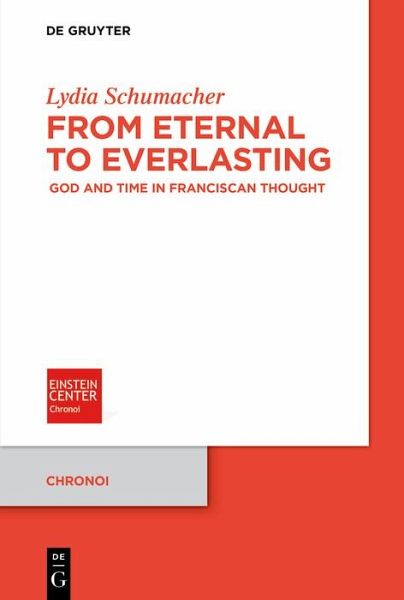
The Middle Ages witnessed a shift in thinking about the way God is related to time. For most of the earlier Middle Ages, scholars had followed an earlier patristic tradition of describing God as eternal and thus as timeless or outside of time. In the early thirteenth century, however, members of the Franciscan order, who played a significant role in the development of the recently-founded universities, re-defined God's relationship to time in terms of his everlastingness. On their account, God is infinite in temporal duration, rather than simply 'timeless', since he has no beginning and no end. So construed, God encompasses and is able to relate to every moment in time in a way that the Franciscans believed was not possible on the eternalist account. This book will discuss some of the factors that contributed to their shift in thinking about God as everlasting instead of eternal. Among these, the book will identity a transition in defining the basic nature of God as either simple (for proponents of eternity) or infinite (for proponents of everlastingness) as well as the Franciscan adoption of the metaphysics of the eleventh-century Islamic philosopher, Avicenna.
Dieser Download kann aus rechtlichen Gründen nur mit Rechnungsadresse in A, B, BG, CY, CZ, D, DK, EW, E, FIN, F, GR, HR, H, IRL, I, LT, L, LR, M, NL, PL, P, R, S, SLO, SK ausgeliefert werden.