39,95 €
39,95 €
inkl. MwSt.
Sofort per Download lieferbar

20 °P sammeln
39,95 €
Als Download kaufen
39,95 €
inkl. MwSt.
Sofort per Download lieferbar
20 °P sammeln
Jetzt verschenken
Alle Infos zum eBook verschenken
39,95 €
inkl. MwSt.
Sofort per Download lieferbar
Alle Infos zum eBook verschenken
20 °P sammeln

Andere Kunden interessierten sich auch für
") From Narcissism to Nihilism (eBook, PDF)39,95 €
From Narcissism to Nihilism (eBook, PDF)39,95 €") Shakespeare, the Renaissance and Empire (eBook, ePUB)38,95 €
Shakespeare, the Renaissance and Empire (eBook, ePUB)38,95 €") Elizabethan Popular Theatre (eBook, ePUB)55,95 €
Elizabethan Popular Theatre (eBook, ePUB)55,95 €") Male-to-Female Crossdressing in Early Modern English Literature (eBook, ePUB)46,95 €
Male-to-Female Crossdressing in Early Modern English Literature (eBook, ePUB)46,95 €") Commentary on Shakespeare's Richard III (eBook, ePUB)45,95 €
Commentary on Shakespeare's Richard III (eBook, ePUB)45,95 €") The Uses of the Future in Early Modern Europe (eBook, ePUB)56,95 €
The Uses of the Future in Early Modern Europe (eBook, ePUB)56,95 €") Colorblind Shakespeare (eBook, ePUB)44,95 €
Colorblind Shakespeare (eBook, ePUB)44,95 €




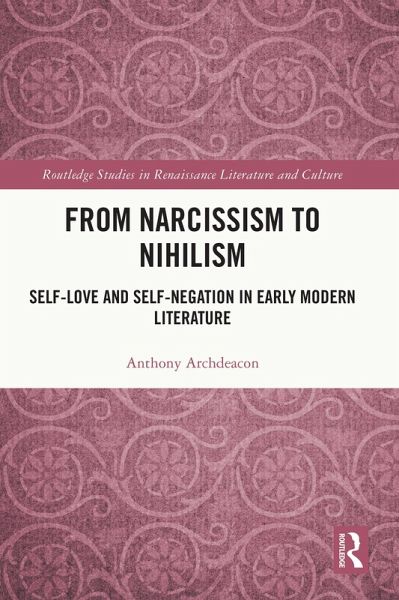
This book explores how the myth of Narcissus, which is at once about self-love and self-destruction, desire and death, beauty and pain, became an ambivalent symbol of humanistic endeavour, and articulated the conflicts of early modern authorship.
In early modern literature, there were expressions of humanistic self-congratulation that sometimes verged on narcissism, and at the same time expressions of self-doubt and anxiety that verged on nihilism. The themes of self-love and self-negation had a long history in western thought, and this book shows how the medieval treatments of the themes developed into something distinctive in the sixteenth century. The two themes, either individually or combined, encompass such topics as poverty, unrequited love, transgressive sexuality, sexual violence, suicidality, self-worth, authorship, religious penitence, martyrdom, courtly ambition and tyranny.
Archdeacon uses over 100 texts from the sixteenth and early seventeenth centuries to show how the early modern writer existed in a culture of contrary forces pulling towards either self-affirmation or self-erasure. Writers attempted to negotiate between the polarised extremes of self-love and self-negation, realising that they are fundamental to how we respond to each other, our selves and the world.
In early modern literature, there were expressions of humanistic self-congratulation that sometimes verged on narcissism, and at the same time expressions of self-doubt and anxiety that verged on nihilism. The themes of self-love and self-negation had a long history in western thought, and this book shows how the medieval treatments of the themes developed into something distinctive in the sixteenth century. The two themes, either individually or combined, encompass such topics as poverty, unrequited love, transgressive sexuality, sexual violence, suicidality, self-worth, authorship, religious penitence, martyrdom, courtly ambition and tyranny.
Archdeacon uses over 100 texts from the sixteenth and early seventeenth centuries to show how the early modern writer existed in a culture of contrary forces pulling towards either self-affirmation or self-erasure. Writers attempted to negotiate between the polarised extremes of self-love and self-negation, realising that they are fundamental to how we respond to each other, our selves and the world.
Dieser Download kann aus rechtlichen Gründen nur mit Rechnungsadresse in A, B, BG, CY, CZ, D, DK, EW, E, FIN, F, GR, HR, H, IRL, I, LT, L, LR, M, NL, PL, P, R, S, SLO, SK ausgeliefert werden.