72,95 €
72,95 €
inkl. MwSt.
Sofort per Download lieferbar

36 °P sammeln
72,95 €
Als Download kaufen
72,95 €
inkl. MwSt.
Sofort per Download lieferbar
36 °P sammeln
Jetzt verschenken
Alle Infos zum eBook verschenken
72,95 €
inkl. MwSt.
Sofort per Download lieferbar
Alle Infos zum eBook verschenken
36 °P sammeln

Andere Kunden interessierten sich auch für
") Cyber-Physical Security (eBook, PDF)72,95 €
Cyber-Physical Security (eBook, PDF)72,95 €") Land and Disaster Management Strategies in Asia (eBook, PDF)88,95 €
Land and Disaster Management Strategies in Asia (eBook, PDF)88,95 €") Corporations as Custodians of the Public Good? (eBook, PDF)68,95 €
Corporations as Custodians of the Public Good? (eBook, PDF)68,95 €") Tapping the Market (eBook, PDF)72,95 €
Tapping the Market (eBook, PDF)72,95 €") Global Warming, Militarism and Nonviolence (eBook, PDF)120,95 €
Global Warming, Militarism and Nonviolence (eBook, PDF)120,95 €") Policy Network Ties in the Dynamic Process of Environmental Conflict Resolution (eBook, PDF)104,95 €
Policy Network Ties in the Dynamic Process of Environmental Conflict Resolution (eBook, PDF)104,95 €") Paradigms and Theories Influencing Policies in the South African and International Water Sectors (eBook, PDF)72,95 €
Paradigms and Theories Influencing Policies in the South African and International Water Sectors (eBook, PDF)72,95 €







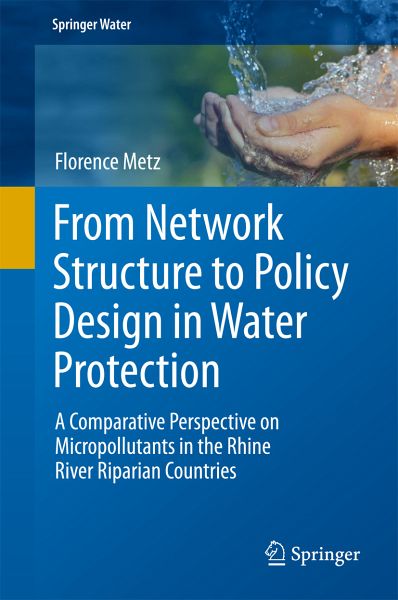
The book examines a new concern in water quality policy, namely aquatic micropollutants. Micropollutants are chemicals detected in small concentrations in waterbodies today, originating from pharmaceuticals, cosmetics, or detergents, among others. Since the regulation of micropollutants is a fairly new issue, it has been largely neglected in social sciences. However, the search for appropriate solutions is of high political relevance at both the national and international levels, with many open questions arising that concern the most adequate governance structures and steering mechanisms. Solutions suitable for classical, macro-pollutants, such as nutrients, do not necessarily apply to micropollutants because of the diversity of compounds and sources, and for technical, financial, and societal reasons. The book addresses this knowledge gap by investigating the steering mechanisms at hand and their prospect for problem solving. In this regard, the research provides a systematic depiction and comparison of policy designs in place for the reduction of micropollutants in the Rhine basin. Moreover, the study yields insights into the governance structures in place, into actors' responsibilities and constellations, and policy processes regarding micropollutants.
The study is furthermore embedded into broader theoretical questions of policy research. More precisely, this research is a contribution to policy analysis that aims to achieve more optimal policy results by providing for a better understanding of the nature of policy designs and the social mechanisms behind the choice of them. Despite the intrinsic aim of policy analysis at contributing to more optimal policy outcomes, there remains a lack of research regarding analytical tools that enable an ex-ante assessment of policy designs' problem-solving abilities. To explore such a research path, this book proposes a novel index of policy comprehensiveness for quantifying the prospective performance of policy designs in alleviating an underlying policy issue, e.g. reducing pollutants in waters.
Furthermore, the book uncovers the social mechanisms behind policymaking and turns to the question: In which social settings is it possible to achieve a comprehensive policy design? Compared to purely micro-level explanations, the advantage of the network approach is that it goes beyond the mere aggregation of policy actors' attributes by taking into consideration actors' interdependencies. In order to take the network approach seriously, the study systematically links the structure of a policy network with comprehensive policy designs. Network concepts, such as coalition structure, interconnectedness, and belief similarity, are employed from policy change research here in order to explore the link between structural network characteristics and comprehensive policy design. By studying how network structures affect policy design, the book critically examines the explanatory value of the network approach.
The study is furthermore embedded into broader theoretical questions of policy research. More precisely, this research is a contribution to policy analysis that aims to achieve more optimal policy results by providing for a better understanding of the nature of policy designs and the social mechanisms behind the choice of them. Despite the intrinsic aim of policy analysis at contributing to more optimal policy outcomes, there remains a lack of research regarding analytical tools that enable an ex-ante assessment of policy designs' problem-solving abilities. To explore such a research path, this book proposes a novel index of policy comprehensiveness for quantifying the prospective performance of policy designs in alleviating an underlying policy issue, e.g. reducing pollutants in waters.
Furthermore, the book uncovers the social mechanisms behind policymaking and turns to the question: In which social settings is it possible to achieve a comprehensive policy design? Compared to purely micro-level explanations, the advantage of the network approach is that it goes beyond the mere aggregation of policy actors' attributes by taking into consideration actors' interdependencies. In order to take the network approach seriously, the study systematically links the structure of a policy network with comprehensive policy designs. Network concepts, such as coalition structure, interconnectedness, and belief similarity, are employed from policy change research here in order to explore the link between structural network characteristics and comprehensive policy design. By studying how network structures affect policy design, the book critically examines the explanatory value of the network approach.
Dieser Download kann aus rechtlichen Gründen nur mit Rechnungsadresse in A, B, BG, CY, CZ, D, DK, EW, E, FIN, F, GR, HR, H, IRL, I, LT, L, LR, M, NL, PL, P, R, S, SLO, SK ausgeliefert werden.