25,95 €
25,95 €
inkl. MwSt.
Sofort per Download lieferbar

13 °P sammeln
25,95 €
Als Download kaufen
25,95 €
inkl. MwSt.
Sofort per Download lieferbar
13 °P sammeln
Jetzt verschenken
Alle Infos zum eBook verschenken
25,95 €
inkl. MwSt.
Sofort per Download lieferbar
Alle Infos zum eBook verschenken
13 °P sammeln

Andere Kunden interessierten sich auch für
") BCIM Economic Cooperation (eBook, ePUB)41,95 €
BCIM Economic Cooperation (eBook, ePUB)41,95 €") Economic Development and Political Action in the Arab World (eBook, ePUB)45,95 €
Economic Development and Political Action in the Arab World (eBook, ePUB)45,95 €") Reclaiming Development Studies (eBook, ePUB)29,95 €
Reclaiming Development Studies (eBook, ePUB)29,95 €") Africa's Economic Partnership with China (eBook, ePUB)39,95 €
Africa's Economic Partnership with China (eBook, ePUB)39,95 €") Displacement, Impoverishment and Exclusion (eBook, ePUB)42,95 €
Displacement, Impoverishment and Exclusion (eBook, ePUB)42,95 €") What is Economic Development? (eBook, ePUB)41,95 €
What is Economic Development? (eBook, ePUB)41,95 €") China and Sustainable Development in Latin America (eBook, ePUB)22,95 €
China and Sustainable Development in Latin America (eBook, ePUB)22,95 €




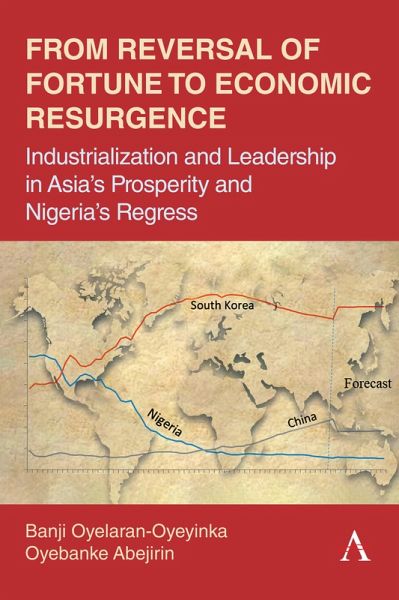
This book examines Nigeria, Africa's largest economy and most populous country, and Asia in comparative development and sectoral perspectives. We traced the divergent growth in wealth between the two regions. It takes a novel approach of matching key growth sectors across five selected Asian countries and Nigeria in a cross-regional context. We found that state and institutional capabilities underlying the generation and diffusion of industrial and technological knowledge in Asia distinguished it from Africa. We employ quantitative and qualitative methods, including case studies and statistical/econometric methods, to analyze factors that separate the sample countries that made rapid economic progress in "catching up" and those that tend to be stagnating and "falling behind."
Progress made by Asian countries over the last five decades was due in large part to their pursuit of industrialization, technological acquisition underpinned by leadership, good governance, and policies in the right institutional contexts. The four Asian countries compared with Nigeria are Indonesia, Malaysia, South Korea, Vietnam, and Bangladesh. There was not one grand development formula; however, the strategy broadly consisted of industrial (vertical) diversification as well as (horizontal) diversification in agriculture. Building industrial capabilities that enable export competitiveness was critical. Again, while leadership is not usually included in factors of growth, the book devotes a chapter to Leadership and Industrialization and another to State Capacity Industrialization and Economic Growth.
African countries on the contrary took the low road in exporting minerals and raw agricultural commodities with little value addition; in the process, Africa experienced a reversal of fortune. The African condition is manifestly a Reversal of Fortune because in the 1950s, they were ahead of, or equal to, Asia in per capita income as well as in other development metrics.
We carried out empirical measurement of Reversal of Fortune manifested in economic, social, technological, and industrial conditions by analyzing the disparities in development metrics, particularly the levels and rates of growth of national incomes, industrialization rates, and Human Development Index (HDI). The differences are stark.
Progress made by Asian countries over the last five decades was due in large part to their pursuit of industrialization, technological acquisition underpinned by leadership, good governance, and policies in the right institutional contexts. The four Asian countries compared with Nigeria are Indonesia, Malaysia, South Korea, Vietnam, and Bangladesh. There was not one grand development formula; however, the strategy broadly consisted of industrial (vertical) diversification as well as (horizontal) diversification in agriculture. Building industrial capabilities that enable export competitiveness was critical. Again, while leadership is not usually included in factors of growth, the book devotes a chapter to Leadership and Industrialization and another to State Capacity Industrialization and Economic Growth.
African countries on the contrary took the low road in exporting minerals and raw agricultural commodities with little value addition; in the process, Africa experienced a reversal of fortune. The African condition is manifestly a Reversal of Fortune because in the 1950s, they were ahead of, or equal to, Asia in per capita income as well as in other development metrics.
We carried out empirical measurement of Reversal of Fortune manifested in economic, social, technological, and industrial conditions by analyzing the disparities in development metrics, particularly the levels and rates of growth of national incomes, industrialization rates, and Human Development Index (HDI). The differences are stark.
Dieser Download kann aus rechtlichen Gründen nur mit Rechnungsadresse in A, D ausgeliefert werden.