Sie sind bereits eingeloggt. Klicken Sie auf 2. tolino select Abo, um fortzufahren.
Bitte loggen Sie sich zunächst in Ihr Kundenkonto ein oder registrieren Sie sich bei bücher.de, um das eBook-Abo tolino select nutzen zu können.
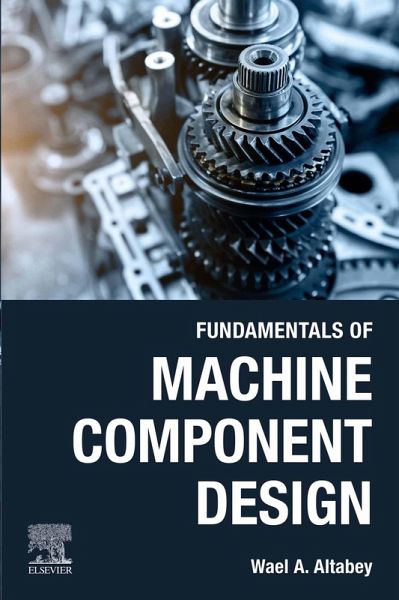
Fundamentals of Machine Component Design bridges theory and practice to provide readers with a thorough understanding of best practices for machine component design and application. Load and stress analysis, fatigue, fracture, and other mechanical behaviors that can result in the failure of a machine component are discussed in the early chapters, before the book moves onto to cover different connections (welded and bolted) prevalent in machine components, and then individual components such as gears, shafts, bearings, springs, pressure vessels, brakes, clutches, keys and couplings, and more.…mehr
Fundamentals of Machine Component Design bridges theory and practice to provide readers with a thorough understanding of best practices for machine component design and application. Load and stress analysis, fatigue, fracture, and other mechanical behaviors that can result in the failure of a machine component are discussed in the early chapters, before the book moves onto to cover different connections (welded and bolted) prevalent in machine components, and then individual components such as gears, shafts, bearings, springs, pressure vessels, brakes, clutches, keys and couplings, and more. The book ends with chapters outlining different design methods as well as design problems for readers to practice with, the solutions to which are also provided. - Covers the design of shafts, power screws, bolts, welded connections, springs, and pressure vessels, as well as transmitted power elements such as belts, chains, gears, and wire ropes - Outlines finite element methods and other techniques that can be used for effectively designing machine components - Discusses contact and sliding bearings, keys and couplings, gears (helical, spur, bevel, and worm), and more - Includes solved problems to help readers refine their skills
Dieser Download kann aus rechtlichen Gründen nur mit Rechnungsadresse in A, B, BG, CY, CZ, D, DK, EW, E, FIN, F, GR, HR, H, IRL, I, LT, L, LR, M, NL, PL, P, R, S, SLO, SK ausgeliefert werden.
Die Herstellerinformationen sind derzeit nicht verfügbar.
Autorenporträt
Prf. Wael A. Altabey is a full professor at department of Mechanical Engineering, Alexandria University, Alexandria, Egypt. Before that he was a research associate professor between 2018 to 2024 at International Institute for Urban Systems Engineering (IIUSE), Southeast University, Nanjing, China, and National and Local Joint Engineering Research Center for Basalt Fiber Production and Application Technology, Southeast University, Nanjing, Jiangsu, China, after completing a postdoctoral research fellowship for two years (2016-2018).Since 2016 his researches have focused on the utilization of Artificial Intelligence (AI) based schemes for structural health monitoring (SHM) and Non-Destructive Testing (NDT) for damage classification, detection, diagnosis, prediction, dynamic response analysis, and Reliability evaluation in composite, and steel Structures (such as aircraft, wind turbines, pipes, bridges and industrial machines) at National and Local Joint Engineering Research Center for Basalt Fiber Production and Application Technology, Southeast University, Nanjing, Jiangsu, China. This is the only national R&D platform awarded by the National Development and Reform Commission in this industry with more than 30 national authorized patents. The center's international and national awards indicators have reached international and local leading levels and filling many technical gaps in China.He participated in several research activities, which achieved from Natural Science Foundation of China (NSFC) and private sectors. He listed in Stanford List of World's Top 2% Scientists from 2020, until now. He is an IOP Associate Membership for 2025 (IOP Publishing-IOP Institute of Physics). He serves on various technical committees in several international conferences and workshops, guest editor of special Issues in several international scientific journals and on the editorial board of several international scientific journals in the field of artificial intelligence, mechanical, materials, and civil engineering. He a peer reviewer of more than 163 international scientific journals, He is an Organizing Member in several international scientific Centers includes members of professors, researchers, and students in mechanical, civil, electrical, chemical, and computer engineering, from nearly all continents (USA, UK, Japan, Egypt, Italy, China, Australia, Canada, Iran, Pakistan, Switzerland) to find and promote engineering solutions to help humanity overcome the continuing challenge of resilient seismic safety and to prevent earthquake disasters. He has a several individual international collaboration with several high talent researchers from different countries at USA, Europe and Asia. About his research, he is an author and co-author of more than 150 high impact journal papers, 60 scientific conference papers and 60 chapters, more than 10 academic and research books, more three patent and copyrights in the field of Artificial Intelligence based schemes for structural health monitoring, and delivered over 60 invited talks. His research interests: Smart and Nanomaterials; Composite Structures; Structural Health Monitoring (SHM); Artificial Intelligence (AI); Non-Destructive Testing (NDT); Digital Twins Model of Structural Behavior, System Identification; Damage Detection: Vibration-Based Techniques; Fiber Optical Sensing Technique, Structural Control; Structural Resilience and Reliability, Hysteretic Systems, Micro/Nano Electro Mechanical Systems (MEMS/ NEMS), and Energy Harvesting Model for Self-Powered Sensors.
Es gelten unsere Allgemeinen Geschäftsbedingungen: www.buecher.de/agb
Impressum
www.buecher.de ist ein Internetauftritt der buecher.de internetstores GmbH
Geschäftsführung: Monica Sawhney | Roland Kölbl | Günter Hilger
Sitz der Gesellschaft: Batheyer Straße 115 - 117, 58099 Hagen
Postanschrift: Bürgermeister-Wegele-Str. 12, 86167 Augsburg
Amtsgericht Hagen HRB 13257
Steuernummer: 321/5800/1497
USt-IdNr: DE450055826