94,95 €
inkl. MwSt.
Sofort per Download lieferbar
47 °P sammeln

Andere Kunden interessierten sich auch für
") Fundamentals of MRI (eBook, ePUB)94,95 €
Fundamentals of MRI (eBook, ePUB)94,95 €") Image Principles, Neck, and the Brain (eBook, PDF)124,95 €
Image Principles, Neck, and the Brain (eBook, PDF)124,95 €") Measurement of Soft Tissue Elasticity in Vivo (eBook, PDF)63,95 €
Measurement of Soft Tissue Elasticity in Vivo (eBook, PDF)63,95 €") Magnetic Resonance Imaging (eBook, PDF)69,95 €
Magnetic Resonance Imaging (eBook, PDF)69,95 €") Tomosynthesis Imaging (eBook, PDF)88,95 €
Tomosynthesis Imaging (eBook, PDF)88,95 €") Image Principles, Neck, and the Brain (eBook, ePUB)124,95 €
Image Principles, Neck, and the Brain (eBook, ePUB)124,95 €") Diagnostic Ultrasound (eBook, PDF)82,95 €
Diagnostic Ultrasound (eBook, PDF)82,95 €


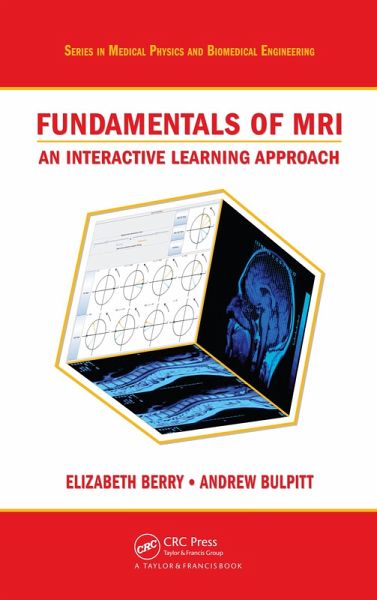
Fundamentals of MRI: An Interactive Learning Approach explores the physical principles that underpin the technique of magnetic resonance imaging (MRI).
After covering background mathematics, physics, and digital imaging, the book presents fundamental physical principles, including magnetization and rotating reference frame. It describes how relaxation mechanisms help predict tissue contrast and how an MR signal is localized to a selected slice through the body. The text then focuses on frequency and phase encoding. It also explores the spin-echo sequence, its scan parameters, and additional imaging sequences, such as inversion recovery and gradient echo.
The authors enhance the learning experience with practical materials. Along with questions, exercises, and solutions, they include ten interactive programs on the accompanying downloadable resources. These programs not only allow concepts to be clearly demonstrated and further developed, but also provide an opportunity to engage in the learning process through guided exercises.
By providing a solid, hands-on foundation in the physics of MRI, this textbook helps students gain confidence with core concepts before they move on to further study or practical training.
After covering background mathematics, physics, and digital imaging, the book presents fundamental physical principles, including magnetization and rotating reference frame. It describes how relaxation mechanisms help predict tissue contrast and how an MR signal is localized to a selected slice through the body. The text then focuses on frequency and phase encoding. It also explores the spin-echo sequence, its scan parameters, and additional imaging sequences, such as inversion recovery and gradient echo.
The authors enhance the learning experience with practical materials. Along with questions, exercises, and solutions, they include ten interactive programs on the accompanying downloadable resources. These programs not only allow concepts to be clearly demonstrated and further developed, but also provide an opportunity to engage in the learning process through guided exercises.
By providing a solid, hands-on foundation in the physics of MRI, this textbook helps students gain confidence with core concepts before they move on to further study or practical training.
Dieser Download kann aus rechtlichen Gründen nur mit Rechnungsadresse in A, B, BG, CY, CZ, D, DK, EW, E, FIN, F, GR, HR, H, IRL, I, LT, L, LR, M, NL, PL, P, R, S, SLO, SK ausgeliefert werden.
Learning by feedback is essential, especially for a subject such as MRI. This interactive book with CD by Berry and Bulpitt provides an easy-to-follow, step-by-step process to efficiently assimilate and develop understanding of the fundamentals of MRI. It is suitable for students, postgraduates new to the field, and even those with a passing interest in MRI. The online teaching methods and exercises are both intuitive and informative. This will be an invaluable learning tool and resource for those interested in grappling with the complexities of MRI. I would highly recommend this interactive book to those wanting an understanding of MRI.
-Vincent Khoo, Royal Marsden Hospital, London, UK
An easy read for those interested in how MRI works but afraid of the heavy mathematics. The basic physics of MRI is clearly explained in layman's language. Many worked examples help the reader to walk through the fundamental concepts. My favorite part is the exercise questions with answers provided. The multiple-choice questions at the end of the book with answers best prepare the reader to pass an exam on this subject. The best text I have seen for students who are preparing for an exam on MRI physics and for self-study.
-Larry Zeng, University of Utah, Salt Lake City, USA
-Vincent Khoo, Royal Marsden Hospital, London, UK
An easy read for those interested in how MRI works but afraid of the heavy mathematics. The basic physics of MRI is clearly explained in layman's language. Many worked examples help the reader to walk through the fundamental concepts. My favorite part is the exercise questions with answers provided. The multiple-choice questions at the end of the book with answers best prepare the reader to pass an exam on this subject. The best text I have seen for students who are preparing for an exam on MRI physics and for self-study.
-Larry Zeng, University of Utah, Salt Lake City, USA