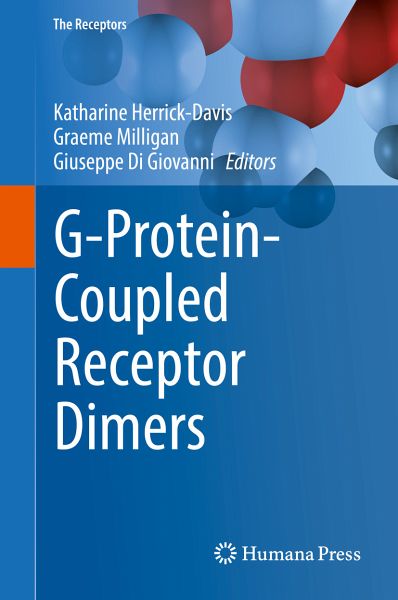
G-Protein-Coupled Receptor Dimers (eBook, PDF)
Redaktion: Herrick-Davis, Katharine; Di Giovanni, Giuseppe; Milligan, Graeme
112,95 €
112,95 €
inkl. MwSt.
Sofort per Download lieferbar

56 °P sammeln
112,95 €
Als Download kaufen
112,95 €
inkl. MwSt.
Sofort per Download lieferbar
56 °P sammeln
Jetzt verschenken
Alle Infos zum eBook verschenken
112,95 €
inkl. MwSt.
Sofort per Download lieferbar
Alle Infos zum eBook verschenken
56 °P sammeln

G-Protein-Coupled Receptor Dimers (eBook, PDF)
Redaktion: Herrick-Davis, Katharine; Di Giovanni, Giuseppe; Milligan, Graeme
- Format: PDF
- Merkliste
- Auf die Merkliste
- Bewerten Bewerten
- Teilen
- Produkt teilen
- Produkterinnerung
- Produkterinnerung

Bitte loggen Sie sich zunächst in Ihr Kundenkonto ein oder registrieren Sie sich bei
bücher.de, um das eBook-Abo tolino select nutzen zu können.
Hier können Sie sich einloggen
Sie sind bereits eingeloggt. Klicken Sie auf 2. tolino select Abo, um fortzufahren.

Bitte loggen Sie sich zunächst in Ihr Kundenkonto ein oder registrieren Sie sich bei bücher.de, um das eBook-Abo tolino select nutzen zu können.
Comprehensive overview of the major GCPR dimers
Contributors are some of the leading experts in this field
Addresses both typical and pathological aspects and explores therapeutic potential
- Geräte: PC
- ohne Kopierschutz
- eBook Hilfe
- Größe: 13.45MB
Andere Kunden interessierten sich auch für
GABAB Receptor (eBook, PDF)160,95 €
GABAB Receptor (eBook, PDF)112,95 €
Functional Selectivity of G Protein-Coupled Receptor Ligands (eBook, PDF)80,95 €
Leucine-Rich Repeat Kinase 2 (LRRK2) (eBook, PDF)112,95 €
The G Protein-Coupled Receptors Handbook (eBook, PDF)160,95 €
Orphan G Protein-Coupled Receptors and Novel Neuropeptides (eBook, PDF)160,95 €
Glutamate and ATP at the Interface of Metabolism and Signaling in the Brain (eBook, PDF)72,95 €-
-
-
Comprehensive overview of the major GCPR dimers
Contributors are some of the leading experts in this field
Addresses both typical and pathological aspects and explores therapeutic potential
Contributors are some of the leading experts in this field
Addresses both typical and pathological aspects and explores therapeutic potential
Dieser Download kann aus rechtlichen Gründen nur mit Rechnungsadresse in A, B, BG, CY, CZ, D, DK, EW, E, FIN, F, GR, HR, H, IRL, I, LT, L, LR, M, NL, PL, P, R, S, SLO, SK ausgeliefert werden.
Produktdetails
- Produktdetails
- Verlag: Springer International Publishing
- Seitenzahl: 501
- Erscheinungstermin: 31. August 2017
- Englisch
- ISBN-13: 9783319601748
- Artikelnr.: 53062611
- Verlag: Springer International Publishing
- Seitenzahl: 501
- Erscheinungstermin: 31. August 2017
- Englisch
- ISBN-13: 9783319601748
- Artikelnr.: 53062611
- Herstellerkennzeichnung Die Herstellerinformationen sind derzeit nicht verfügbar.
Katharine Herrick-Davis is Professor of Neuroscience and Experimental Therapeutics at Albany Medical College, Albany, USA. Her research has focused on investigating receptor dimerization and how it affects receptor function using the 5-HT2C receptor as a model system. Graeme Milligan is Professor of Molecular Pharmacology, University of Glasgow, U.K. he is the Dean of Research, College of Medical, Veterinary and Life Sciences, University of Glasgow. His main research group centres on the function, structure and regulation of GPCRs and their interacting proteins. Giuseppe Di Giovanni is Professor of Human Physiology, University of Malta, Malta. He is the President of the Malta Neuroscience Network and Treasurer of the Mediterranean Neuroscience Society. His research has focused on the pathophysiology of the monoaminergic systems in different neuropsychiatric disorders, such as Parkinson's disease, depression, drug of abuse and epilepsy.
Part I. Introduction.- 1. From Monomers to Dimers and Beyond: An Exciting Journey in the World of the G protein-coupled Receptor Family.- 2. The use of Spatial Intensity Distribution Analysis to Examine G protein-coupled Receptor Oligomerization.- 3. Advanced Microscopy Techniques for Studying G protein-coupled Receptors.- Part II. Receptors.- 4. Light Sensing G protein-coupled Receptor Rhodopsin Dimer.- 5. Extreme Vetting of Dopamine Receptor Oligomerization.- 6. Serotonin receptors.- 7. Cannabinoid and Opioid Receptor Heteromers.- 8. Di/oligomerization of Glycoprotein Hormone Receptors.- 9. Chemokine Receptor Oligomerization to Tweak Chemotactic Responses.- 10. Secretin Receptor Dimerization. Prototypic of Class B GPCR Behavior.- 11. Receptors and RAMPs.- 12. Obligatory Heterodimerization of GABAB Receptor.- 13. Metabotropic Glutamate Receptors. Part III. Assembly and Trafficking.- 14. The monomer/homodimer Equilibrium of G protein-coupled Receptors: Formation in the Secretory Pathway and Potential Functional Significance.- 15. Probing Self-assembly of G protein-coupled Receptor Oligomers in Membranes using Molecular Dynamics Modeling and Experimental Approaches.- 16. Interaction of Membrane Cholesterol with GPCRs: Implications in Receptor Oligomerization.- Part IV. Physiology and Therapeutic Potential.- 17. Allosterism within GPCR Oligomers: Back to Symmetry.- 18. Understanding the Physiological Significance of GPCR Dimers and Oligomers.- 19. Heteromers form Novel Signaling Complexes.- 20. Heteroreceptor Complexes Implicated in Parkinson's Disease.