Sie sind bereits eingeloggt. Klicken Sie auf 2. tolino select Abo, um fortzufahren.
Bitte loggen Sie sich zunächst in Ihr Kundenkonto ein oder registrieren Sie sich bei bücher.de, um das eBook-Abo tolino select nutzen zu können.
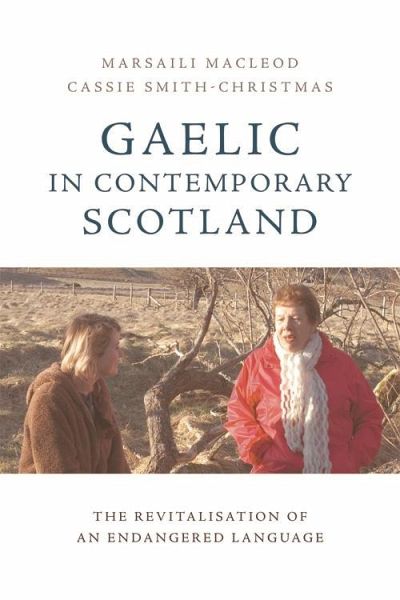
The number of young people speaking Gaelic in Scotland is growing for the first time since Census records began but less than half of all Gaelic speakers use Gaelic in the home. This book sets out to explore why.
The number of young people speaking Gaelic in Scotland is growing for the first time since Census records began but less than half of all Gaelic speakers use Gaelic in the home. This book sets out to explore why.
Dieser Download kann aus rechtlichen Gründen nur mit Rechnungsadresse in A, B, BG, CY, CZ, D, DK, EW, E, FIN, F, GR, HR, H, IRL, I, LT, L, LR, M, NL, PL, P, R, S, SLO, SK ausgeliefert werden.
Die Herstellerinformationen sind derzeit nicht verfügbar.
Autorenporträt
Marsaili MacLeod is a Lecturer in Gaelic Studies in the School of Language and Literature at the University of Aberdeen. Cassie Smith-Christmas currently holds a fellowship with the Smithsonian Institution and is a co-principal investigator on the project 'The Intersection of Language and Community in Corca Dhuibhne' as part of the 'Sustaining Minoritized Languages in Europe (SMiLE)' initiative. She is Research Fellow at the National University of Ireland, Galway National University of Ireland, Galway
Inhaltsangabe
Prelims: List of figures, List of tables, Acknowledgements, List of abbreviations, Notes on contributors Chapter 1: Introduction (Marsaili MacLeod, Cassie Smith-Christmas & Nicola Carty) Chapter 2: The language of the playground: Activists building consensus on the language policy and ethos of a new Gaelic immersion school (Timothy C. Armstrong) Chapter 3: Mismatches between national and local Gaelic development: Cròileagan Dùn Èideann and the promotion of Gaelic-medium education (Kirstie MacLeod) Chapter 4: Gaelic amongst schoolchildren: Ideas on language change and linguistic choices in Gaelic (Sìleas L. NicLeòid) Chapter 5: When school is over and done with: Linguistic practices and socio-demographic profiles of Gaelic-medium educated adults (Stuart Dunmore) Chapter 6: New speakers of Gaelic: A historical and policy perspective (Wilson McLeod) Chapter 7: Learning Gaelic in adulthood: Second language learning in minority language contexts (Marsaili MacLeod) Chapter 8: Dlùth is Inneach: Charting language ideology in the contemporary Gaelic world (Susan Bell & Mark McConville) Chapter 9: Gaelic language use in public domains (Ingeborg Birnie) Chapter 10: Planning for growth: the professionalisation of the taskforce for Gaelic revitalisation (Michelle Macleod, Timothy C. Armstrong, Gillian Munro & Ian Taylor) Chapter 11: Organisational language planning: Gaelic Language Plans in the public sector (Robert Dunbar) Chapter 12: The future of Gaelic language revitalisation in Scotland (Marsaili MacLeod & Cassie Smith-Christmas)
Prelims: List of figures, List of tables, Acknowledgements, List of abbreviations, Notes on contributors Chapter 1: Introduction (Marsaili MacLeod, Cassie Smith-Christmas & Nicola Carty) Chapter 2: The language of the playground: Activists building consensus on the language policy and ethos of a new Gaelic immersion school (Timothy C. Armstrong) Chapter 3: Mismatches between national and local Gaelic development: Cròileagan Dùn Èideann and the promotion of Gaelic-medium education (Kirstie MacLeod) Chapter 4: Gaelic amongst schoolchildren: Ideas on language change and linguistic choices in Gaelic (Sìleas L. NicLeòid) Chapter 5: When school is over and done with: Linguistic practices and socio-demographic profiles of Gaelic-medium educated adults (Stuart Dunmore) Chapter 6: New speakers of Gaelic: A historical and policy perspective (Wilson McLeod) Chapter 7: Learning Gaelic in adulthood: Second language learning in minority language contexts (Marsaili MacLeod) Chapter 8: Dlùth is Inneach: Charting language ideology in the contemporary Gaelic world (Susan Bell & Mark McConville) Chapter 9: Gaelic language use in public domains (Ingeborg Birnie) Chapter 10: Planning for growth: the professionalisation of the taskforce for Gaelic revitalisation (Michelle Macleod, Timothy C. Armstrong, Gillian Munro & Ian Taylor) Chapter 11: Organisational language planning: Gaelic Language Plans in the public sector (Robert Dunbar) Chapter 12: The future of Gaelic language revitalisation in Scotland (Marsaili MacLeod & Cassie Smith-Christmas)
Es gelten unsere Allgemeinen Geschäftsbedingungen: www.buecher.de/agb
Impressum
www.buecher.de ist ein Internetauftritt der buecher.de internetstores GmbH
Geschäftsführung: Monica Sawhney | Roland Kölbl | Günter Hilger
Sitz der Gesellschaft: Batheyer Straße 115 - 117, 58099 Hagen
Postanschrift: Bürgermeister-Wegele-Str. 12, 86167 Augsburg
Amtsgericht Hagen HRB 13257
Steuernummer: 321/5800/1497
USt-IdNr: DE450055826