154,95 €
154,95 €
inkl. MwSt.
Sofort per Download lieferbar

0 °P sammeln
154,95 €
Als Download kaufen
154,95 €
inkl. MwSt.
Sofort per Download lieferbar
0 °P sammeln
Jetzt verschenken
Alle Infos zum eBook verschenken
154,95 €
inkl. MwSt.
Sofort per Download lieferbar
Alle Infos zum eBook verschenken
0 °P sammeln

Andere Kunden interessierten sich auch für
") Gebrochener Glanz (eBook, ePUB)154,95 €
Gebrochener Glanz (eBook, ePUB)154,95 €![]() "Fabellae" (eBook, PDF)0,00 €
"Fabellae" (eBook, PDF)0,00 €") Philoktet (eBook, PDF)59,95 €
Philoktet (eBook, PDF)59,95 €") Carmina profana (eBook, PDF)42,95 €
Carmina profana (eBook, PDF)42,95 € Porphyrios, "Contra Christianos" (eBook, PDF)194,95 €
") Poesie-Erotik-Witz (eBook, PDF)114,95 €
Poesie-Erotik-Witz (eBook, PDF)114,95 € Demostene, "Contro Leptine" (eBook, PDF)115,95 €
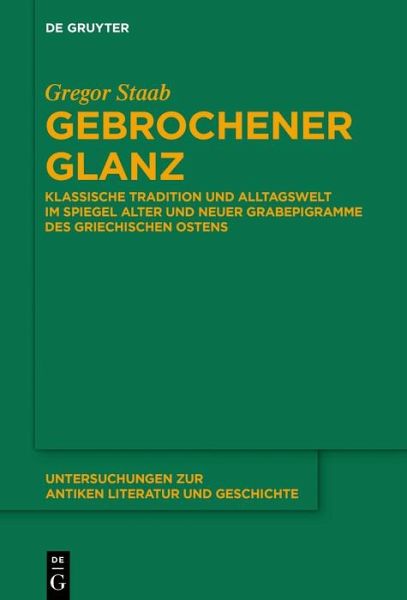
Around 5000 Greek funerary poems on stone are known from antiquity. The peculiarity of this inscription genre lies in its sub-literary character: the deceased are to be permanently recognised under the diverse, individual conditions of the everyday world, but at the same time through the means of expression of a 'classical' tradition.
The study explores this tension systematically and through detailed commentary on 19 texts from the Greek East, some of which are new. For example, the relationship between the stone poems and book epigrammar is examined and the extent to which Homer's epics, with their language, motifs and figures, which were familiar from ancient school lessons, were paradigmatic for the epigrams compared to other literary models. The educational milieu of the stone poets and their patrons comes to light, as do the methods used to compose the poems.
This study of epigraphic sources against the background of the literary tradition contributes to the literary-theoretical localisation of sepulchral stone epigrammar and also opens up important approaches to the history of education and everyday life in antiquity.
The study explores this tension systematically and through detailed commentary on 19 texts from the Greek East, some of which are new. For example, the relationship between the stone poems and book epigrammar is examined and the extent to which Homer's epics, with their language, motifs and figures, which were familiar from ancient school lessons, were paradigmatic for the epigrams compared to other literary models. The educational milieu of the stone poets and their patrons comes to light, as do the methods used to compose the poems.
This study of epigraphic sources against the background of the literary tradition contributes to the literary-theoretical localisation of sepulchral stone epigrammar and also opens up important approaches to the history of education and everyday life in antiquity.
Dieser Download kann aus rechtlichen Gründen nur mit Rechnungsadresse in A, B, BG, CY, CZ, D, DK, EW, E, FIN, F, GR, HR, H, IRL, I, LT, L, LR, M, NL, PL, P, R, S, SLO, SK ausgeliefert werden.
"Resümierend lässt sich sagen, dass diese Studie sowohl einen wichtigen Beitrag zur Alltagsgeschichte und Bildungswelt in Kleinasien liefert, als auch durch die abschließende Präsentation von 19 Texten Einblick in die Epigramme selbst gibt. Staab zeigt damit eindrucksvoll, wie sich in den Epigrammen die Welt der Verstorbenen und der Auftragsgeber, aber auch des Publikums sowie der Dichter widerspiegelt, welche in den Inschriften mit den Anforderungen und Denkmustern der klassischen Tradition zusammentrifft."
Renate Lafer in: H-Soz-Kult (14.01.2019), hsk.redaktion@geschichte.hu-berlin.de
"Trotz dieser eher allgemeinen Vorbehalte stellt St.s Studie einen in vielen Punkten überzeugenden und anregenden Beitrag zur Erforschung der Literaturrezeption in der Grabepigrammatik dar, der die Diskussion um die Frage nach der "Literarizität" der Versinschriften weiter vorantreiben wird."
Timo Christian in: Gymnasium 126.4 (2019), 369-372
"The book is an important contribution to the study of inscriptional verses in general and those from the Greek East in particular; it also opens up many directions for futures studies and makes one look forward to the promised 400-item rich upgrade to the volumes of SGO." Julia Lougovaya in: Anzeiger für die Altertumswissenschaft, 2020, H. 1, 60-65
Renate Lafer in: H-Soz-Kult (14.01.2019), hsk.redaktion@geschichte.hu-berlin.de
"Trotz dieser eher allgemeinen Vorbehalte stellt St.s Studie einen in vielen Punkten überzeugenden und anregenden Beitrag zur Erforschung der Literaturrezeption in der Grabepigrammatik dar, der die Diskussion um die Frage nach der "Literarizität" der Versinschriften weiter vorantreiben wird."
Timo Christian in: Gymnasium 126.4 (2019), 369-372
"The book is an important contribution to the study of inscriptional verses in general and those from the Greek East in particular; it also opens up many directions for futures studies and makes one look forward to the promised 400-item rich upgrade to the volumes of SGO." Julia Lougovaya in: Anzeiger für die Altertumswissenschaft, 2020, H. 1, 60-65