48,95 €
inkl. MwSt.
Sofort per Download lieferbar
24 °P sammeln

Andere Kunden interessierten sich auch für
") Gender, Subjectivity, and Cultural Work (eBook, ePUB)48,95 €
Gender, Subjectivity, and Cultural Work (eBook, ePUB)48,95 €") Theorizing Cultural Work (eBook, PDF)46,95 €
Theorizing Cultural Work (eBook, PDF)46,95 €") Emotions as Commodities (eBook, PDF)48,95 €
Emotions as Commodities (eBook, PDF)48,95 €") The Lonely Mirror (eBook, PDF)55,95 €
The Lonely Mirror (eBook, PDF)55,95 €") Jean Baudrillard (eBook, PDF)36,95 €
Jean Baudrillard (eBook, PDF)36,95 €") Globalizing Dissent (eBook, PDF)47,95 €
Globalizing Dissent (eBook, PDF)47,95 €") The Cultural Study of Music (eBook, PDF)55,95 €
The Cultural Study of Music (eBook, PDF)55,95 €





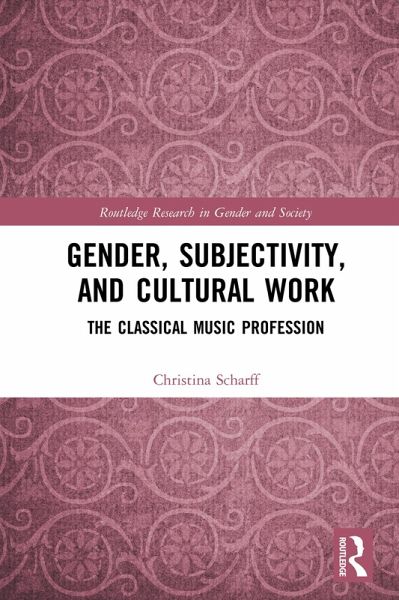
What is it like to work as a classical musician today? How can we explain ongoing gender, racial, and class inequalities in the classical music profession? What happens when musicians become entrepreneurial and think of themselves as a product that needs to be sold and marketed?
Gender, Subjectivity, and Cultural Work explores these and other questions by drawing on innovative, empirical research on the working lives of classical musicians in Germany and the UK. Indeed, Scharff examines a range of timely issues such as the gender, racial, and class inequalities that characterise the cultural and creative industries; the ways in which entrepreneurialism - as an ethos to work on and improve the self - is lived out; and the subjective experiences of precarious work in so-called 'creative cities'. Thus, this book not only adds to our understanding of the working lives of artists and creatives, but also makes broader contributions by exploring how precarity, neoliberalism, and inequalities shape subjective experiences.
Contributing to a range of contemporary debates around cultural work, Gender, Subjectivity, and Cultural Work will be of interest to scholars and students in the fields of Sociology, Gender and Cultural Studies.
Gender, Subjectivity, and Cultural Work explores these and other questions by drawing on innovative, empirical research on the working lives of classical musicians in Germany and the UK. Indeed, Scharff examines a range of timely issues such as the gender, racial, and class inequalities that characterise the cultural and creative industries; the ways in which entrepreneurialism - as an ethos to work on and improve the self - is lived out; and the subjective experiences of precarious work in so-called 'creative cities'. Thus, this book not only adds to our understanding of the working lives of artists and creatives, but also makes broader contributions by exploring how precarity, neoliberalism, and inequalities shape subjective experiences.
Contributing to a range of contemporary debates around cultural work, Gender, Subjectivity, and Cultural Work will be of interest to scholars and students in the fields of Sociology, Gender and Cultural Studies.
Dieser Download kann aus rechtlichen Gründen nur mit Rechnungsadresse in A, B, BG, CY, CZ, D, DK, EW, E, FIN, F, GR, HR, H, IRL, I, LT, L, LR, M, NL, PL, P, R, S, SLO, SK ausgeliefert werden.
This is a beautifully written and compelling account of what it is like to work in the classical music profession. Written with admirable clarity and great insight, the book makes a major contribution to our understanding of gendered subjectivity in the workplace, and also to the growing field of studies of creative labour. A magnificent book that deserves to become essential reading.
Rosalind Gill, Professor of Cultural and Social Analysis, City University of London, UK
This is a dazzling and important book. Meticulously researched, Scharff documents the ways in which female classical musicians experience their own professional identities and how they become 'entrepreneurial subjects'. Scharff plays close attention to the texture of inequities in this milieu, and to how competition takes specifically gendered forms. The book is a major contribution to creative economy studies, to sociology, social psychology and gender studies.
Angela McRobbie, Professor of Communications, Goldsmiths University of London, UK
Christina Scharff's book is a superbly thoughtful and insightful feminist study of women musicians in two contrasting cities, and it is also a major contribution to studies of creative labour. It shows how cultural workers are required to be entrepreneurs - and skilfully reveals how this contributes to workplace inequalities.
David Hesmondhalgh, Professor of Media, Music and Culture, University of Leeds, UK
Rosalind Gill, Professor of Cultural and Social Analysis, City University of London, UK
This is a dazzling and important book. Meticulously researched, Scharff documents the ways in which female classical musicians experience their own professional identities and how they become 'entrepreneurial subjects'. Scharff plays close attention to the texture of inequities in this milieu, and to how competition takes specifically gendered forms. The book is a major contribution to creative economy studies, to sociology, social psychology and gender studies.
Angela McRobbie, Professor of Communications, Goldsmiths University of London, UK
Christina Scharff's book is a superbly thoughtful and insightful feminist study of women musicians in two contrasting cities, and it is also a major contribution to studies of creative labour. It shows how cultural workers are required to be entrepreneurs - and skilfully reveals how this contributes to workplace inequalities.
David Hesmondhalgh, Professor of Media, Music and Culture, University of Leeds, UK