22,95 €
22,95 €
inkl. MwSt.
Sofort per Download lieferbar

11 °P sammeln
22,95 €
Als Download kaufen
22,95 €
inkl. MwSt.
Sofort per Download lieferbar
11 °P sammeln
Jetzt verschenken
Alle Infos zum eBook verschenken
22,95 €
inkl. MwSt.
Sofort per Download lieferbar
Alle Infos zum eBook verschenken
11 °P sammeln

Andere Kunden interessierten sich auch für
") The Age of Youth in Argentina (eBook, ePUB)22,95 €
The Age of Youth in Argentina (eBook, ePUB)22,95 €") With Masses and Arms (eBook, ePUB)19,95 €
With Masses and Arms (eBook, ePUB)19,95 €") Gendered Crossings (eBook, ePUB)23,73 €
Gendered Crossings (eBook, ePUB)23,73 €") In Place of Mobility (eBook, ePUB)16,95 €
In Place of Mobility (eBook, ePUB)16,95 €") Civilizing Argentina (eBook, ePUB)22,95 €
Civilizing Argentina (eBook, ePUB)22,95 €") On Our Own Terms (eBook, ePUB)16,95 €
On Our Own Terms (eBook, ePUB)16,95 €") Restructuring Patriarchy (eBook, ePUB)22,95 €
Restructuring Patriarchy (eBook, ePUB)22,95 €







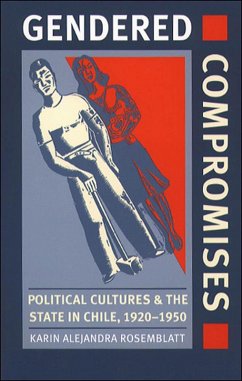
With this book, Karin Rosemblatt presents a gendered history of the politics and political compromise that emerged in Chile during the 1930s and 1940s, when reformist popular-front coalitions held power. While other scholars have focused on the economic realignments and novel political pacts that characterized Chilean politics during this era, Rosemblatt explores how gender helped shape Chile’s evolving national identity. Rosemblatt examines how and why the aims of feminists, socialists, labor activists, social workers, physicians, and political leaders converged around a shared gender ideology. Tracing the complex negotiations surrounding the implementation of new labor, health, and welfare policies, she shows that professionals in health and welfare agencies sought to regulate gender and sexuality within the working class and to consolidate the male-led nuclear family as the basis of societal stability. Leftists collaborated in these efforts because they felt that strong family bonds would generate a sense of class belonging and help unify the Left, while feminists perceived male familial responsibility as beneficial for women. Diverse actors within civil society thus reworked the norms of masculinity and femininity developed by state agencies and political leaders — even as others challenged those ideals.
Dieser Download kann aus rechtlichen Gründen nur mit Rechnungsadresse in A, D ausgeliefert werden.