44,95 €
44,95 €
inkl. MwSt.
Sofort per Download lieferbar

22 °P sammeln
44,95 €
Als Download kaufen
44,95 €
inkl. MwSt.
Sofort per Download lieferbar
22 °P sammeln
Jetzt verschenken
Alle Infos zum eBook verschenken
44,95 €
inkl. MwSt.
Sofort per Download lieferbar
Alle Infos zum eBook verschenken
22 °P sammeln

Andere Kunden interessierten sich auch für
") George Eliot's English Travels (eBook, PDF)42,95 €
George Eliot's English Travels (eBook, PDF)42,95 €") George Eliot's 'The Lifted Veil' (eBook, PDF)44,95 €
George Eliot's 'The Lifted Veil' (eBook, PDF)44,95 €") T. S. Eliot's Ariel Poems (eBook, PDF)39,95 €
T. S. Eliot's Ariel Poems (eBook, PDF)39,95 €") T.S. Eliot's Civilized Savage (eBook, PDF)55,95 €
T.S. Eliot's Civilized Savage (eBook, PDF)55,95 €") T.S. Eliot Volume I (eBook, PDF)28,95 €
T.S. Eliot Volume I (eBook, PDF)28,95 €") T. S. Eliot's Romantic Dilemma (eBook, PDF)33,95 €
T. S. Eliot's Romantic Dilemma (eBook, PDF)33,95 €") Inchbald, Hawthorne and the Romantic Moral Romance (eBook, PDF)34,95 €
Inchbald, Hawthorne and the Romantic Moral Romance (eBook, PDF)34,95 €




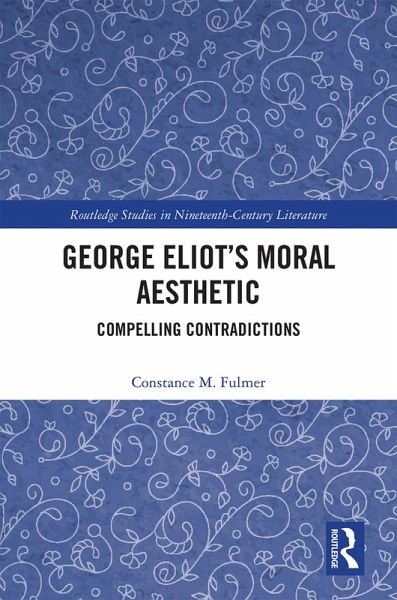
George Eliot's serious readers have been intrigued by the fact that she declared that she had lost her faith in God and had renounced her hope for a traditional Christian heaven and yet she continued to preach her own version of morality in everything she wrote, to hope for an immortality which allowed her to join an invisible choir which would influence generations to come, and to be concerned about the moral growth of her characters. This is only one of the many compelling contradictions in her life and in her artistry.
This volume aims to investigate Eliot's ethical and artistic principles by defining her moral aesthetic as it relates to her self-concept and exploring Eliot's narrative decisions and the decisions made by her characters and the circumstances which prompt those choices. Dr. Fulmer includes chapters on her clerical figures and other types of individuals such as musicians, and politicians. Dr. Fulmer also illuminates the paradoxes and contradictions in George Eliot's life and in her philosophy by focusing on Eliot's use of animals, mirrors, windows, jewelry, wills and other tangible images in her poetry as well as her novels.
George Eliot's Moral Aesthetic contends that everything about her moral philosophy is related to her writing and that everything about her writing is related to her moral philosophy.
This volume aims to investigate Eliot's ethical and artistic principles by defining her moral aesthetic as it relates to her self-concept and exploring Eliot's narrative decisions and the decisions made by her characters and the circumstances which prompt those choices. Dr. Fulmer includes chapters on her clerical figures and other types of individuals such as musicians, and politicians. Dr. Fulmer also illuminates the paradoxes and contradictions in George Eliot's life and in her philosophy by focusing on Eliot's use of animals, mirrors, windows, jewelry, wills and other tangible images in her poetry as well as her novels.
George Eliot's Moral Aesthetic contends that everything about her moral philosophy is related to her writing and that everything about her writing is related to her moral philosophy.
Dieser Download kann aus rechtlichen Gründen nur mit Rechnungsadresse in A, B, BG, CY, CZ, D, DK, EW, E, FIN, F, GR, HR, H, IRL, I, LT, L, LR, M, NL, PL, P, R, S, SLO, SK ausgeliefert werden.