37,95 €
37,95 €
inkl. MwSt.
Sofort per Download lieferbar

19 °P sammeln
37,95 €
Als Download kaufen
37,95 €
inkl. MwSt.
Sofort per Download lieferbar
19 °P sammeln
Jetzt verschenken
Alle Infos zum eBook verschenken
37,95 €
inkl. MwSt.
Sofort per Download lieferbar
Alle Infos zum eBook verschenken
19 °P sammeln

Andere Kunden interessierten sich auch für
") German Philosophy in the Twentieth Century (eBook, PDF)37,95 €
German Philosophy in the Twentieth Century (eBook, PDF)37,95 €") German Philosophy in the Twentieth Century (eBook, ePUB)39,95 €
German Philosophy in the Twentieth Century (eBook, ePUB)39,95 €") German Philosophy in the Twentieth Century (eBook, ePUB)38,95 €
German Philosophy in the Twentieth Century (eBook, ePUB)38,95 €") German Philosophy in the Twentieth Century (eBook, PDF)39,95 €
German Philosophy in the Twentieth Century (eBook, PDF)39,95 €") German Philosophy in the Twentieth Century (eBook, PDF)38,95 €
German Philosophy in the Twentieth Century (eBook, PDF)38,95 €") Reason and Revolution (eBook, ePUB)19,95 €
Reason and Revolution (eBook, ePUB)19,95 €") Routledge Philosophy GuideBook to Spinoza on Politics (eBook, ePUB)27,95 €
Routledge Philosophy GuideBook to Spinoza on Politics (eBook, ePUB)27,95 €
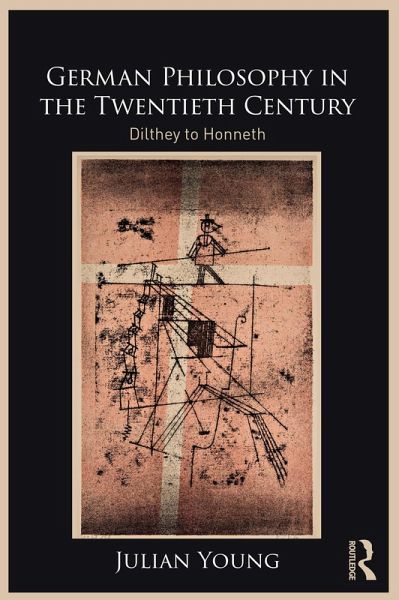
The path taken by German philosophy in the twentieth century is one of the most exciting and controversial in the history of human thought, by turns radical and conservative and secular and religious. In this outstanding introduction, German Philosophy in the Twentieth Century: Dilthey to Honneth-the third and final volume in his trilogy-Julian Young examines the work of eight German philosophers and theologians of the period. He discusses their engagement with the deepest existential questions, their critique of the rationalization and mechanization of modernity, and their commitment to varying forms of liberalism, socialism, and democracy.
Young introduces and assesses the thought of the following figures:
Lucidly and engagingly written, German Philosophy in the Twentieth Century: Dilthey to Honneth is essential reading for students of German philosophy, phenomenology, and theology and will also be of interest to students in related fields such as literature, political theory, and sociology.
German Philosophy in the Twentieth Century: Weber to Heidegger (2018) and German Philosophy in the Twentieth Century: Lukács to Strauss (2020) are also available from Routledge.
Young introduces and assesses the thought of the following figures:
- Wilhelm Dilthey: the need for 'worldviews', and the distinction between 'explanation' and 'understanding' as a bulwark against the reduction of human beings to scientific quanta
- Karl Jaspers: existentialism, the challenge of nihilism, and the turn to theology
- Edith Stein: the phenomenology of empathy, community versus society, and the turn to Catholicism
- Paul Tillich: philosophical theology and the 'theonomous' life
- Martin Buber: recovering the 'thou' in the face of modernity's reduction of everything to an 'it'; the kibbutz as the paradigm of a socialist community
- Hans Jonas: the mortal threat posed by the unknown consequences of modern technology and the ethics of responsibility for the planet
- Erich Fromm: the 'art of loving' as a bulwark against hard and soft totalitarianism; the replacement of capitalism by communitarian socialism
- Axel Honneth: contemporary Hegelianism and the ethics and politics of recognition; the nature of real freedom.
Lucidly and engagingly written, German Philosophy in the Twentieth Century: Dilthey to Honneth is essential reading for students of German philosophy, phenomenology, and theology and will also be of interest to students in related fields such as literature, political theory, and sociology.
German Philosophy in the Twentieth Century: Weber to Heidegger (2018) and German Philosophy in the Twentieth Century: Lukács to Strauss (2020) are also available from Routledge.
Dieser Download kann aus rechtlichen Gründen nur mit Rechnungsadresse in A, B, BG, CY, CZ, D, DK, EW, E, FIN, F, GR, HR, H, IRL, I, LT, L, LR, M, NL, PL, P, R, S, SLO, SK ausgeliefert werden.
"Preceded by volumes covering Weber to Habermas and Lukács to Strauss,(published in 2018 and 2020) this third and final volume of Young's German Philosophy in the Twentieth Century examines eight philosophers and theologians who once were, but no longer are, central to the pressing philosophical debates of the 20th century. ... In company with the previous two volumes in the set, this insightful, well-written volume is an exciting guide through 20th-century German philosophy. Summing Up: Highly recommended. Upper-division undergraduates through faculty; general readers." - J. A. Fischel, CHOICE
"Young's mastery of modern German philosophy is unsurpassed. In this lucid, compelling, and wide-ranging study, he continues his long-standing effort to map and assess this complex terrain, throwing new and much needed light especially on the relation between philosophy and politics. While revealing unexpected and exciting approaches to its subject matter, it offers timely and intellectually stimulating perspectives on our contemporary challenges." - Espen Hammer, Temple University, USA