Sie sind bereits eingeloggt. Klicken Sie auf 2. tolino select Abo, um fortzufahren.
Bitte loggen Sie sich zunächst in Ihr Kundenkonto ein oder registrieren Sie sich bei bücher.de, um das eBook-Abo tolino select nutzen zu können.
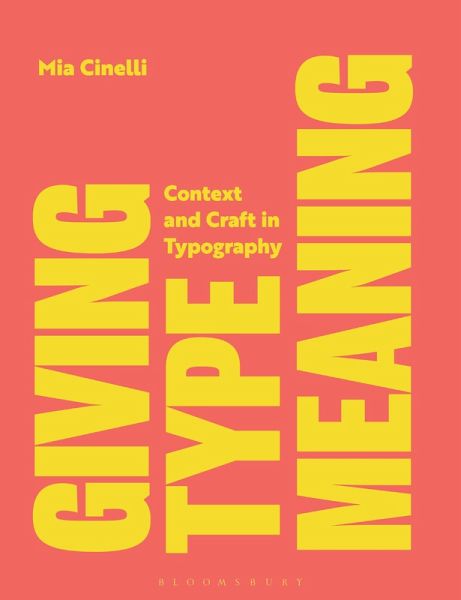
When we encounter typography, how do we know what it means? How is the tone of type influenced by the way it is set, when it is made, and where it exists? Considering the social, spatial, and temporal contexts of visual language, this text informs and inspires students, educators, and professionals looking to engage more deeply with the letterforms they use and see. Featuring diverse typographic works, "closer looks", and interviews with practicing artists and designers, Giving Type Meaning serves to inform how and why we understand what type communicates. The book includes: - The importance…mehr
When we encounter typography, how do we know what it means? How is the tone of type influenced by the way it is set, when it is made, and where it exists? Considering the social, spatial, and temporal contexts of visual language, this text informs and inspires students, educators, and professionals looking to engage more deeply with the letterforms they use and see. Featuring diverse typographic works, "closer looks", and interviews with practicing artists and designers, Giving Type Meaning serves to inform how and why we understand what type communicates. The book includes: - The importance and impact of cultural and social context across the expanded field of art and design - How to use visual, physical, and gestural space to inform meaning - The ways time impacts type, such as historical references, recontextualizations, and the use of time as medium - A range of global examples, including Lushootseed language letterforms (Lushootseed Sulad by Juliet Shen), Arabic calligraphy and type design (Regard Each Other as Brothers by Josh Berer, Mirsaal by Rana Abou Rjeily), American civil rights inspired type (Martin by Tré Seals), Italian concrete poetry (Storia Del Monumento by Mirella Bentivoglio), and animated Chinese characters (Motion Type Project by Ting-An Ho)
Die Herstellerinformationen sind derzeit nicht verfügbar.
Autorenporträt
Mia Cinelli is an Associate Professor of Art Studio and Digital Design at the University of Kentucky, USA. With work ranging from speculative typography to experimental products, her multidisciplinary work in art and design explores frameworks for creating meaningful physical and visual interactions.
Inhaltsangabe
Introduction: Chapter 1: Social Context 1.1 Context and meaning 1.a. Visual Inflection 1.b. Social Meaning & Typography 1.c. Visual Metaphors and Analogies 1.d. Cultural Context 1.e Power Structures 1.f Recontextualization Chapter 2: Spatial Context 2.1. Visual Space (section) 2.1a Kinetic and Expressive Type 2.1b. Sound, Shape, and Speech 2.2. Concrete and Visual Poetry 2.2a. Physical Space 2.2b. Material Meaning 2.2c. A Known Social Context 2.2d. History and Material Meanings 2.2e. Material Metaphors and Analogies 2.3 Architectural Materials 2.3a. Public Space 2.3b. Place-Based Meaning 2.4b. Public Type & Community Participations 2.5 Private Space 2.5a Challenging Private Space 2.6 Personal Space 2.6a Apparel and Affiliation 2.6b Proximity and Politics 2.7 Virtual Space 2.7a Digital Methods 2.7b Augmented Reality, Mixed Reality, and Virtual Reality 2.8 Gestural Space 2.8a The Human Hand 2.8b Gesture in and of Letterforms 2.8c Gesture of Mark 2.8d Gesture and Expression 2.8e Corporeality and Performance Chapter 3: Temporal Context 3.1. Time and history 3.1a Temporal Influence: Technology and Society 3.1b Temporal Influence: Current Events 3.2 Typographic Trends 3.2a. Historical Type in Contemporary Use 3.2b. Revivals and References 3.2c. Temporal Recontextualisations 3.2d. History-Inspired Type 3.3 Voices in Design 3.3a Type and Identity 3.4 Time as Medium 3.5 Into the Future 3.6 Language, Form and Meaning 3.7 Speculative Typography 3.8 What's Next? Resources for Educators and Students Bibliography Index Acknowledgements
Es gelten unsere Allgemeinen Geschäftsbedingungen: www.buecher.de/agb
Impressum
www.buecher.de ist ein Internetauftritt der buecher.de internetstores GmbH
Geschäftsführung: Monica Sawhney | Roland Kölbl | Günter Hilger
Sitz der Gesellschaft: Batheyer Straße 115 - 117, 58099 Hagen
Postanschrift: Bürgermeister-Wegele-Str. 12, 86167 Augsburg
Amtsgericht Hagen HRB 13257
Steuernummer: 321/5800/1497
USt-IdNr: DE450055826