Sie sind bereits eingeloggt. Klicken Sie auf 2. tolino select Abo, um fortzufahren.
Bitte loggen Sie sich zunächst in Ihr Kundenkonto ein oder registrieren Sie sich bei bücher.de, um das eBook-Abo tolino select nutzen zu können.
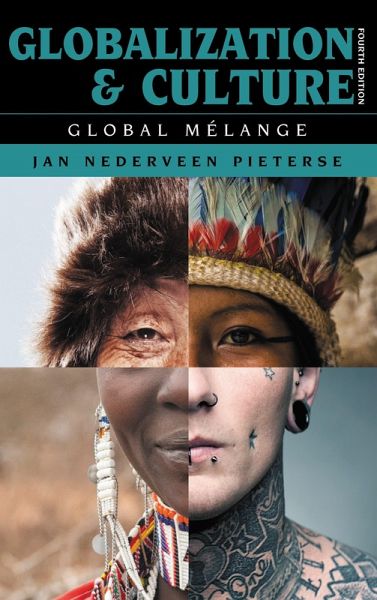
Now updated with new chapters on culture and on populism, this seminal text disputes the view that we are experiencing a "clash of civilizations" as well as the idea that globalization leads to cultural homogenization. Instead, Jan Nederveen Pieterse argues that we are witnessing the formation of a global mélange culture through processes of cultural mixing or hybridization. From this perspective on globalization, conflict may be mitigated and identity preserved, albeit transformed. In a new chapter on China, the author focuses on the key issue of agency and power in hybridization. Throughout,…mehr
Now updated with new chapters on culture and on populism, this seminal text disputes the view that we are experiencing a "clash of civilizations" as well as the idea that globalization leads to cultural homogenization. Instead, Jan Nederveen Pieterse argues that we are witnessing the formation of a global mélange culture through processes of cultural mixing or hybridization. From this perspective on globalization, conflict may be mitigated and identity preserved, albeit transformed. In a new chapter on China, the author focuses on the key issue of agency and power in hybridization. Throughout, the book offers a comprehensive treatment of hybridization arguments, and in discussing globalization and culture, problematizes the meaning of culture. This historically deep and geographically wide approach to globalization is essential reading as we face the increasing spread of conflicts bred by cultural misunderstanding.
Die Herstellerinformationen sind derzeit nicht verfügbar.
Autorenporträt
Jan Nederveen Pieterse is Mellichamp Distinguished Professor of Global Studies and Sociology at the University of California, Santa Barbara. His current research interests include connectivity, Covid-19, and multicentric globalization. A project underway is comparative study of capitalisms and varieties of market economies with a focus on inequality. He is the author or editor of 30 books. Nederveen Pieterse's early work concerns anthropology, cultural studies, Eurocentrism, ethnicity and multiculturalism (Globalization and Culture, 2019; Ethnicities and global multiculture, 2007; The Decolonization of Imagination, 1995), race (White on Black, 1992), imperialism (Empire and Emancipation, 1989; Globalization or Empire? 2004), religion (Christianity and Hegemony, 1992), social movements and social theory (Globalization and social movements, 2001; Emancipations, modern and postmodern, 1992). A further cycle concerns development studies (Development Theory, 2010), emerging economies (Globalization and Emerging Societies, 2009), sociology of United States (Beyond the American Bubble, 2008), East Asia (Capitalisms in Asia, 2018; Globalization and development in East Asia, 2012), comparative study of Southeast and Northeast Asia (Changing constellations of Southeast Asia, 2017), China (China's contingencies and globalization, 2017), the Emirates (Perspectives from the Gulf, 2010), Brazil (Brazil Emerging, 2013), humanitarian intervention (World Orders in the Making, 1998) and futures studies (Global Futures, 2000). Books have been translated in Italian, Spanish, Portuguese, Danish, Japanese, Korean and Chinese. He was previously at Maastricht University; University of Illinois Urbana-Champaign; Institute of Social Studies, The Hague; University of Cape Coast, Ghana and University of Amsterdam. He held visiting professorships at National University of Malaysia (endowed research chair), Freiburg University; Gadjah Mada University, Yogyakarta; JNU, New Delhi; National College of Arts, Lahore; Chulalongkorn University, Bangkok; Shanghai University; fellowships at EHESS, Paris, Stockholm University, Indiana University, India Social Science Research Council. He did lecture tours in India, Pakistan, Westbank and Gaza, Thailand, and Brazil, and gave lectures in several countries (Argentina, Australia, Austria, Belgium, Chechia, China, Cuba, Denmark, Finland, France, Germany, Hong Kong, Ireland, Italy, Japan, Jordan, Macau, Mexico, Nepal, Norway, Peru, Poland, Russia, Singapore, South Africa, South Korea, Spain, Sri Lanka, Suriname, Taiwan, Tunisia, Turkey, UAE, UK, Ukraine). He is organizer of lecture series and conferences (including global studies conferences in Chicago, Dubai, Busan, Rio de Janeiro, Moscow, New Delhi, Shanghai), edits book series with Routledge and Palgrave Macmillan and advises universities on international programming.
Inhaltsangabe
Preface to the Fourth Edition Acknowledgments Introduction 1 What Is Culture? Nation and Culture Culture Sprawl Disentangling Threads of Culture 2 Globalization: Consensus and Controversies Consensus Controversies Twenty-First-Century Globalization 3 Globalization and Human Integration: We Are All Migrants Globalization as a Deep Historical Process Utopian Visions: Human Unity as a Theme Uneven Globalization We Are All Migrants: Migration and Human Integration 4 Globalization and Culture: Three Paradigms Clash of Civilizations McDonaldization Hybridization: Rhizomes of Culture Futures 5 Globalization as Hybridization Globalization and Modernity Structural Hybridization Global Mélange Politics of Hybridity Post-hybridity? Forward Moves 6 Hybridity, So What? The Anti-hybridity Backlash Varieties of Hybridity The Anti-hybridity Backlash Hybridity and the longue durée Different Cultural Takes on Hybridity Patterns of Hybridity So What? 7 Globalization Is Braided: East-West Osmosis East-West Islam-West Easternization, Westernization, and Back Again 8 Hybrid China Silk Roads New Silk Roads Hybridity with Chinese Characteristics Globalized, Globalizing 9 Populism, Globalization, and Culture Meridians of Populism Populism and Globalization Populism and Culture 10 Global Mélange Bibliography Index About the Author
Preface to the Fourth Edition Acknowledgments Introduction 1 What Is Culture? Nation and Culture Culture Sprawl Disentangling Threads of Culture 2 Globalization: Consensus and Controversies Consensus Controversies Twenty-First-Century Globalization 3 Globalization and Human Integration: We Are All Migrants Globalization as a Deep Historical Process Utopian Visions: Human Unity as a Theme Uneven Globalization We Are All Migrants: Migration and Human Integration 4 Globalization and Culture: Three Paradigms Clash of Civilizations McDonaldization Hybridization: Rhizomes of Culture Futures 5 Globalization as Hybridization Globalization and Modernity Structural Hybridization Global Mélange Politics of Hybridity Post-hybridity? Forward Moves 6 Hybridity, So What? The Anti-hybridity Backlash Varieties of Hybridity The Anti-hybridity Backlash Hybridity and the longue durée Different Cultural Takes on Hybridity Patterns of Hybridity So What? 7 Globalization Is Braided: East-West Osmosis East-West Islam-West Easternization, Westernization, and Back Again 8 Hybrid China Silk Roads New Silk Roads Hybridity with Chinese Characteristics Globalized, Globalizing 9 Populism, Globalization, and Culture Meridians of Populism Populism and Globalization Populism and Culture 10 Global Mélange Bibliography Index About the Author
Es gelten unsere Allgemeinen Geschäftsbedingungen: www.buecher.de/agb
Impressum
www.buecher.de ist ein Internetauftritt der buecher.de internetstores GmbH
Geschäftsführung: Monica Sawhney | Roland Kölbl | Günter Hilger
Sitz der Gesellschaft: Batheyer Straße 115 - 117, 58099 Hagen
Postanschrift: Bürgermeister-Wegele-Str. 12, 86167 Augsburg
Amtsgericht Hagen HRB 13257
Steuernummer: 321/5800/1497
USt-IdNr: DE450055826